
Business environments shift constantly. Markets evolve, new competitors emerge, and customer expectations change overnight. Without a clear framework to understand these dynamics, organizations often find themselves reacting to problems instead of anticipating them. This is where the Five Forces Analysis comes into play. Developed by Michael Porter, this strategic tool provides a structured way to evaluate the competitive intensity and attractiveness of an industry.
By understanding the underlying forces at work, leaders can make informed decisions about where to invest resources, how to price products, and when to pivot strategies. This guide breaks down the methodology, explains each component in detail, and outlines how to apply these insights to real-world scenarios without relying on complex software or jargon.
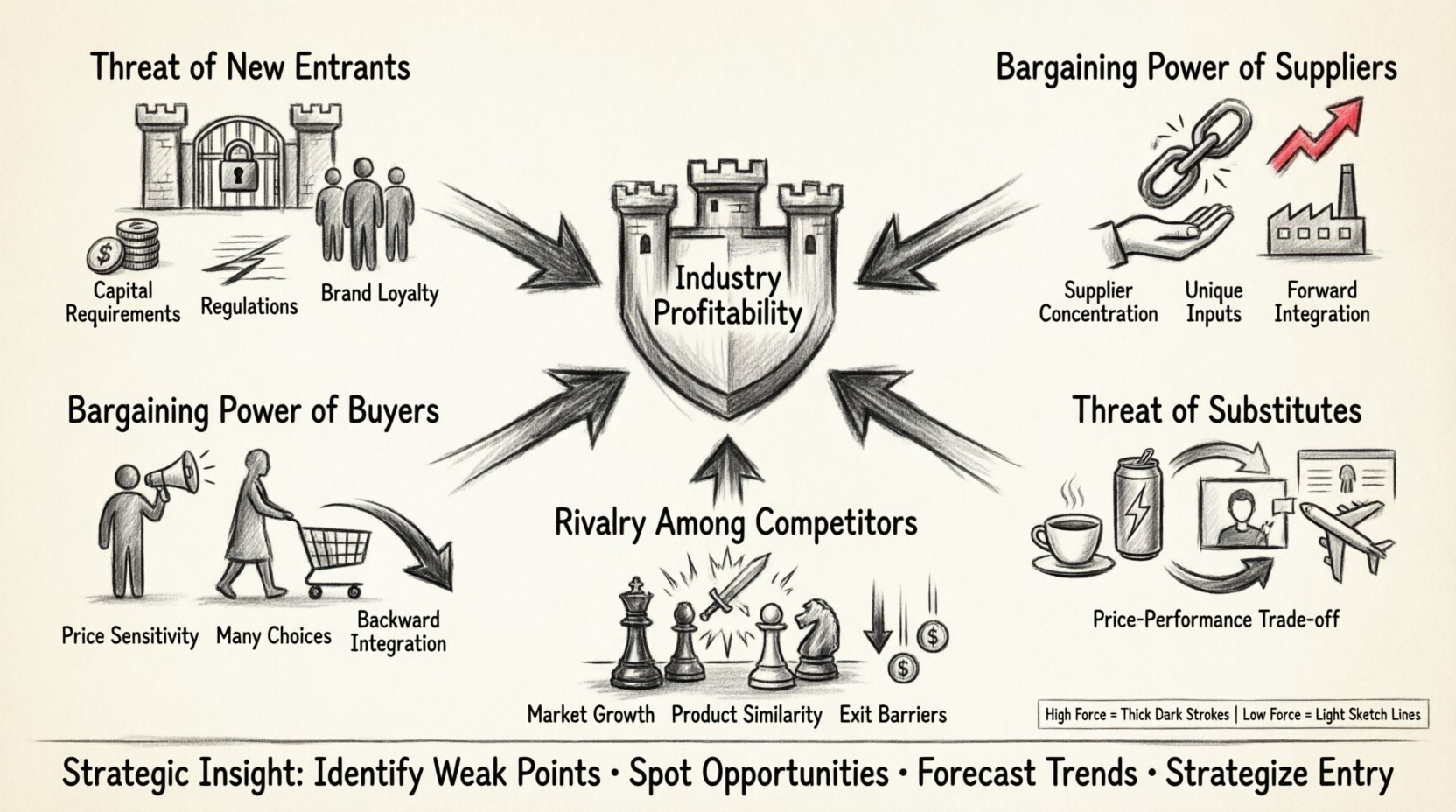
What Is Porter’s Five Forces Framework? 🤔
The Five Forces framework is a model used to analyze the competitive environment of an industry. It suggests that the profitability and long-term viability of a business are determined by five specific forces. These forces dictate the balance of power between companies and their environment.
Unlike traditional analysis that focuses solely on direct competitors, this model looks at the broader ecosystem. It considers suppliers, buyers, potential new players, and substitute products. Each force exerts pressure on the industry’s profit margins. When these pressures are high, the industry becomes less attractive for investment. When they are low, there is more room for growth and stability.
Using this framework helps organizations:
- Identify weak points: See where margins are being squeezed.
- Spot opportunities: Find areas where leverage can be gained.
- Forecast trends: Anticipate changes before they impact the bottom line.
- Strategize entry: Decide if entering a new market is feasible.
The Five Forces Explained in Detail 🔍
To apply this analysis effectively, you must understand each force individually. Below is a deep dive into what each force represents and how to assess it.
1. Threat of New Entrants 🚪
This force measures how easy it is for new competitors to enter your market. If barriers to entry are low, new players can quickly erode your market share and drive down prices. If barriers are high, your position is more secure.
Key factors to consider include:
- Capital Requirements: Does starting a business here require millions in funding?
- Regulations: Are there licenses or permits required by the government?
- Brand Loyalty: Do customers stick to established names?
- Access to Distribution: Is it hard to get products to shelves or online platforms?
- Switching Costs: Is it difficult for customers to switch to a new provider?
High barriers mean a safer market. Low barriers mean a crowded and volatile landscape.
2. Bargaining Power of Suppliers 🤝
Suppliers control the input costs of your business. If they can raise prices or lower quality without losing customers, they hold power. This reduces your profit margin. Conversely, if you have many suppliers to choose from, you hold the power.
Assess supplier power by asking:
- Number of Suppliers: Is the market monopolized or fragmented?
- Uniqueness of Product: Are the materials or components unique?
- Switching Costs: How much does it cost to change suppliers?
- Threat of Forward Integration: Can suppliers start making your product themselves?
When supplier power is high, you face cost volatility. When it is low, you can negotiate better terms.
3. Bargaining Power of Buyers 👥
Buyers (customers) want lower prices and higher quality. If they have leverage, they can demand better deals, squeezing your margins. This force is strong when buyers have many choices or purchase in large volumes.
Indicators of strong buyer power include:
- Concentration: Are there few large buyers or many small ones?
- Price Sensitivity: Do customers care more about price than features?
- Availability of Info: Can customers easily compare prices online?
- Threat of Backward Integration: Can buyers start producing the product themselves?
Understanding buyer power helps you determine pricing strategies and customer retention tactics.
4. Threat of Substitute Products 🔄
Substitutes are products from other industries that satisfy the same need. They place a ceiling on the prices you can charge. If a substitute becomes cheaper or better, customers will switch.
Common examples include:
- Video Conferencing vs. Business Travel: Zoom replaced many face-to-face meetings.
- Coffee vs. Energy Drinks: Both provide a caffeine boost.
- Streaming vs. Cable TV: Netflix replaced traditional cable subscriptions.
To analyze this force, consider:
- Price-Performance Trade-off: Is the substitute cheaper or better value?
- Switching Costs: How hard is it for a customer to try the alternative?
- Perceived Quality: Do customers view substitutes as inferior or equal?
5. Rivalry Among Existing Competitors 🥊
This is the most obvious force. It refers to the intensity of competition between current players in the industry. High rivalry leads to price wars, heavy advertising spend, and innovation races, all of which hurt profitability.
Factors increasing rivalry:
- Number of Competitors: More players mean more fighting for market share.
- Industry Growth: In slow-growth markets, companies fight for existing customers.
- Product Similarity: If products are identical, price becomes the main differentiator.
- Exit Barriers: If it is hard to leave the industry, companies stay and fight.
Comparing the Forces: A Quick Reference Table 📋
Visualizing the forces helps in organizing your thoughts. Use the table below to quickly reference the impact of each force on your strategy.
| Force | Impact on Profitability | Key Question to Ask | Strategic Response |
|---|---|---|---|
| New Entrants | High threat reduces margins | How hard is it to start here? | Build barriers (brand, patents) |
| Suppliers | High power increases costs | Do they control the supply? | Diversify supply chain |
| Buyers | High power lowers prices | Can they dictate terms? | Increase switching costs |
| Substitutes | High threat caps pricing | What else solves this problem? | Improve value proposition |
| Rivalry | High intensity kills growth | How aggressive are competitors? | Differentiate or niche down |
How to Conduct the Analysis Step-by-Step 📝
Implementing this framework requires a systematic approach. You do not need expensive tools; you need data, observation, and critical thinking. Follow these steps to conduct a robust analysis.
Step 1: Define the Industry Scope 🌍
Before analyzing, you must define what industry you are studying. Is it “automobiles” or “electric vehicle charging stations”? The scope matters. A broader scope includes more substitutes; a narrower scope changes the competitive landscape.
Step 2: Gather Data 📊
Collect information on each of the five forces. Sources can include:
- Financial reports of public companies
- Industry trade publications
- Customer feedback and reviews
- Supplier contracts and pricing trends
- Government regulations and filings
Step 3: Assess the Intensity 🔎
Rate each force as Low, Medium, or High. Be honest about the data. A force might be low for you but high for a competitor. Context is key.
Step 4: Map the Dynamics 🔗
Look for relationships between the forces. For example, if supplier power is high, it might increase the threat of new entrants if they can’t get materials. If buyer power is high, it might increase rivalry as companies fight for the same few customers.
Step 5: Formulate Strategy 🎯
Use the insights to decide on a course of action. Do you need to cut costs? Do you need to innovate? Do you need to merge with a supplier? The analysis is useless without a resulting plan.
Common Pitfalls to Avoid ⚠️
Even with a solid framework, mistakes can happen. Avoid these common errors to ensure your analysis remains accurate.
- Ignoring Dynamic Changes: Markets move fast. A static analysis from five years ago is likely invalid today. Regularly update your data.
- Focusing Only on Direct Competitors: If you ignore substitutes, you might miss a disruption from a completely different sector.
- Overlooking Global Factors: Supply chains are often international. Local analysis might miss global supplier risks.
- Assuming All Forces Are Equal: One force might dominate the others. Focus your energy on the most critical threats.
- Lacking Data: Guessing the intensity of a force leads to bad decisions. Validate your assumptions with evidence.
Real-World Application: A Hypothetical Scenario 🏗️
Let’s apply this to a hypothetical scenario: A company looking to launch a subscription-based meal delivery service.
- New Entrants: Low capital is needed to start a small kitchen, but high marketing costs are required to acquire customers. Threat is Medium.
- Suppliers: Farmers and food distributors are fragmented. The company has some leverage. Threat is Low.
- Buyers: Customers have many apps to choose from. They are price-sensitive. Threat is High.
- Substitutes: Grocery stores and home cooking are strong substitutes. Threat is High.
- Rivalry: Many established players exist with strong branding. Rivalry is High.
Conclusion of Analysis: The market is crowded and risky. To succeed, the company must differentiate through unique recipes or superior logistics to lower switching costs, rather than competing solely on price.
Integrating with Other Strategic Tools 🧩
The Five Forces Analysis is powerful on its own, but it works best when combined with other frameworks. It focuses on the industry, while other tools focus on internal capabilities.
SWOT Analysis
Use the Five Forces to inform the “Threats” and “Opportunities” sections of a SWOT analysis. The external forces identified here feed directly into the external opportunities and threats of your SWOT.
PESTEL Analysis
PESTEL looks at macro-environmental factors (Political, Economic, Social, Technological, Environmental, Legal). These factors often influence the Five Forces. For example, a new environmental regulation (PESTEL) might increase the power of suppliers (Five Forces) by limiting raw material availability.
VRIO Framework
Once you know the industry pressures, use VRIO to check if your internal resources can withstand them. If the industry has high rivalry, do you have a unique value that protects you?
When to Use This Framework 📅
Timing is important for strategic analysis. Use this framework during:
- Strategic Planning Sessions: Annual or quarterly planning.
- Market Entry Decisions: Before entering a new geographic region or product line.
- Investment Reviews: When evaluating potential acquisitions or partnerships.
- Crisis Management: When profits are declining and you need to understand why.
The Value of Strategic Foresight 🔮
The ultimate goal of this analysis is not just to understand the present, but to shape the future. By recognizing threats early, you can build defenses before they cause damage.
For instance, if you see that supplier power is increasing due to consolidation, you might invest in vertical integration or long-term contracts before prices spike. If you notice that customer switching costs are dropping, you might invest in loyalty programs or proprietary technology to lock them in.
Strategic foresight transforms data into action. It moves the organization from a reactive stance to a proactive one. This shift is often the difference between market leaders and followers.
Final Thoughts on Competitive Strategy 💡
Building a robust strategy requires clarity. The Five Forces Analysis provides that clarity by breaking down complex market dynamics into manageable parts. It forces you to look beyond your immediate competitors and consider the entire value chain.
While no tool guarantees success, this framework significantly increases the odds by reducing blind spots. It encourages a disciplined approach to decision-making, ensuring that resources are allocated to areas that offer the best return on investment.
As you move forward, remember that industries are not static. Forces shift over time. What is a low threat today might be a high threat tomorrow. Continuous monitoring is the key to long-term sustainability.