

Now Reading: Empowering Software Engineering with UML and AI: A Strategic Approach with Visual Paradigm
-
01
Empowering Software Engineering with UML and AI: A Strategic Approach with Visual Paradigm



Empowering Software Engineering with UML and AI: A Strategic Approach with Visual Paradigm

In modern software engineering, the ability to design robust, maintainable, and scalable systems hinges on a deep understanding of object-oriented principles. The six cornerstones of object-oriented software engineering—classification, abstraction, encapsulation, association, inheritance, and polymorphism—form the foundation for building reusable, modular, and extensible applications. When combined with UML (Unified Modeling Language) and enhanced by AI-powered tools like those in Visual Paradigm, these principles become even more powerful, enabling teams to accelerate development, improve collaboration, and deliver higher-quality software faster.
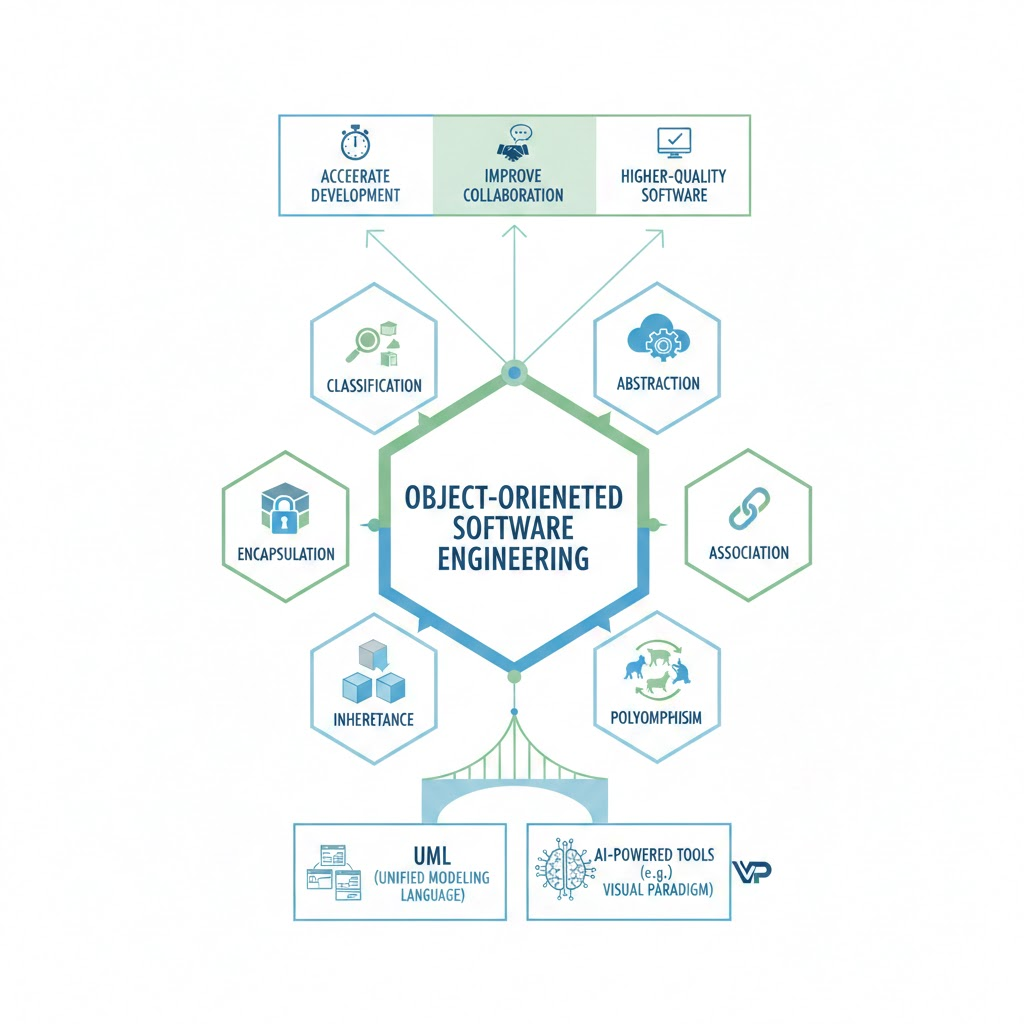
🔷 The Six Cornerstones of Object-Oriented Software Engineering
Before exploring how Visual Paradigm enhances this process, let’s briefly revisit the core pillars that define object-oriented design:
1. Classification (Grouping)
“Identify entities in the business space and group them based on requirements.”
Classification is the first step in modeling real-world systems. Engineers identify key domain entities—such as Customer, Order, Product—and group them into logical categories based on business logic and use cases. This helps in defining the scope of the system early in the development lifecycle.
✅ Why it matters: Proper classification ensures the system reflects real-world semantics, making it easier to communicate with stakeholders and build intuitive models.
2. Abstraction (Representing)
“Represent classified objects as a template (a class).”
Abstraction allows developers to define classes that capture common attributes and behaviors. For example, a Vehicle class may abstract properties like speed, color, and methods like start() and stop(). Higher-level abstractions (e.g., LandVehicle, WaterVehicle) further refine the model.
✅ Why it matters: Abstraction reduces complexity by hiding implementation details and focusing on what an object does, not how it does it.
3. Encapsulation (Modularizing)
“Wrap cohesive data with meaningful code to localize it.”
Encapsulation bundles data and methods within a class, restricting direct access via private or protected visibility. Only public methods (interfaces) expose functionality, ensuring data integrity and reducing side effects.
✅ Why it matters: Encourages maintainability, security, and easier debugging—core to building reliable systems.
4. Association (Relating)
“Provide a mechanism for two or more classes to relate to each other.”
Association defines relationships between classes, such as Person uses Clock, or Customer places Order. These are often represented as lines in UML class diagrams.
✅ Why it matters: Models dynamic interactions and dependencies, crucial for understanding system behavior and workflow.
5. Inheritance (Generalizing)
“Generalize classes into higher-level abstracted classes.”
Inheritance allows a subclass to inherit properties and behaviors from a parent class. For example, Car and Motorcycle inherit from Vehicle. This promotes code reuse and supports extensibility.
✅ Why it matters: Reduces redundancy and enables hierarchical modeling of real-world relationships.
6. Polymorphism (Executing)
“Runtime ability of an object to interpret a message based on its own definition.”
Polymorphism allows different objects to respond uniquely to the same method call. For example, calling move() on a Frog results in a leap, while on a Horse, it results in a gallop.
✅ Why it matters: Enables flexible, extensible designs. New types can be added without modifying existing code—key for long-term system evolution.
🌐 Why UML Matters in Modern Software Development
UML provides a standardized visual language to represent complex software systems. It allows teams to:
-
Communicate design ideas clearly across roles (developers, analysts, stakeholders).
-
Detect flaws early through diagrammatic modeling.
-
Document system architecture, behavior, and interactions.
Common UML diagrams include:
-
Class Diagrams – Represent structure using classification, abstraction, encapsulation, and inheritance.
-
Sequence Diagrams – Model interactions between objects over time (association, polymorphism).
-
Use Case Diagrams – Capture system functionality from user perspectives (abstraction, association).
-
State Machine Diagrams – Show state transitions (encapsulation, polymorphism).
-
Component & Deployment Diagrams – Support modular and scalable architecture.
🛠️ UML is not just for design—it’s a communication and validation tool.
🚀 How Visual Paradigm Elevates UML with AI: A Game-Changer for Teams
Visual Paradigm is a leading UML modeling and software design tool that integrates AI-powered automation to streamline and enhance the entire software engineering lifecycle. Here’s how its AI and UML features directly support the six cornerstones and empower teams:
✅ 1. AI-Powered Classification & Domain Modeling
Automatically identify entities and relationships from natural language requirements.
-
Feature: Use AI Requirements Analyzer to input business requirements (e.g., “Customers place orders and receive invoices”) and automatically extract candidate classes like
Customer,Order,Invoice. -
Impact: Eliminates manual brainstorming and reduces modeling errors. Accelerates the classification phase.
🎯 Example: Type: “A customer can have multiple orders.” → AI detects:
Customer(1) —Order(*), suggesting a 1-to-many association.
✅ 2. Smart Abstraction with AI-Driven Class Generation
Automatically generate class templates from user stories or documentation.
-
Feature: AI Class Generator analyzes text descriptions and generates class skeletons with attributes, methods, and relationships.
-
Impact: Reduces boilerplate work. Ensures consistent abstraction across the team.
🎯 Example: “An employee has a name, salary, and department.” → AI generates:
class Employee {
    private String name;
    private double salary;
    private Department department;
    public void promote() { ... }
}
✅ 3. Encapsulation Made Easy with AI Code Generation
Auto-generate getters, setters, constructors, and validation logic.
-
Feature: After defining a class, Visual Paradigm’s AI Code Generator automatically creates:
-
Accessors (getters/setters)
-
Constructors
-
toString(),equals(),hashCode() -
Validation rules (e.g., “salary > 0”)
-
-
Impact: Enforces encapsulation best practices instantly and consistently across the codebase.
🎯 Result: No more repetitive, error-prone manual coding. Teams focus on logic, not boilerplate.
✅ 4. AI-Powered Association & Relationship Detection
Automatically detect and suggest associations from text.
-
Feature: AI analyzes sentences like “A student enrolls in multiple courses” and suggests:
-
Student—Course(association with multiplicity: 1 to many) -
Suggests
Enrollmentclass as a bridge for many-to-many relationships.
-
-
Impact: Reduces modeling mistakes and accelerates class diagram creation.
🎯 Benefit: Supports accurate modeling of complex domain relationships.
✅ 5. Inheritance & Polymorphism with AI Guidance
AI suggests inheritance hierarchies and polymorphic behavior based on domain patterns.
-
Feature: When you define
Vehicle, AI can suggest:-
Subclasses:
Car,Motorcycle,Truck -
Common methods:
start(),stop(),move() -
Suggests abstract methods and interface implementations.
-
-
Impact: Helps enforce proper generalization/specialization and supports polymorphic behavior.
🎯 Example: AI detects “All vehicles can move” → suggests
move()method inVehicleclass → enables polymorphism in runtime.
✅ 6. AI-Driven UML-to-Code & Code-to-UML Synchronization
Keep models and code in sync with AI-powered bidirectional generation.
-
Feature: Visual Paradigm’s AI Synchronization Engine:
-
Converts UML diagrams into clean, production-ready code (Java, C#, Python, etc.).
-
Updates UML diagrams automatically when code changes (e.g., adding a new method).
-
-
Impact: Eliminates version drift. Ensures design and implementation are always aligned.
🎯 Use Case: A developer adds a
notify()method toCustomerclass → AI updates the class diagram in real time.
🏁 Why Visual Paradigm’s AI + UML is a Game-Changer for Teams
| Benefit | How Visual Paradigm Delivers |
|---|---|
| Faster Onboarding | AI helps new team members understand the domain and model quickly. |
| Reduced Design Errors | AI validates relationships, detects missing associations, and suggests corrections. |
| Consistency Across Teams | Enforces standardized modeling and coding practices. |
| Accelerated Development | AI generates 70–90% of boilerplate code automatically. |
| Better Collaboration | UML diagrams serve as living documentation for developers, testers, and managers. |
| Future-Proof Architecture | Supports clean separation of concerns, encapsulation, and extensibility. |
🧠 Final Thoughts: The Future of Software Engineering is Visual & Intelligent
The six cornerstones of object-oriented engineering—classification, abstraction, encapsulation, association, inheritance, and polymorphism—are not just theoretical concepts. When visually modeled with UML and enhanced by AI-powered automation, they become practical, actionable, and scalable tools in the hands of development teams.
Visual Paradigm’s integration of AI and UML transforms software engineering from a manual, error-prone process into a smart, collaborative, and efficient workflow. It empowers teams to:
-
Focus on business logic, not boilerplate.
-
Build robust, maintainable systems grounded in sound OOP principles.
-
Deliver software faster, with fewer bugs, and greater clarity.
💡 Bottom Line: With Visual Paradigm, your team doesn’t just use UML—they think, design, and build with AI-powered clarity.
📣 Ready to Transform Your Team’s Software Engineering Process?
👉 Try Visual Paradigm today and unlock the power of AI-driven UML modeling.
🌐 https://www.visual-paradigm.com
Build smarter. Code faster. Deliver with confidence.
-
AI-Powered UML Class Diagram Generator by Visual Paradigm: This advanced AI-assisted tool automatically generates UML class diagrams from natural language descriptions, significantly streamlining software design and modeling.
-
AI-Powered Sequence Diagram Refinement Tool: Discover how this feature enhances software design by automatically improving and optimizing sequence diagrams with intelligent suggestions.
-
AI Textual Analysis – Transform Text into UML Models Automatically: This resource explains how to use AI to analyze text documents and automatically generate UML diagrams for faster modeling and documentation.
-
Generate Activity Diagrams from Use Cases Instantly: Learn how the AI engine enables rapid and accurate conversion of use case descriptions into professional activity diagrams with minimal effort.
-
How AI Chatbot Can Help You Learn UML Faster: This article details how users can practice UML interactively, visualize concepts instantly, and receive immediate feedback to improve their modeling skills.
-
AI-Powered MVC System Architecture Generator: A specialized tool that leverages AI to automatically generate clean, scalable MVC (Model-View-Controller) system architectures through automated modeling.
-
Major Upgrade to AI UML Component Diagram Generation: An official update detailing enhancements that make the AI assistant an indispensable tool for generating modular software structures.
-
Definitive Guide to UML State Machine Diagrams with AI: A detailed technical guide on using AI-enhanced tools to model dynamic object behavior and complex state-driven logic.
-
AI Use Case Description Generator by Visual Paradigm: An AI-powered tool that automatically generates detailed use case descriptions from user inputs, accelerating system analysis and documentation.
-
Real-Life Case Study: Generating UML Class Diagrams with AI: A detailed case study demonstrating how an AI assistant successfully transformed textual requirements into accurate UML class diagrams for a real-world project.


