
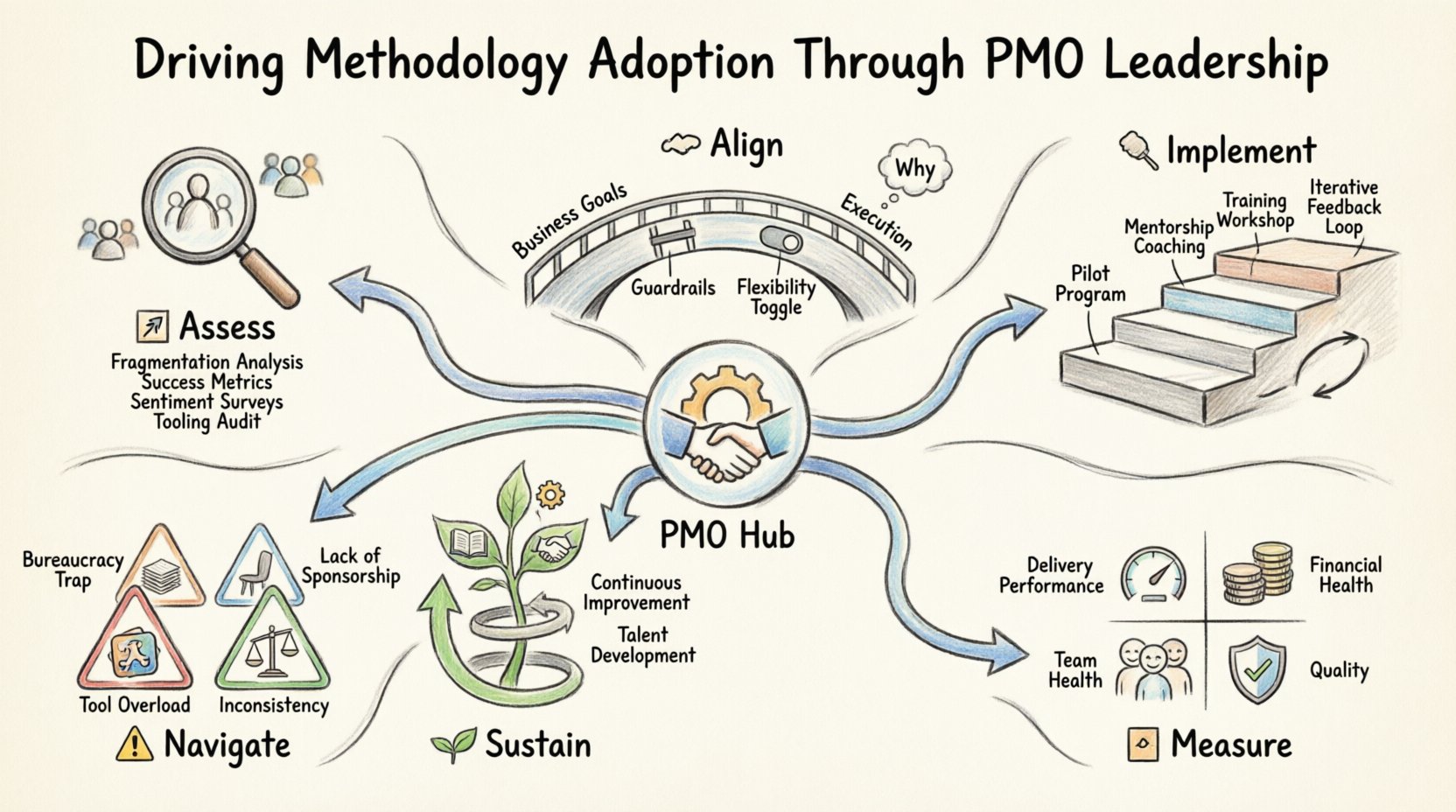
In the modern landscape of organizational management, consistency is often the missing link between strategy and execution. Organizations frequently struggle with fragmented approaches to delivering value, where one team operates in one framework while another operates in a completely different manner. This inconsistency creates friction, obscures visibility, and dilutes the return on investment for initiatives. The Project Management Office (PMO) stands as the central authority capable of harmonizing these disparate efforts. However, the PMO cannot simply mandate change. It must lead the cultural and operational shift required to embed new methodologies into the daily workflow.
Driving methodology adoption is not a technical exercise; it is a human one. It requires understanding resistance, communicating value, and providing the necessary scaffolding for teams to succeed. This article explores how PMO leadership can effectively steer organizations through complex transitions, ensuring that chosen frameworks serve the business rather than becoming bureaucratic obstacles.
🧭 Assessing the Current State of Maturity
Before implementing any new governance structure, the PMO must understand the existing environment. A “one size fits all” approach rarely succeeds because different departments possess different levels of maturity and distinct operational needs. A thorough assessment reveals the gaps between current practices and desired outcomes.
- Identify Fragmentation: Determine which teams are using which methods. Are some groups using iterative cycles while others rely on linear planning?
- Evaluate Success Rates: Look at historical project data. Which methodologies correlate with on-time delivery and budget adherence?
- Survey Team Sentiment: Direct feedback from practitioners often highlights pain points that metrics cannot capture. Is there fatigue from excessive reporting?
- Analyze Tooling: Understand the technology stack currently in use and how it supports or hinders the workflow.
This diagnostic phase prevents the imposition of rigid structures on teams that are not ready for them. It allows the PMO to tailor the approach, ensuring that the transition feels organic rather than forced.
🤝 Aligning Strategy with Execution
Methodologies are means to an end, not the end itself. The PMO must ensure that the selected frameworks directly support the organization’s strategic goals. If the business prioritizes speed to market, a heavy, documentation-heavy waterfall approach may be counterproductive. Conversely, if regulatory compliance is paramount, a rigid structure with strict audit trails might be necessary.
Leadership within the PMO plays a critical role in translating high-level objectives into actionable guidelines. This involves:
- Defining Governance Guardrails: Establish clear boundaries within which teams have autonomy. This prevents chaos without stifling innovation.
- Creating Flexibility: Allow for hybrid models where appropriate. A team might use Agile for development but Waterfall for procurement.
- Communicating the “Why”: Teams are more likely to adopt a new process if they understand how it benefits them. Explain how better planning reduces overtime or how better tracking reduces risk.
🛠️ Implementation Strategies for Change
Once the strategy is defined, the execution of the adoption plan requires careful pacing. Rushing the process often leads to backlash and a return to old habits. A phased approach allows for learning and adjustment.
1. Pilot Programs
Start with a willing team or a specific project type. Use this pilot to refine the methodology. Identify what works and what creates friction. Document these lessons to build a knowledge base for broader rollout.
2. Training and Enablement
Knowledge is the antidote to fear. Provide role-specific training that addresses the practicalities of the new workflow. Avoid generic theory; focus on how to fill out a card, how to run a meeting, and how to report status.
3. Mentorship and Coaching
Identify internal champions within the teams. These individuals can provide peer support, answer questions, and model the desired behaviors. This creates a network of influence that extends beyond the PMO.
4. Iterative Refinement
No framework is perfect on day one. Schedule regular reviews to gather feedback. If a process is causing bottlenecks, adjust it. This demonstrates that the PMO is responsive to the needs of the workforce.
📊 Measuring Success and Value
To justify the effort of adoption, the PMO must demonstrate value. Traditional metrics like “number of projects completed” are insufficient. The focus should shift to outcome-based indicators that reflect the effectiveness of the methodology.
| Metric Category | Key Indicators | Why It Matters |
|---|---|---|
| Delivery Performance | On-time completion rate, Cycle time | Shows if the method improves speed and reliability. |
| Financial Health | Budget variance, ROI per project | Ensures financial discipline and resource efficiency. |
| Team Health | Satisfaction surveys, Turnover rate | Indicates if the process is sustainable for the people. |
| Quality | Defect rate, Rework percentage | Measures the output quality resulting from the process. |
Reporting these metrics back to the organization reinforces the benefits of the new approach. It turns abstract concepts into tangible results.
⚠️ Navigating Resistance and Pitfalls
Even with a solid plan, resistance is inevitable. Some stakeholders may view the PMO as an administrative burden rather than a support function. Understanding the sources of this resistance helps in addressing it proactively.
- Bureaucracy Trap: Avoid creating excessive paperwork. If the governance requires more time than the actual work, the process will fail.
- Lack of Executive Sponsorship: Without visible support from senior leadership, the PMO lacks the authority to enforce standards.
- Tool Overload: Do not implement complex management systems before the process is stable. Process should drive tools, not the other way around.
- Inconsistent Application: If the rules apply to some teams but not others, trust in the PMO erodes. Consistency is key to credibility.
When resistance arises, listen. Often, the pushback highlights a genuine flaw in the design. Adjusting the plan based on this feedback builds trust and improves the final outcome.
🌱 Long-Term Sustainability
Adoption is not a destination; it is a continuous journey. Markets change, technologies evolve, and team structures shift. The PMO must remain agile in its own approach to governance. This means regularly reviewing the methodology library to ensure it remains relevant.
Investing in the development of project management talent within the organization is also crucial. When teams possess strong internal skills, they require less oversight and can self-correct. The PMO evolves from a policing body to a center of excellence, providing resources and guidance rather than directives.
🔑 Final Thoughts
Successful methodology adoption relies on the balance between structure and flexibility. The PMO must act as a guiding force, helping teams navigate complexity without imposing unnecessary constraints. By focusing on clear communication, practical training, and measurable value, the PMO can transform the way work gets done.
Leadership in this context is not about issuing commands. It is about creating an environment where best practices are understood, valued, and integrated into the fabric of the organization. When the PMO succeeds in this, it enables the entire organization to deliver higher quality results with greater consistency and efficiency.