
Every founder enters the market with a vision, a product, and a belief that their solution is the missing piece. Yet, statistics show that a significant percentage of startups fail within the first few years. Often, the root cause is not a lack of execution or a bad product, but a fundamental misunderstanding of the industry landscape. Ignoring the Porter’s Five Forces framework is one of the most expensive strategic errors a business can make. This analysis is not merely academic; it is a survival mechanism.
When founders skip a deep dive into competitive dynamics, they walk into a battlefield blindfolded. They underestimate barriers to entry, overestimate customer loyalty, and fail to see the threat of substitutes until it is too late. The cost of this oversight is measured in burned capital, lost market share, and eventual liquidation. This guide details exactly how ignoring these forces destroys value and how to correct course before it is too late.
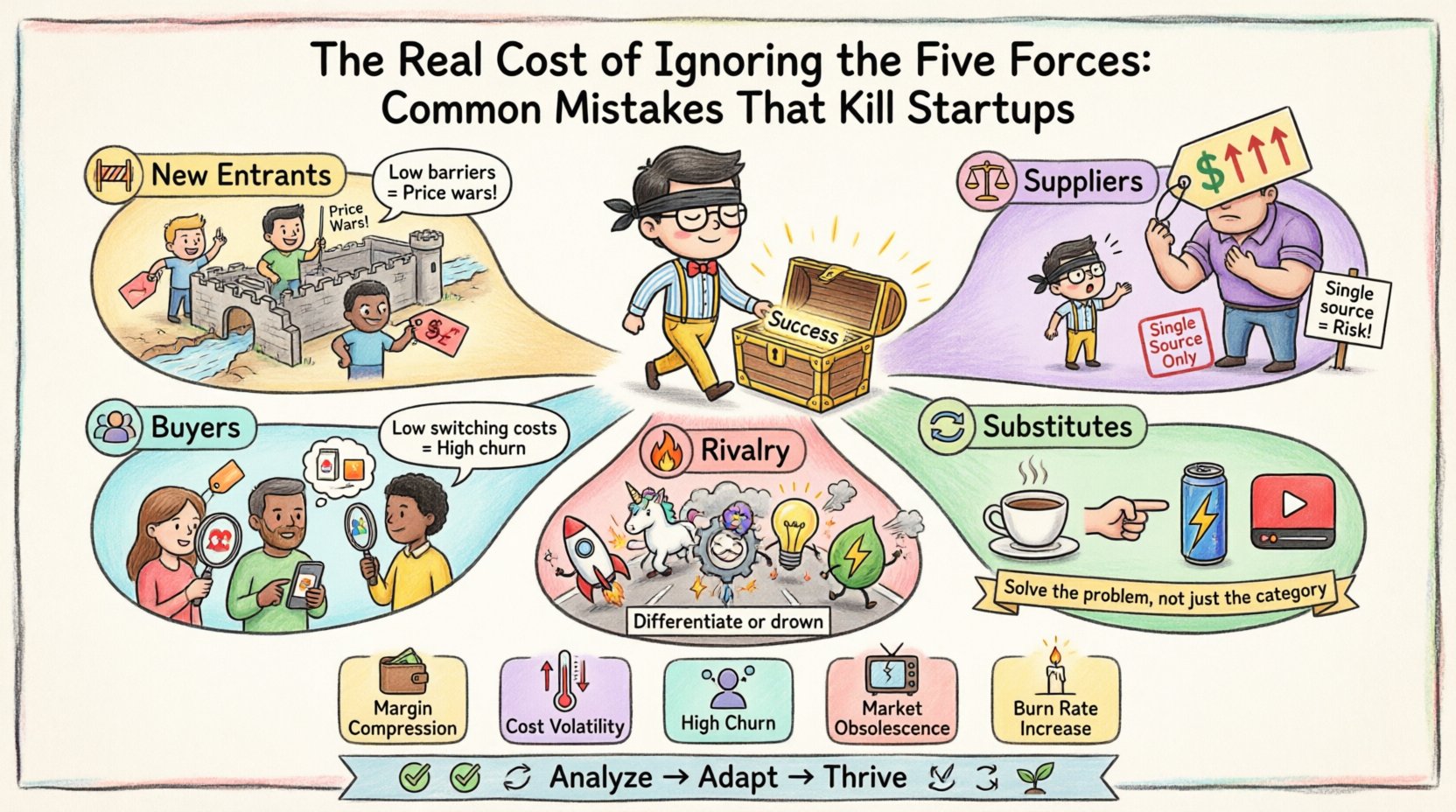
Understanding the Framework 💡
Porter’s Five Forces is a model used to analyze the competitive environment of an industry. It assesses the intensity of competition and the profitability of a market. By understanding these five forces, a startup can determine if an industry is attractive and where the real power lies.
Most founders focus heavily on their direct competitors. They look at who else is selling the same thing. However, the Five Forces model expands this view significantly. It forces the entrepreneur to look at suppliers, customers, new entrants, and substitutes. Ignoring any of these pillars creates blind spots that competitors will exploit.
1. The Threat of New Entrants 🚧
This force measures how easy it is for new competitors to enter your market. If barriers are low, established players face constant pressure to defend their share. Many startups make the mistake of assuming they have a “moat” when they do not.
- The Mistake: Founders often assume their proprietary code, unique branding, or first-mover advantage is enough to stop competition. They underestimate the capital and resources required for others to replicate the offering.
- The Consequence: When barriers are low, margins shrink rapidly. New entrants undercut prices or offer better features, forcing the original startup into a price war.
- Real-World Scenario: A SaaS startup launches a project management tool. They assume their user interface is unique. Two years later, a well-funded competitor enters with a free tier and better integrations. The original startup loses its customer base because they did not anticipate the ease of entry.
To mitigate this, founders must identify what creates barriers. Is it regulatory compliance? High upfront capital? Network effects? If there are no significant barriers, the strategy must focus on speed and differentiation rather than volume.
2. Bargaining Power of Suppliers ⚖️
Suppliers are not just vendors; they are partners who can dictate your costs. If a startup relies on a single source for a critical component, that supplier holds immense leverage. This force examines the number of suppliers available and the uniqueness of their products.
- The Mistake: Startups often sign long-term contracts with a single supplier to secure lower prices, unaware that this locks them in. They fail to diversify their supply chain until it is too late.
- The Consequence: The supplier raises prices, increases lead times, or lowers quality. The startup cannot switch easily without incurring massive costs or delays.
- Real-World Scenario: A hardware startup relies on a single manufacturer in a specific region for a key chip. Supply chain disruptions occur. The startup has no alternative. Production halts for months. Investors pull funding due to missed milestones.
Strategic planning must include identifying alternative suppliers and negotiating terms that protect against sudden price hikes. Dependency is a risk that can kill a business even if the product is excellent.
3. Bargaining Power of Buyers 👥
Buyers are your customers, but their power varies. If customers have many options and switching costs are low, they hold the power. This force determines how much pricing pressure a company can withstand.
- The Mistake: Founders assume customers are loyal simply because they like the product. They ignore the ease with which a customer can move to a competitor.
- The Consequence: Price sensitivity increases. Customers demand discounts, better service, or more features without paying more. Revenue growth stalls.
- Real-World Scenario: A subscription service launches without data lock-in features. After six months, a competitor offers a similar plan for half the price. Customers switch en masse. The churn rate spikes, destroying the unit economics.
Reducing buyer power involves increasing switching costs. This does not mean making the process difficult, but rather making the value of staying high. Integration into a customer’s workflow is a powerful deterrent against churn.
4. Threat of Substitute Products 🔄
Substitutes are products outside your industry that solve the same problem. This is often the most overlooked force. A startup might focus on beating direct competitors while ignoring a completely different solution that renders their product obsolete.
- The Mistake: Focusing solely on the “category” definition. For example, a coffee shop might worry about other cafes but ignore the convenience of energy drinks or home brewing.
- The Consequence: Market demand shifts to the substitute. The startup fights a losing battle against a changing consumer behavior.
- Real-World Scenario: A video rental startup worries about other rental stores. They ignore the rise of streaming technology. The substitute product offers more convenience and lower cost. The original business model collapses.
Founders must define their product by the problem it solves, not the features it has. This perspective reveals substitutes that are not obvious at first glance.
5. Competitive Rivalry 🔥
This force assesses the intensity of competition among existing firms. High rivalry leads to aggressive marketing, price wars, and innovation races. It is the most visible force, but often misunderstood.
- The Mistake: Entering a saturated market without a clear differentiation strategy. Founders believe they can “do it better” without defining what “better” means in the context of the market.
- The Consequence: Customer acquisition costs skyrocket. Profitability becomes negative. The startup burns cash trying to win share in a zero-sum game.
- Real-World Scenario: A food delivery startup enters a market with two dominant players. They offer no unique value proposition other than a small discount. They burn through their funding on marketing and fail to gain traction.
Low rivalry is often found in niche markets. Startups should look for segments where competition is fragmented or where incumbents are slow to adapt.
The Financial Impact of Negligence 💸
Ignoring these forces is not just a strategic error; it is a financial liability. The table below outlines the direct financial correlations between force analysis and startup viability.
| Force Ignored | Primary Financial Risk | Long-Term Outcome |
|---|---|---|
| New Entrants | Margin Compression | Loss of Market Share |
| Suppliers | Cost Volatility | Operational Instability |
| Buyers | High Churn Rate | Revenue Stagnation |
| Substitutes | Market Obsolescence | Business Cessation |
| Rivalry | Burn Rate Increase | Funding Depletion |
These risks compound. A supplier price hike combined with buyer price sensitivity can lead to a negative cash flow situation that no amount of funding can fix.
How to Conduct the Analysis Properly 📝
Conducting a Five Forces analysis does not require expensive software or consultants. It requires rigorous thinking and data gathering. Follow these steps to ensure accuracy.
Step 1: Define the Industry Scope
Be specific. Is the industry “Food Delivery” or “Urban Logistics”? The scope determines the competitors and substitutes. A narrow scope might hide threats, while a broad scope might dilute the analysis.
Step 2: Gather Data on Competitors
Look at public financial reports, customer reviews, and marketing materials. Identify how many competitors exist and what their pricing strategies are. Talk to potential customers about why they chose their current solution.
Step 3: Assess Supplier Dependencies
List all critical inputs. Count how many vendors provide each input. Calculate the percentage of total spend going to the top supplier. This reveals concentration risk.
Step 4: Analyze Customer Switching Costs
What happens when a customer leaves? Do they lose data? Do they lose history? Do they lose access to a network? If the answer is “nothing,” switching costs are low, and buyer power is high.
Step 5: Identify Substitutes
Ask customers what they do when they don’t use your product. They might use Excel, a pen and paper, or a competitor. These are all substitutes.
Common Pitfalls in Execution ⚠️
Even when founders attempt this analysis, they often make mistakes that render it useless.
- Static Analysis: The market changes. A Five Forces analysis done once is a snapshot. It must be revisited quarterly as new technologies or regulations emerge.
- Internal Bias: Founders often overestimate their own strengths and underestimate the market’s toughness. They assume their product is unique when it is not.
- Ignoring the Macro Environment: While Five Forces focuses on the industry, external factors like economic downturns or regulatory changes can shift the forces overnight.
- Overcomplicating the Output: The goal is insight, not a perfect report. If the analysis is too complex, no one will read it. Keep it actionable.
Building a Resilient Strategy 🛡️
Once the analysis is complete, the strategy must adapt. Here is how to build resilience based on the findings.
If New Entrants are Likely: Focus on brand loyalty and network effects. Make the product sticky.
If Suppliers are Powerful: Backward integrate if possible. Develop multiple sourcing channels. Build inventory buffers.
If Buyers are Powerful: Differentiate on value, not price. Increase switching costs through integration and data portability.
If Substitutes are Threatening: Pivot or innovate. Be the one who makes the substitute obsolete.
If Rivalry is High: Find a niche. Do not compete on price. Compete on service, quality, or speed.
Conclusion: The Cost of Inaction
The cost of ignoring the Five Forces is not just a theoretical loss of potential profit. It is the actual destruction of the company. Startups that survive are those that understand the battlefield before they step onto it. They know where the traps are set and where the opportunities lie.
Investing time in this analysis is the difference between a gamble and a calculated business plan. It provides the clarity needed to secure funding, manage burn rates, and sustain growth. Do not wait for a crisis to force this review. Make it a foundational habit of your leadership team.
The market does not reward ignorance. It rewards understanding. Ensure your understanding is deep, accurate, and continuously updated. This is the only way to navigate the uncertainty of the startup ecosystem with confidence and precision.