
In the landscape of Object-Oriented Analysis and Design, managing user actions and system states requires a robust architectural approach. The Command Pattern stands as a fundamental structural solution, particularly when dealing with undoable operations. This design pattern encapsulates a request as an object, allowing you to parameterize clients with different requests, queue requests, or log operations. This guide explores the mechanics of implementing undo functionality using this pattern without relying on specific software tools.
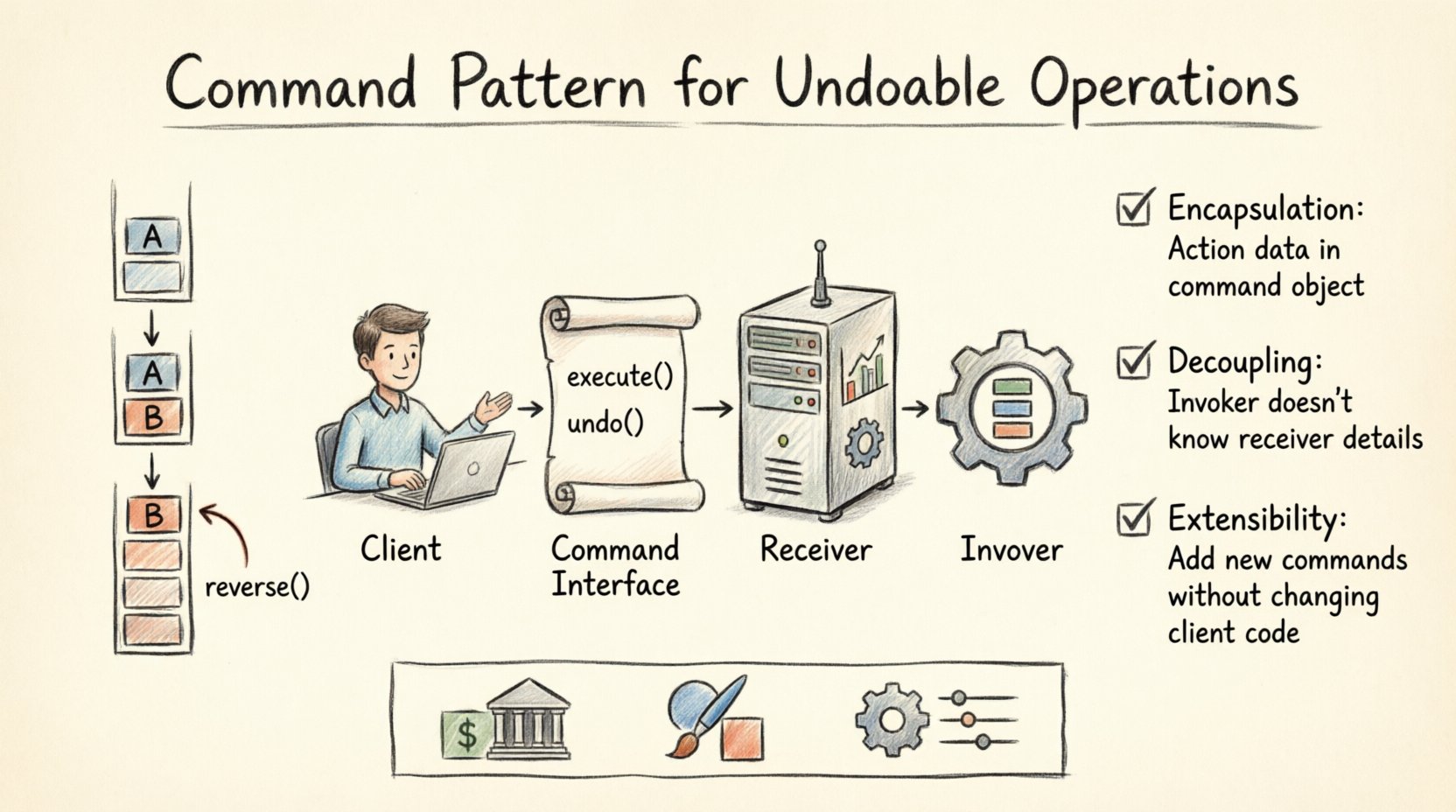
Understanding the Core Objective 🎯
The primary goal of this architectural pattern is to decouple the object that invokes an operation from the object that performs it. When building applications that require undoable operations, the complexity increases significantly. Users expect to reverse mistakes. Developers need to ensure that the system state remains consistent after a reversal. The Command Pattern addresses this by treating actions as first-class objects.
Consider a scenario where a user modifies a document. If an error occurs, the system must revert to the previous state. This is not merely a function call; it is a request object. By wrapping the logic of “save,” “delete,” or “modify” into a command, the system gains flexibility. It becomes possible to stack these commands, review the history, and reverse them individually.
- Encapsulation: All information needed to perform an action is contained within the command object.
- Decoupling: The invoker does not need to know the details of the receiver.
- Extensibility: New commands can be added without modifying existing client code.
Key Components of the Command Architecture ⚙️
To implement undoable operations effectively, one must understand the four primary roles involved. Each role has a specific responsibility that contributes to the stability of the system.
1. The Client 🧑💻
The Client creates the command objects. It knows which receiver to associate with which command and which arguments the command requires. In a typical workflow, the Client initializes the concrete command, sets up the necessary state, and passes it to the Invoker.
2. The Command Interface 📜
This is the abstract contract. It declares an execute method. Any command class that implements this interface must provide the logic for performing the action. For undo functionality, a concrete command also implements a reverse method. This separation allows the system to distinguish between doing and undoing.
3. The Receiver 🖥️
The Receiver contains the actual business logic. It knows how to perform the operation. For example, in a text editing context, the Receiver manages the text buffer. The Command object calls methods on the Receiver but does not know the specifics of the Receiver’s implementation details.
4. The Invoker 🚀
The Invoker is responsible for triggering the command. It stores a reference to a Command object and calls its execute method. Crucially, for undoable operations, the Invoker often manages a history stack. It does not know what the command does; it only knows how to execute it.
| Component | Responsibility | Example Context |
|---|---|---|
| Client | Instantiates commands | User clicks a button |
| Command Interface | Defines execute/undo methods | Abstract base class |
| Receiver | Performs the actual work | Text buffer manager |
| Invoker | Manages history and execution | Application main loop |
Implementing the History Stack 📚
The heart of undoable operations lies in the management of command history. When a user performs an action, the system must record it. When an undo is requested, the system must retrieve the most recent action, reverse it, and then remove it from the active history.
The Stack Mechanism
A stack data structure is the ideal choice for this purpose. It follows the Last-In, First-Out (LIFO) principle. The most recent command is the first one to be undone. This aligns perfectly with user expectations.
- Push: When a command is executed successfully, it is pushed onto the stack.
- Pop: When an undo is triggered, the top command is popped from the stack.
- Peek: The system can inspect the top command without removing it, useful for UI indicators.
Handling Multiple Levels
Implementing a single undo is straightforward. Implementing multiple undo levels requires careful state management. The Invoker must maintain a persistent list of command objects. As the user performs actions, the list grows. As the user undoes, the list shrinks.
Consider the following workflow:
- User performs Action A. Command A is executed. Command A is added to history.
- User performs Action B. Command B is executed. Command B is added to history.
- User undoes. Command B is popped. Command B.reverse() is called.
- User undoes again. Command A is popped. Command A.reverse() is called.
This structure ensures that the system state reverts exactly to where it was before the sequence of actions began.
Designing the Reverse Logic 🔄
For a command to be truly undoable, it must possess a mechanism to reverse its effects. This is often the most complex part of the design. Not all operations are reversible in a simple manner.
State Preservation
Some commands require saving the state before execution. If a command modifies a complex object, the original state must be preserved so it can be restored during the undo phase. This is often handled by the Command object itself, holding a snapshot of the Receiver’s state before execution.
Method Signature Design
The Command Interface should explicitly define an undo method. This enforces the contract across all command types.
execute(): Performs the forward operation.undo(): Reverses the operation.
By enforcing this interface, the Invoker treats all commands uniformly. It does not need to know if the command is “Save” or “Delete.” It simply calls undo() on whatever command is at the top of the stack.
Extending to Redo Functionality 🔄
While undo is essential, redo provides a complete user experience. Redo allows the user to re-execute commands that were previously undone. This requires a second stack or a split history management strategy.
The Redo Stack
When an undo occurs, the Command object is not destroyed. Instead, it is moved from the Undo Stack to a Redo Stack. If the user chooses to redo, the command is popped from the Redo Stack and re-executed.
Branching Logic
A complication arises when a new action is performed after an undo. The Redo history becomes invalid. If a user undoes three steps and then types a new letter, the previous “redo” steps can no longer be reached. The Redo Stack must be cleared in this scenario.
- Scenario: User edits text ➔ Undoes change ➔ Types new text.
- Result: The previous undo steps are lost.
- Implementation: Clear the Redo Stack upon a new execute command.
Challenges in Implementation ⚠️
While the Command Pattern provides a clean structure for undoable operations, several challenges exist. Developers must address these to ensure system performance and stability.
Memory Consumption
Every command object stored in the history stack consumes memory. In long-running sessions with frequent actions, this can lead to significant memory usage. Each command may need to store references to the Receiver’s state.
- Solution: Limit the number of undo levels allowed.
- Solution: Use weak references where possible.
- Solution: Implement command compression for similar actions.
Concurrency Issues
If the application handles multiple threads, the history stack must be thread-safe. A user might undo an action while another thread is executing a different command. Race conditions can lead to corrupted state.
- Synchronization: Lock the history stack during push and pop operations.
- Queueing: Use a thread-safe queue to manage command execution order.
Complex Reversal Logic
Not all actions have a simple inverse. Deleting a file is easy to undo (restore file). Updating a database record is harder (requires transaction logs). The Command object must encapsulate enough information to reverse the specific action.
Best Practices for Design 📝
To maintain a clean architecture, adhere to these guidelines when implementing the Command Pattern for undoable operations.
- Keep Commands Small: Each command should represent a single logical action. Avoid batching unrelated operations into one command unless they are atomic.
- Document State Changes: Clearly define what state changes occur in
execute()and whatundo()restores. This aids future maintenance. - Log Errors: If a command fails during execution, it should not be added to the history stack. The user should not be able to undo a failed operation.
- Interface Segregation: If a command cannot be undone, do not force it to implement the undo method. Use separate interfaces for Executable and Undoable commands.
Comparison with Other Patterns 🔍
While the Command Pattern is excellent for undoable operations, it is often compared with the Memento Pattern. Understanding the distinction helps in choosing the right tool.
| Feature | Command Pattern | Memento Pattern |
|---|---|---|
| Focus | Action encapsulation | State encapsulation |
| Undo Mechanism | Reverses logic | Restores previous state |
| Performance | Lower memory if logic is simple | Higher memory for state snapshots |
| Complexity | Requires inverse logic | Requires snapshot logic |
The Command Pattern is preferred when the operation is complex and the inverse logic is well-defined. The Memento Pattern is better when the state is too complex to reverse logically, such as saving the entire state of a window.
Real-World Application Scenarios 🌍
This pattern is not limited to text editors. It is applicable across various domains requiring state management.
Financial Systems
In banking software, transactions must be reversible. A withdrawal command can be undone if an error is detected. The Command Pattern ensures that the ledger remains consistent.
Graphic Design Tools
When drawing shapes, users expect to move, resize, and delete objects. Each tool interaction becomes a command. The history stack allows for complex editing sessions without data loss.
Configuration Management
System administrators often change configurations. If a change breaks the system, the ability to revert to the previous configuration is critical. Commands encapsulate configuration changes.
Final Thoughts on Structure 🏗️
Implementing undoable operations using the Command Pattern requires careful planning. It shifts the focus from direct function calls to object-oriented encapsulation. The Invoker manages the flow, while the Command objects manage the logic.
By adhering to the principles of separation of concerns, developers create systems that are robust and user-friendly. The history stack becomes the backbone of the user experience, providing safety and flexibility. While challenges regarding memory and concurrency exist, they are manageable with proper architectural decisions.
This approach ensures that the software remains maintainable. Adding new features does not break existing undo logic. The decoupling allows the system to evolve without constant refactoring of the core execution engine.