
Building a startup is rarely a solo journey. It is a partnership forged in uncertainty, driven by ambition, and tested by the daily grind of execution. Yet, statistics show that a significant portion of startup failures stem not from market rejection or lack of funding, but from internal friction. Co-founder conflict is a silent killer. When visions diverge, resources dissipate, and momentum stalls.
How do you ensure two distinct individuals move toward the same horizon? The answer lies in structure. Specifically, the Business Model Canvas (BMC). This tool is more than a planning sheet; it is a communication framework. It forces abstract ideas into concrete blocks, allowing you to spot disagreements before they become deal-breakers.
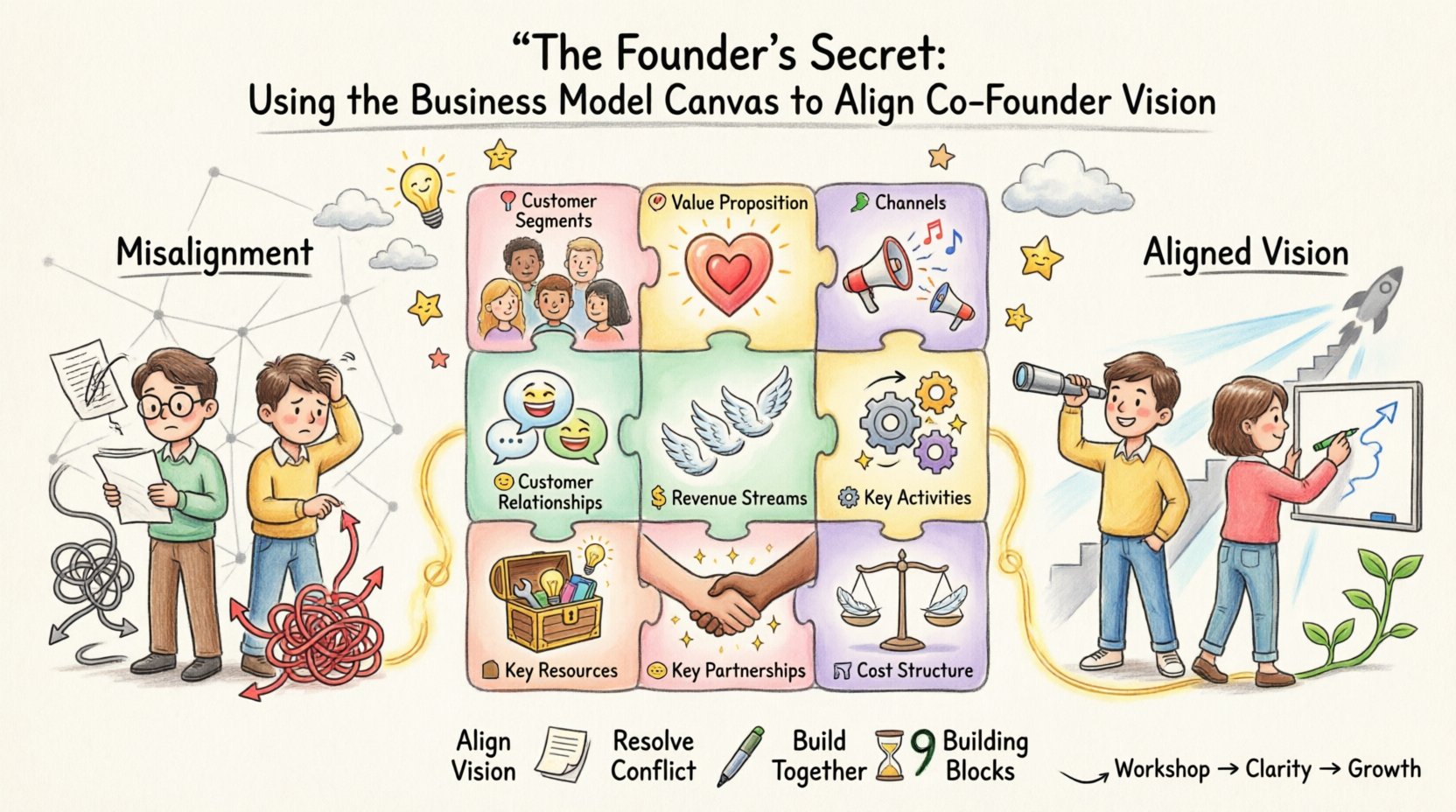
This guide explores how to leverage the Business Model Canvas to align co-founder vision, resolve strategic conflicts, and build a shared roadmap for growth. We will break down the nine building blocks, examine where friction typically occurs, and provide a structured approach to workshops that solidify your partnership. 🤝
Why Alignment Matters More Than Funding 💰
Investors look at traction, but they also look at the team. A team that cannot agree on the fundamental mechanics of their business is a risk. Misalignment often manifests in subtle ways:
- Strategic Drift: One founder pivots while the other resists, confusing the team and customers.
- Resource Allocation: Disagreements on where to spend the first million dollars (R&D vs. Marketing).
- Exit Strategy: One founder wants a quick acquisition; the other wants to build a legacy brand.
- Operational Focus: Technical perfectionism clashing with aggressive market capture.
The Business Model Canvas addresses these issues by externalizing the strategy. When you write on a wall, the argument is about the text, not the person. It depersonalizes the conflict.
Deconstructing the 9 Building Blocks for Co-Founders 🧩
The canvas consists of four main pillars: Infrastructure, Offering, Customers, and Finance. Each block represents a specific area of decision-making. Here is how co-founders can use each section to align their vision.
1. Customer Segments (Who are we serving?) 👥
This is often the first point of contention. One founder might envision a mass-market B2C approach, while the other sees a niche B2B solution.
- The Alignment Question: Can we agree on who benefits most from our product?
- The Conflict: Broad targeting dilutes focus. Narrow targeting limits growth.
- The Resolution: Define the primary segment clearly. Acknowledge secondary segments but agree to ignore them for now.
Write down the specific demographics, behaviors, and pain points. If you cannot agree on the problem the customer faces, you cannot agree on the solution.
2. Value Proposition (Why do they choose us?) 🎯
Your value proposition is the core promise. Does it rely on price, speed, quality, or design? This block dictates your marketing tone and product roadmap.
- The Alignment Question: Is our value functional, emotional, or economic?
- The Conflict: A product designer might prioritize aesthetics, while a sales founder prioritizes feature density.
- The Resolution: Map your features to specific customer pains. If a feature does not solve a stated pain, cut it.
3. Channels (How do we reach them?) 📢
This block covers distribution. Do you sell directly, use partners, or rely on organic search? This is where operational roles often clash.
- The Alignment Question: Where does the customer buy from us?
- The Conflict: Online self-serve vs. high-touch sales team.
- The Resolution: Choose one primary channel to start. Map the customer journey step-by-step.
4. Customer Relationships (How do we interact?) 💬
Is the relationship automated, personal, or community-driven? This defines your customer support model and user experience design.
- The Alignment Question: Do we want high touch or self-serve?
- The Conflict: Service costs vs. scalability.
- The Resolution: Define the standard level of service. If a customer asks for help, what is the expected response time?
5. Revenue Streams (How do we make money?) 💵
This is often the most sensitive topic. Pricing models, subscription tiers, licensing, or transaction fees. This directly impacts cash flow and valuation.
- The Alignment Question: What is the unit economics model?
- The Conflict: Low price/high volume vs. high price/low volume.
- The Resolution: Test pricing hypotheses. Ensure the price covers the cost of acquisition and delivery.
6. Key Activities (What do we do daily?) ⚙️
These are the most important actions required to make the business work. Is it software development, manufacturing, or content creation?
- The Alignment Question: What takes up 80% of our time?
- The Conflict: CTO wants to refactor code; CEO wants to close deals.
- The Resolution: Prioritize activities that directly impact the Value Proposition.
7. Key Resources (What do we need?) 🏗️
Assets required to offer the value. Physical, intellectual, human, or financial.
- The Alignment Question: Do we own our data? Do we need capital equipment?
- The Conflict: Building in-house vs. outsourcing.
- The Resolution: List resources by criticality. Protect the core assets.
8. Key Partnerships (Who helps us?) 🤝
Suppliers, allies, and strategic partners. This affects your risk profile and scalability.
- The Alignment Question: Who do we rely on to function?
- The Conflict: Vertical integration vs. ecosystem play.
- The Resolution: Identify critical dependencies. Mitigate risk by having alternatives.
9. Cost Structure (What does it cost?) 📉
All costs incurred to operate the business. Fixed vs. variable costs.
- The Alignment Question: Are we cost-driven or value-driven?
- The Conflict: Frugality vs. investment in growth.
- The Resolution: Map costs to revenue streams. Eliminate waste that does not add value.
Comparing Founder Focus Areas vs. Canvas Blocks 📊
To visualize how different personalities map to the canvas, consider this breakdown. This helps assign ownership during workshops.
| Founder Archetype | Primary Canvas Focus | Typical Conflict Point |
|---|---|---|
| The Visionary | Value Proposition, Customer Segments | Over-ambition vs. Feasibility |
| The Operator | Key Activities, Resources, Partners | Efficiency vs. Innovation |
| The Commercial Lead | Revenue Streams, Channels, Relationships | Pricing Strategy vs. Market Fit |
| The Technical Lead | Key Activities, Key Resources | Code Quality vs. Time to Market |
Conducting the Alignment Workshop 🛠️
Writing the canvas is a process. It should not be a one-off meeting. It requires a structured session to ensure buy-in.
Step 1: Preparation
- Gather a large physical space or a digital whiteboard.
- Print large sticky notes or have a marker ready.
- Schedule at least 4 hours. Do not rush.
- Set ground rules: No interrupting, no judgment on ideas during the draft phase.
Step 2: The Blank Slate
Start with the Customer Segments. If you do not know who you are serving, nothing else matters. Write down every possible segment you can think of.
Step 3: Iterative Filling
Fill the blocks in a logical flow, but allow for backtracking. If you change the Revenue Stream, go back and check if the Key Activities still match.
Step 4: The Stress Test
Once the canvas is full, challenge it. Ask:
- Is this sustainable for 5 years?
- What is the biggest risk in this model?
- Does this match our personal values?
Resolving Conflict Using the Canvas ⚖️
When disagreements arise, return to the canvas. Use it as an arbiter. Here are common scenarios and how to handle them.
Scenario A: The Pivot Debate
One founder wants to change the product direction. The other wants to stay the course.
- Action: Draw a second canvas representing the new idea.
- Comparison: Place the two canvases side-by-side.
- Analysis: Which model is more viable? Which aligns better with resources?
Scenario B: The Budget Clash
One founder wants to hire more sales staff. The other wants to invest in engineering.
- Action: Look at the Cost Structure and Key Resources blocks.
- Analysis: Which investment drives the Revenue Stream more effectively?
- Decision: Base the spend on the metric that matters most at this stage (e.g., CAC vs. Churn).
Scenario C: The Vision Drift
Over time, goals change. One founder now wants to sell; the other wants to stay independent.
- Action: Revisit the Value Proposition and Customer Segments.
- Analysis: Does the original problem still exist? Has the market shifted?
- Decision: If the problem is solved, the exit strategy becomes relevant. If not, alignment on growth is key.
Common Pitfalls to Avoid ⚠️
Even with a tool like the Business Model Canvas, teams can stumble. Be aware of these traps.
- Perfectionism: Do not wait for the perfect canvas. Version 1.0 is enough to start.
- Ignoring the Environment: Do not forget that external factors (competitors, regulations) affect the model. Keep a separate space for context.
- Static Thinking: A canvas is a living document. Review it quarterly.
- Groupthink: If everyone agrees too quickly, you might be missing a blind spot. Assign a “devil’s advocate” role during the workshop.
Maintaining Alignment Over Time 🔄
Alignment is not a destination; it is a continuous practice. As the company grows, the canvas must evolve.
- Quarterly Reviews: Set a recurring meeting to update the canvas.
- Team Input: Involve early employees. They often see friction points founders miss.
- Customer Feedback: Validate the Value Proposition block regularly with real user data.
- Financial Check-ins: Ensure the Cost Structure matches actual burn rates.
Practical Checklist for Your Next Session ✅
Before you begin, ensure you have the following:
- 🖍️ Markers in multiple colors for different blocks.
- 📝 Printed copies of the canvas template.
- ⏰ A timer to keep the discussion focused.
- 📊 Access to any market research or data you currently have.
- 🧠 A mindset of collaboration, not competition.
Final Thoughts on Strategic Unity 🌟
Using the Business Model Canvas to align co-founder vision is about more than filling out boxes. It is about creating a shared language. It transforms vague hopes into tangible plans. When you disagree, you do not argue about feelings; you argue about the model.
This approach reduces emotional friction and increases strategic clarity. It allows you to test assumptions without risking the entire venture. By treating your business model as a hypothesis, you invite change rather than fearing it.
Remember, the best founders are not those who never disagree. They are the ones who have a system to resolve disagreement and move forward together. Use this tool to build that system. Your partnership is your greatest asset; protect it with structure.