
Founders and strategists often face a pivotal crossroads when preparing their ventures for growth or investment. The question arises: Does the Business Model Canvas actually replace your Pitch Deck? Many assume these tools serve the same function, yet they operate in distinct capacities within the startup ecosystem. Understanding the nuance between a strategic map and a narrative presentation is critical for clear communication with stakeholders.
This guide dissects both frameworks. It explores their structural differences, functional purposes, and optimal usage scenarios. By the end, you will understand why relying on one without the other limits your strategic clarity.
Understanding the Business Model Canvas 🗺️
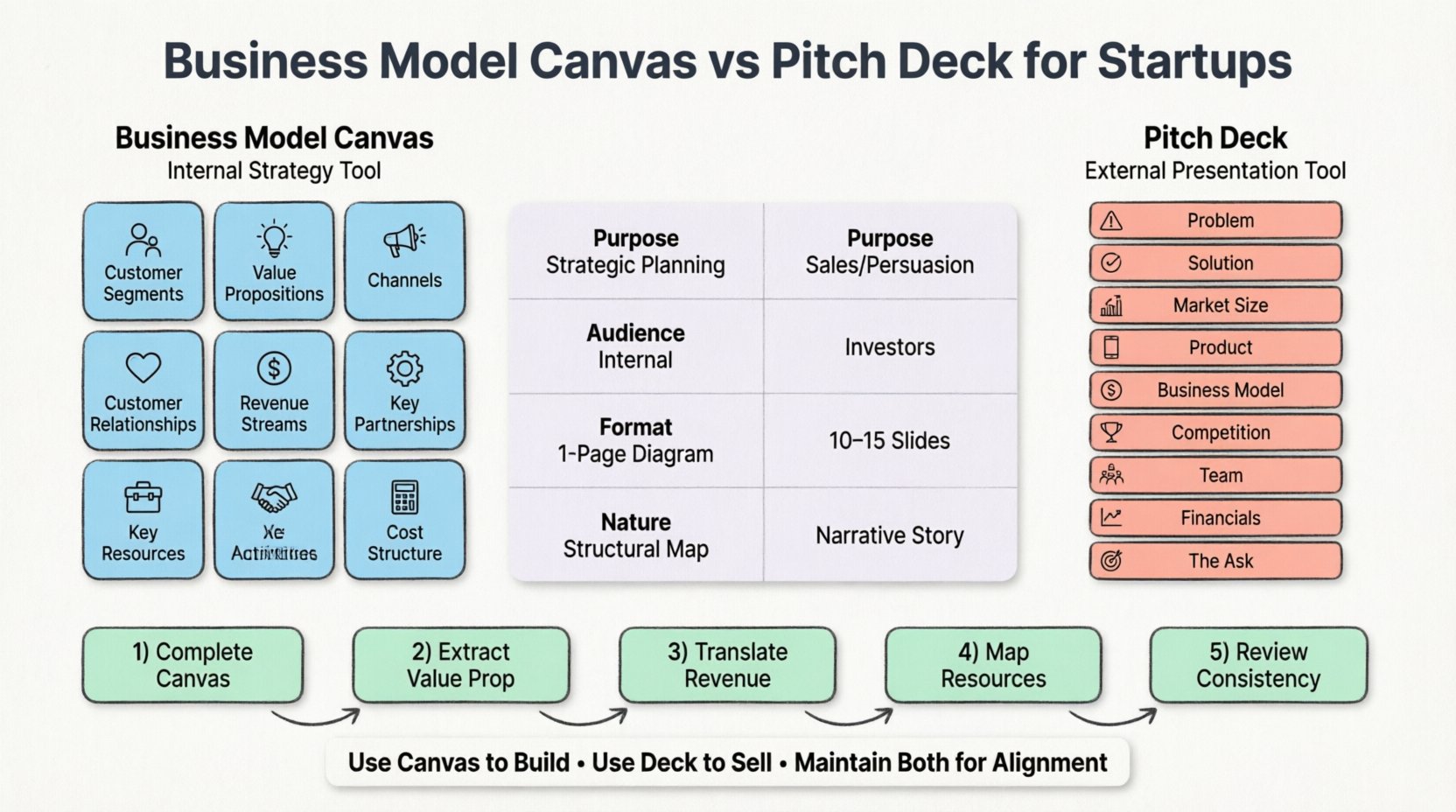
The Business Model Canvas (BMC) is a strategic management template. It visualizes the logic of how an organization creates, delivers, and captures value. It is not a linear document but a holistic diagram.
Developed by Alexander Osterwalder, the canvas divides the business architecture into nine fundamental building blocks. These blocks interact dynamically rather than sequentially.
The 9 Building Blocks Explained
Each block represents a core pillar of your operation. A deep understanding of these is necessary before attempting to communicate with external parties.
- Customer Segments: Who are you creating value for? This defines the specific groups of people or organizations you aim to serve.
- Value Propositions: What problem are you solving? This describes the bundle of products and services that create value for a specific customer segment.
- Channels: How do you reach customers? This outlines the touchpoints through which you communicate with and reach your customer segments.
- Customer Relationships: What type of relationship does each segment expect? This defines the types of relationships you establish with specific customer segments.
- Revenue Streams: How do you make money? This represents the cash a company generates from each customer segment.
- Key Resources: What assets do you need? These are the most important assets required to make a business model work.
- Key Activities: What do you do? These are the most important things a company must do to make its business model work.
- Key Partnerships: Who helps you? This network of suppliers and partners is crucial for the operation of the business model.
- Cost Structure: What are the major costs? This describes all costs incurred to operate a business model.
The BMC is internal-facing. It serves as the blueprint for the founders, operations teams, and internal strategy sessions. It answers the question: “How does this machine run?”
The Role of the Pitch Deck 📊
A Pitch Deck is a presentation, typically a slide deck, used to provide a concise overview of a business plan. Its primary audience is external: investors, partners, or potential hires.
The deck is not a blueprint; it is a story. It follows a narrative arc designed to persuade the audience to take a specific action, such as funding the venture or joining the team.
Standard Slide Structure
While flexibility exists, most successful decks follow a consistent flow to align with investor expectations.
- Problem: Define the pain point clearly.
- Solution: Present your product or service as the answer.
- Market Size: Demonstrate the opportunity (TAM, SAM, SOM).
- Product: Show the technology or service in action.
- Business Model: Briefly explain how you monetize.
- Competition: Acknowledge rivals and define your advantage.
- Team: Highlight why this group is capable of execution.
- Financials: Show traction, projections, and unit economics.
- The Ask: State clearly what you need and how you will use it.
The pitch deck answers the question: “Why should you bet on this?”
Side-by-Side Comparison 📋
To clarify the distinction, we must look at the functional differences. The table below outlines the core variances in purpose, audience, and format.
| Feature | Business Model Canvas | Pitch Deck |
|---|---|---|
| Primary Purpose | Strategic planning and internal alignment | Sales and persuasion for external parties |
| Audience | Founders, Employees, Internal Stakeholders | Investors, Partners, Media, Hires |
| Format | Single-page visual diagram | Multi-slide presentation (10-15 slides) |
| Nature | Structural Map | Narrative Story |
| Detail Level | High (Operational specifics) | Medium (Highlights and metrics) |
| Update Frequency | As strategy shifts | Before every major meeting |
Why One Cannot Replace the Other ❌
Founders often try to compress the pitch deck into a single canvas to save time. This is a strategic error. The canvas lacks the narrative flow required to build emotional investment. Conversely, a pitch deck often glosses over operational realities that the canvas captures.
The Narrative Gap
Investors do not just buy data; they buy a story. The pitch deck constructs a timeline. It moves from the current state of the problem to the future state enabled by your solution. The Business Model Canvas is static. It shows the current state. It does not inherently show growth velocity or market entry strategy.
The Operational Gap
A pitch deck can be glossy and vague. It might claim “strong partnerships” without listing them. The Canvas forces specificity. If you cannot fill the “Key Partnerships” block, you do not have the partnerships you claim in the deck. The Canvas exposes the operational gaps that a polished presentation might hide.
When to Use Which Tool 🕰️
Knowing the tool for the job is half the battle. Here is a breakdown of scenarios where each tool takes precedence.
Use the Business Model Canvas When:
- Validating a Hypothesis: You are in the early ideation phase and need to test assumptions about costs and revenue.
- Aligning a Team: You need to ensure every department understands the value proposition and resource allocation.
- Identifying Gaps: You need to find where your cost structure does not match your revenue streams.
- Onboarding New Hires: You need to explain how the company makes money and who it serves.
Use the Pitch Deck When:
- Raising Capital: You are in a fundraising round and need to secure funding.
- Seeking Partnerships: You need to convince a large enterprise to integrate your product.
- Public Speaking: You are presenting at a conference or investor forum.
- Hiring Key Talent: You need to sell the vision to a potential executive.
The Integration Strategy 🤝
The most effective founders do not choose one over the other. They use the Canvas to build the foundation and the Deck to sell the vision. The Canvas informs the content of the Deck.
Step-by-Step Integration
Follow this workflow to ensure consistency between your internal strategy and external messaging.
- Complete the Canvas First: Ensure all nine blocks are filled out accurately. This is your source of truth.
- Extract the Value Proposition: Move the “Value Proposition” block from the Canvas to the “Solution” slide of the Deck.
- Translate Revenue Streams: Convert the “Revenue Streams” block into the “Business Model” and “Financials” slides.
- Map Key Resources: Use “Key Resources” to build the “Team” and “Technology” sections of the Deck.
- Review for Consistency: Ensure the costs in the Canvas match the burn rate in the Deck.
This process ensures that what you promise to investors is grounded in your actual operational reality.
Common Misconceptions 🧐
Several myths circulate in the startup community regarding these tools. It is important to address them to avoid strategic confusion.
Myth 1: The Canvas is for Investors
While some investors appreciate seeing a Canvas, it is rarely the primary document for due diligence. Investors want to see traction, market dynamics, and financial projections. A Canvas is too abstract for deep financial analysis.
Myth 2: The Deck is a Business Plan
A pitch deck is not a business plan. A business plan is a detailed document (30+ pages) covering every operational aspect. A pitch deck is a summary. It is a teaser designed to get a meeting, not a contract.
Myth 3: One-Time Setup
Both documents are living artifacts. As your business pivots or scales, the Canvas must be updated. The Deck must be updated to reflect new traction and milestones. Treating them as static documents leads to misalignment.
Investor Psychology and Presentation 🧠
Understanding how investors process information helps clarify why the Deck is necessary even if you have a perfect Canvas.
The Story Arc
Investors hear hundreds of pitches. They rely on cognitive patterns. The Pitch Deck follows a pattern they understand: Problem, Solution, Market, Traction, Team. This reduces cognitive load. The Canvas does not follow this narrative arc. It is a grid.
Visual Hierarchy
A pitch deck uses visual hierarchy to guide attention. Large fonts for key metrics, graphs for growth, and images for emotion. The Canvas is dense. It requires the viewer to read every block. In a meeting setting, investors do not have time to read a dense grid.
Emotional Connection
Investment is an emotional decision backed by logic. The Deck tells the story of the founder’s passion and the market’s pain. The Canvas is logical and structural. It lacks the emotional resonance required to secure a commitment.
Advanced Usage: The Canvas as a Due Diligence Tool 🔍
Once the relationship is established and you move to due diligence, the Canvas becomes valuable again. At this stage, investors look for operational consistency.
- Unit Economics: Investors will ask for the math behind your “Revenue Streams.” The Canvas helps visualize the link between cost and revenue.
- Scalability: The “Key Activities” block shows what must happen to grow. Investors use this to assess if your growth is linear or exponential.
- Risk Assessment: The “Key Partnerships” and “Key Resources” blocks highlight dependencies. Investors look for single points of failure.
This is where the Canvas validates the claims made in the Deck. It provides the evidence for the story.
Tailoring for Different Stages of Growth 📈
The weight of each tool changes as your company matures.
Pre-Seed Stage
Focus on the Canvas. You have an idea but little traction. You need to prove the logic works. The Deck should be minimal, focusing on the Problem and Team. The Canvas helps you refine the Value Proposition.
Seed Stage
Focus on the Deck. You need money to execute. The Canvas is already defined. The Deck must show how the Canvas will be populated with real data. You need to show traction.
Growth / Series B+ Stage
Focus on Data. Both tools evolve. The Canvas becomes a dashboard. The Deck becomes a report. You need to show efficiency and scale. The narrative shifts from “vision” to “execution”.
Final Thoughts on Strategic Alignment 💡
The question is not which tool is better. The question is which tool serves the current communication need. The Business Model Canvas is the engine of your strategy. The Pitch Deck is the steering wheel for your external relations.
Trying to replace the Deck with the Canvas results in a presentation that is too dense and lacks a story. Trying to replace the Canvas with the Deck results in a strategy that is too vague to execute.
Use the Canvas to build. Use the Deck to sell. Maintain both to ensure your business remains grounded in reality while projecting a compelling future.
Key Takeaways ✅
- The Business Model Canvas is for internal strategy and operational mapping.
- The Pitch Deck is for external persuasion and fundraising.
- They serve different psychological functions: Structure vs. Narrative.
- Never present a Canvas as a substitute for a Pitch Deck in a funding meeting.
- Use the Canvas to validate the data points in your Pitch Deck.
- Update both documents as your business evolves.
- Investors need the story (Deck) and the logic (Canvas) to feel secure.
By respecting the distinct roles of these frameworks, you build a more resilient venture. You avoid the trap of confusing structure with story. You ensure that your operational reality matches your external promise. This alignment is the foundation of sustainable growth.