
In the high-stakes arena of venture capital, valuation is often a reflection of potential rather than current profit. Yet, beneath the surface of a billion-dollar assessment lies a structured framework that investors scrutinize closely. The Business Model Canvas (BMC) serves as the blueprint for this potential. This analysis dissects how specific configurations within the canvas correlate with the exponential growth seen in unicorn startups.
Understanding the mechanics of the canvas is not merely an academic exercise; it is a strategic necessity for founders and analysts alike. When a company transitions from a local player to a global giant, the underlying architecture of its value creation must evolve. We examine the nine building blocks of the canvas and how they interact to drive the metrics that justify a multi-billion dollar valuation.
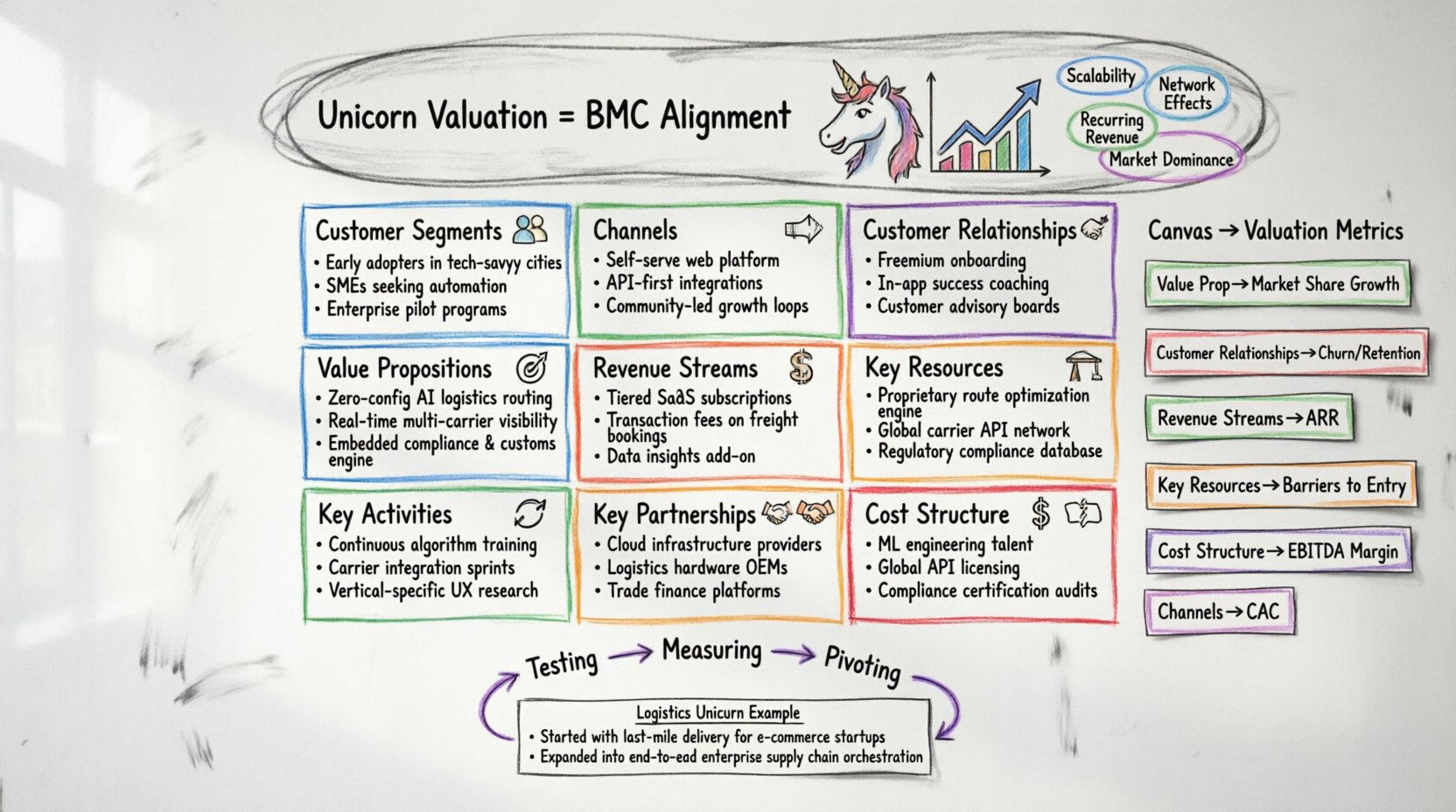
Why Unicorns Command Premium Valuations 📈
A unicorn is defined as a private company valued at over $1 billion. This status is rarely accidental. It is the result of a deliberate alignment between market opportunity and operational efficiency. Investors do not simply fund ideas; they fund scalable systems.
- Scalability: The ability to grow revenue without a proportional increase in costs.
- Network Effects: The value of the service increases as more users join.
- Recurring Revenue: Predictable cash flow reduces risk for stakeholders.
- Market Dominance: A clear path to becoming the primary provider in a sector.
The Business Model Canvas provides the visual language to map these attributes. When the blocks of the canvas reinforce one another, the resulting model signals resilience and growth. A weak link in any block can dampen investor confidence, regardless of the size of the total addressable market.
Deconstructing the 9 Building Blocks 🧩
To understand the surge in valuation, we must look at the canvas components individually and then as a cohesive unit. Each block represents a critical decision point that impacts the financial trajectory of the organization.
1. Customer Segments 👥
Unicorns rarely serve everyone. They identify a specific segment and dominate it before expanding. Early-stage unicorns often target a niche that is underserved by traditional incumbents. As valuation grows, this segment expands into broader markets.
- Niche Focus: Solving a painful problem for a specific group.
- Mass Market: Moving from niche to general availability.
- Multi-sided Platforms: Serving two distinct groups, such as buyers and sellers.
2. Value Propositions 🎯
This is the core reason customers choose one service over another. In high-growth companies, the value proposition often combines innovation with convenience.
- Novelty: Offering something new to the market.
- Performance: Delivering superior speed or quality.
- Cost Reduction: Drastically lowering the price of a service.
3. Channels 📢
How the product reaches the customer. Unicorns often leverage digital channels to minimize customer acquisition costs while maximizing reach.
- Direct Sales: Personal engagement for high-value clients.
- Automated Platforms: Self-service tools for volume users.
- Community Driven: Growth through user networks.
4. Customer Relationships 🤝
Maintaining the connection between the company and the user. This block dictates retention rates, which are vital for valuation multiples.
- Personal Assistance: Dedicated support for enterprise clients.
- Automated Services: AI-driven support for mass users.
- Communities: Building loyalty through shared interests.
5. Revenue Streams 💰
Where the money comes from. The structure of revenue is often a stronger predictor of valuation than current revenue volume.
- Subscription: Recurring billing ensures stability.
- Transaction Fees: Scaling with volume.
- Licensing: Monetizing intellectual property.
6. Key Resources 🏗️
The assets required to make the model work. For tech unicorns, intellectual property and data are often the most critical resources.
- Human Capital: Specialized engineering and sales talent.
- Physical Infrastructure: Data centers and logistics networks.
- Intellectual Property: Patents and proprietary algorithms.
7. Key Activities 🔄
The most important things the company must do to make the business work.
- Problem Solving: Continuous product improvement.
- Platform Management: Ensuring uptime and security.
- Content Creation: Generating material to attract users.
8. Key Partnerships 🤝
The network of suppliers and partners that make the model work.
- Strategic Alliances: Joint ventures to enter new markets.
- Supplier Relationships: Securing low-cost inputs.
- Technology Integration: Connecting with complementary platforms.
9. Cost Structure 💸
The costs incurred to operate the model. Efficiency here directly impacts the burn rate and runway.
- Fixed Costs: Salaries and infrastructure.
- Variable Costs: Transaction fees and hosting.
- Economies of Scale: Reducing unit costs as volume increases.
Mapping Canvas Blocks to Valuation Metrics 📊
Investors translate the qualitative aspects of the canvas into quantitative metrics. The following table illustrates how specific blocks influence financial performance indicators used in valuation models.
| Canvas Block | Valuation Metric Influence | Strategic Goal |
|---|---|---|
| Value Proposition | Market Share Growth | Differentiation from competitors |
| Customer Relationships | Churn Rate / Retention | Long-term Customer Lifetime Value |
| Revenue Streams | ARR (Annual Recurring Revenue) | Predictable Cash Flow |
| Key Resources | Barriers to Entry | Sustainable Competitive Advantage |
| Cost Structure | EBITDA Margin | Operational Efficiency |
| Channels | CAC (Customer Acquisition Cost) | Scalable Marketing |
Deep Dive: Customer Segments & Value Propositions 👥
Consider a hypothetical logistics technology firm that achieved unicorn status. Their initial canvas focused on Customer Segments limited to mid-sized e-commerce businesses. These companies struggled with last-mile delivery but lacked the scale of giants like Amazon.
The Value Proposition was not just delivery, but integration. The system connected directly to the merchant’s inventory management. This created a lock-in effect. When a company moves to this platform, switching costs become high. High switching costs are a key driver of valuation because they guarantee future revenue.
As the company scaled, the canvas shifted. The Customer Segments block expanded to include enterprise clients. The Value Proposition evolved to include advanced analytics and supply chain optimization. This pivot allowed the company to charge higher fees, increasing the Average Revenue Per User (ARPU).
Revenue Streams & Cost Structures 💰
The transition to a subscription model often marks the beginning of the valuation surge. One-time sales projects create lumpy revenue. Subscriptions smooth out cash flow, allowing for better forecasting.
In the case of the logistics unicorn, the Revenue Streams block included:
- Base platform subscription fees.
- Per-shipment transaction fees.
- Premium data analytics add-ons.
Simultaneously, the Cost Structure was optimized. Instead of building a physical fleet, they utilized a partner network. This asset-light approach kept fixed costs low while allowing variable costs to scale with demand. This leverage is essential for high growth. It means that for every dollar of new revenue, the marginal cost is lower than the previous dollar.
Key Resources & Partnerships 🤝
Technology unicorns rely heavily on Key Resources. In this scenario, the algorithm was the primary resource. The ability to route shipments efficiently faster than any competitor was the moat.
Key Partnerships played a crucial role in expansion. By partnering with regional carriers in different countries, the company avoided the massive capital expenditure of building local infrastructure. This allowed them to expand globally without a corresponding increase in debt.
Investors look for partners that provide access to new markets or technology. A strong partnership network reduces risk. It shows that the company has allies who are invested in its success.
The Iteration Loop: From Canvas to Scale 🔄
The Business Model Canvas is not static. A static canvas leads to stagnation. Unicorn valuations are driven by the ability to iterate the model quickly based on market feedback.
This process involves:
- Testing Hypotheses: Trying new value propositions on small segments.
- Measuring Results: Tracking conversion rates and engagement.
- Pivoting: Changing a block if the data suggests a better fit.
For example, if Channels are too expensive, the company might shift to organic growth strategies. If Customer Relationships are weak, they might invest in community building tools. This agility allows the company to find the product-market fit faster than competitors.
Common Strategic Gaps in High-Growth Models ⚠️
Despite careful planning, gaps often emerge. Recognizing these gaps early is vital for maintaining valuation.
Gaps in Value Proposition
Many companies fall in love with their technology rather than the customer problem. If the Value Proposition does not solve a genuine pain point, growth will stall. The market will reject the product regardless of how sophisticated the technology is.
Gaps in Cost Structure
Unicorns must balance growth with efficiency. If the Cost Structure grows faster than revenue, the company faces a cash crunch. This often happens when customer acquisition costs rise while retention remains low.
Gaps in Key Resources
Talent is often a bottleneck. If the Key Resources section does not account for the need for specialized engineers or sales leaders, execution slows down. Scaling requires a different type of talent than starting.
Validating the Model Before the IPO 🛡️
Before a company goes public, the canvas must be stress-tested. Valuation drops if investors believe the growth model is unsustainable.
Validation involves checking the unit economics. Does the revenue from a single customer exceed the cost to acquire and serve them? If the answer is no, the company must adjust its Revenue Streams or Cost Structure.
Investors look for evidence that the model works at scale. They want to see that the relationships and processes hold up when the volume increases tenfold or hundredfold.
Future-Proofing the Business Architecture 🔮
Market conditions change. Regulations shift. Technology evolves. A robust canvas anticipates these changes.
- Regulatory Compliance: Ensuring the Key Activities align with legal requirements.
- Technological Disruption: Preparing for new tools that could replace current resources.
- Economic Cycles: Maintaining cash reserves during downturns.
Companies that adapt their canvas to these external forces maintain their valuation premium. Those that ignore the environment risk obsolescence.
Strategic Takeaways for Founders and Analysts
The path to unicorn status is complex, but the Business Model Canvas provides a clear map. It forces clarity on how value is created, delivered, and captured. By analyzing each block against valuation drivers, stakeholders can identify leverage points.
Success requires alignment across all nine blocks. A strong value proposition cannot save a company with high acquisition costs. A great technology cannot succeed without a clear customer segment. The whole must be greater than the sum of its parts.
For those building high-growth ventures, the canvas is a living document. It should be revisited regularly. Updates should reflect real market data, not internal assumptions. This discipline separates sustainable growth from temporary hype.
Ultimately, valuation is a bet on the future. The canvas helps structure that bet. It transforms abstract ambition into a concrete operational plan. When the plan is sound, the market rewards it with capital. This is the engine behind the surge in valuation for modern unicorns.