
Creating a business plan often feels like running a marathon without training. You start with high energy, gather mountains of data, and by the end, you are exhausted and unsure if the map is even accurate. This is a common experience for founders, managers, and strategists alike. The goal is not to create a document that sits on a shelf, but to build a living understanding of how your organization creates, delivers, and captures value.
The Business Model Canvas (BMC) offers a different path. It is a strategic management template that condenses complex information into a single visual layout. This guide walks you through the process of filling out the canvas without burning out. We focus on clarity, logical flow, and sustainable effort. By following this structured approach, you can build a robust foundation for your venture without losing your sanity in the process.
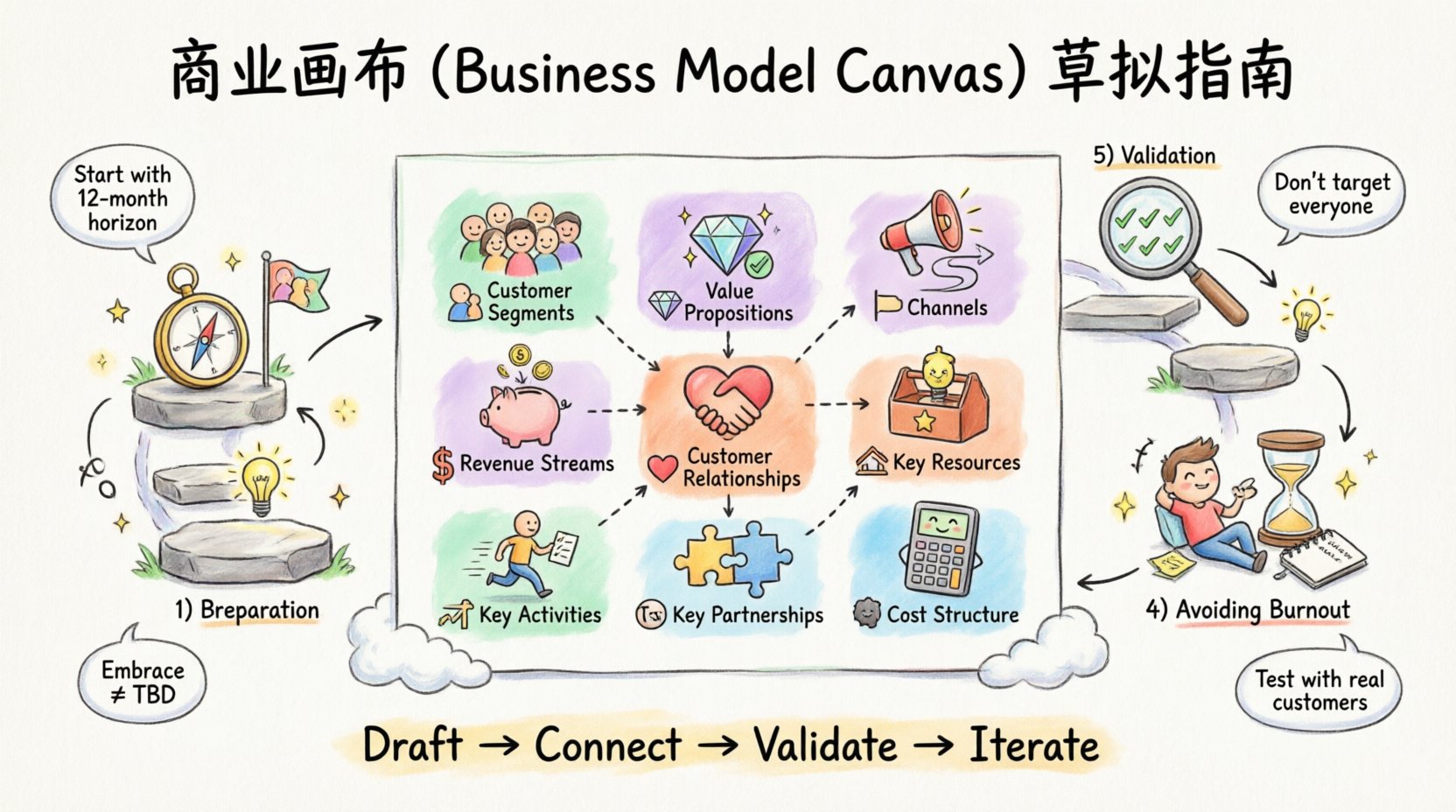
🛠️ Phase 1: Preparation and Scope
Before you draw a single line on a whiteboard or open a digital file, you must define the boundaries of your work. Spreading yourself thin often happens because the scope is too vague. You try to plan the entire five-year strategy instead of focusing on the current operational reality.
- Define the Timeframe: Are you planning for the next quarter? The next fiscal year? Start with a 12-month horizon.
- Identify Stakeholders: Who needs to be in the room? Include operations, sales, and product leads to avoid blind spots.
- Gather Existing Data: Do not start from zero. Collect current sales figures, customer feedback, and existing cost sheets.
- Set Time Limits: Allocate specific blocks of time for the workshop. A 90-minute session is often better than a half-day marathon.
This preparation phase ensures that when you begin the drafting process, you are working with facts rather than assumptions. It keeps the team focused and prevents the meeting from drifting into unrelated topics.
🧱 Phase 2: The Nine Building Blocks
The canvas consists of nine specific building blocks. These represent the logic of how an organization functions. Filling them out is not a linear process; you will jump back and forth as you discover connections. Below is a detailed breakdown of each block, including the core questions to ask and common pitfalls to avoid.
1. Customer Segments 👥
This block defines the different groups of people or organizations you aim to reach and serve. You cannot be everything to everyone. Identifying your specific audience is the first step to clarity.
- Key Questions: Who are your most important customers? Are you serving a mass market, a niche segment, or a specific industry?
- Types: Consider markets like B2B (business-to-business), B2C (business-to-consumer), or multi-sided platforms where two distinct groups interact.
- Pitfall: Avoid listing “everyone” as a segment. If you target everyone, you likely target no one effectively.
2. Value Propositions 💎
This is the heart of your business. It describes the bundle of products and services that create value for a specific customer segment. It answers the question: “Why should the customer choose you over the competition?”
- Key Questions: What problem are you solving for the customer? Are you offering novelty, performance, customization, or price reduction?
- Types: Value can be tangible (speed, design) or intangible (status, trust, risk reduction).
- Pitfall: Do not confuse features with value. “We have a 5MP camera” is a feature. “You can capture memories in low light” is a value.
3. Channels 📢
Channels describe how you communicate with and reach your customer segments to deliver your value proposition. This covers the customer journey from awareness to purchase to after-sales support.
- Key Questions: Which channels are integrated? Which ones work best for your specific audience? Are you using direct sales, email, or retail partners?
- Stages: Consider awareness (how they hear about you), evaluation (how they assess you), purchase (how they buy), delivery (how they get it), and after-sales.
- Pitfall: Do not assume the channel you currently use is the only one. Be open to digital and physical combinations.
4. Customer Relationships ❤️
This block describes the types of relationships you establish with specific customer segments. These relationships can drive acquisition, retention, or upselling.
- Key Questions: Is the relationship personal or automated? Is it dedicated personal assistance or self-service? Are you building a community?
- Types: Options range from personal assistance and dedicated account management to automated services and self-service portals.
- Pitfall: Do not promise a level of service you cannot sustain. A dedicated account manager is expensive; ensure the revenue model supports it.
5. Revenue Streams 💰
This represents the cash a company generates from each customer segment. It is the result of successfully delivering value propositions.
- Key Questions: What are customers willing to pay for? How do they currently pay? Are revenues recurring or one-time?
- Models: Consider asset sales, usage fees, subscription fees, licensing, brokerage fees, or advertising.
- Pitfall: Do not underestimate the cost of acquisition. A high revenue stream is useless if the cost to acquire the customer exceeds the lifetime value.
6. Key Resources 🏗️
These are the most important assets required to make the business model work. Without these, the value proposition cannot be delivered.
- Key Questions: What physical, intellectual, human, or financial resources do we need? Do we own them or do we need to access them?
- Types: Physical assets (buildings, vehicles), intellectual assets (brands, patents), human resources (specialized staff), and financial resources (cash, credit lines).
- Pitfall: Do not overestimate your current capabilities. If you need specialized engineering talent, ensure you have the budget to hire it.
7. Key Activities 🏃
These are the most important things a company must do to make its business model work. They are the actions required to deliver the value proposition.
- Key Questions: What activities are required to deliver our value? Are we manufacturing, problem-solving, or platform management?
- Types: Production (designing and making a product), Problem Solving (creating new solutions), and Platform/Network (managing the platform).
- Pitfall: Do not confuse activities with resources. An activity is what you do; a resource is what you use to do it.
8. Key Partnerships 🤝
The network of suppliers and partners that make the business model work. Companies form partnerships to optimize efficiency, reduce risk, or acquire resources.
- Key Questions: Who are our key suppliers? What key resources do we get from them? Are we looking for non-competitor partnerships?
- Types: Strategic alliances, coopetition (partnerships between competitors), joint ventures, and buyer-supplier relationships.
- Pitfall: Do not rely on a single partner. If a key partner fails, your business model may collapse. Diversify your supply chain.
9. Cost Structure 💸
This describes all costs incurred to operate a business model. It is the flip side of the revenue stream.
- Key Questions: What are the most important costs? Which key resources and activities are most expensive?
- Types: Costs can be fixed (salaries, rent) or variable (production costs, commissions). They can also be driven by economies of scale or scope.
- Pitfall: Do not ignore hidden costs. Logistics, maintenance, and customer support often eat into margins more than expected.
🔗 Phase 3: Connecting the Logic
Once the nine blocks are filled, the real work begins: connecting them. A canvas is not just a list of items; it is a story of how they interact. Visualizing these connections helps identify gaps and contradictions.
| Connection | Logic Check | Example |
|---|---|---|
| Value Prop → Revenue | Does the value justify the price? | A premium security service commands higher fees. |
| Resources → Activities | Do we have the tools to execute? | Software engineers are needed for coding activities. |
| Channels → Customer Segments | Can we reach them this way? | TikTok ads reach Gen Z; White papers reach B2B. |
| Partnerships → Resources | Does the partner fill a gap? | A logistics partner provides shipping without owning a fleet. |
When reviewing these connections, look for friction. If your Value Proposition promises “24/7 Support,” but your Cost Structure does not account for a night shift, you have a disconnect. These inconsistencies are valuable findings that allow you to adjust the model before investing heavily.
⚖️ Phase 4: Avoiding Overwhelm and Burnout
Even with a structured template, the cognitive load of strategic planning can be heavy. Here are specific tactics to keep the process manageable and sustainable.
1. Break It Down into Sprints
Do not try to complete the entire canvas in one sitting. Treat each block as a mini-project. Dedicate Monday to Customer Segments, Tuesday to Value Propositions, and so on. This pacing prevents fatigue and allows for subconscious processing between sessions.
2. Use Physical Tools
While digital tools exist, physical whiteboards or sticky notes often facilitate better movement and collaboration. Moving a sticky note from one block to another is a tactile way to visualize changes. It forces you to engage physically with the strategy rather than passively clicking a screen.
3. Embrace the Draft Phase
Your first version will not be perfect. It is a hypothesis, not a law. Give yourself permission to write “TBD” or “Maybe” in blocks where you lack data. This reduces the pressure to have immediate answers and encourages curiosity instead of anxiety.
4. Limit the Participants
Too many cooks spoil the broth. Keep the core workshop to 4 to 6 people who have decision-making power. Others can review the output later. Smaller groups move faster and stay more focused on the core mechanics of the model.
🧪 Phase 5: Validation and Iteration
Once the canvas is drafted, it must be tested against reality. A plan is only as good as its alignment with market conditions. This phase is about gathering evidence to support or refute your assumptions.
- Customer Interviews: Take your Value Proposition and Customer Segments to potential buyers. Ask if they would pay for the solution described. Do not pitch; listen.
- Cost Reality Checks: Get quotes for your Key Resources. If you assumed a remote team but need office space, update the Cost Structure immediately.
- Competitor Analysis: See how others fill these blocks. Are they using different channels? Are they charging differently? This helps calibrate your Revenue Streams.
- Iterate Frequently: The canvas is a living document. Update it quarterly or whenever a major market shift occurs. Do not let it become a static artifact.
📈 Maintaining Focus Over Time
The danger after drafting is complacency. Teams often feel they have “done the planning” and stop evaluating the model. To keep from spreading yourself thin, integrate the canvas into regular operational rhythms.
- Monthly Reviews: Spend 30 minutes at the start of each month reviewing the Canvas. Did the Revenue Streams match projections? Did Costs spike?
- Strategy Meetings: Use the visual layout as the agenda for strategy meetings. If a discussion goes off-topic, refer back to the relevant block.
- Onboarding: Use the canvas to onboard new employees. It provides a clear snapshot of the business logic without requiring a 100-page manual.
By treating the canvas as a reference point rather than a one-time assignment, you maintain strategic alignment without the burden of constant heavy lifting. It becomes a tool for navigation rather than a project to complete.
🔍 Common Pitfalls and How to Dodge Them
Even with the best intentions, errors occur during the drafting process. Being aware of common traps helps you navigate them smoothly.
Confusing Internal vs. External Views
A common mistake is describing what the company does (internal) rather than what the customer gets (external). For example, “We have a manufacturing plant” is internal. “We provide custom furniture quickly” is external. Focus on the customer experience in the Value and Revenue blocks.
Ignoring the Cost of Acquisition
It is easy to focus on revenue and ignore the friction required to get it. Ensure your Channels and Customer Relationships reflect the effort needed to acquire and retain clients. If the sales cycle is long, your Cash Flow needs to reflect that delay.
Over-Engineering the Model
Do not try to capture every single nuance of the business. If a detail does not impact the core logic or strategy, leave it out. Simplicity aids understanding. If a stakeholder cannot grasp the model in five minutes, it is too complex.
🏁 Final Thoughts on Strategic Clarity
Drafting a Business Model Canvas is an exercise in honest self-reflection. It requires you to admit what you know, what you assume, and what you need to find out. When done correctly, it removes the fog of uncertainty and provides a clear path forward.
The goal is not to produce a perfect document, but to create a shared understanding among your team. When everyone sees the same map, collaboration becomes easier, and decisions become faster. By pacing yourself and focusing on the core logic, you can build a resilient business model without sacrificing your well-being.
Start with the blocks, connect the lines, and validate the assumptions. The market will tell you if you are right. Until then, keep the canvas visible, the team aligned, and the workload manageable.