
Starting a new venture or refining an existing one often begins with a single question: How does this actually work? 🤔 The Business Model Canvas (BMC) provides a structured framework to answer that question. Instead of writing lengthy documents that gather dust, this visual chart describes the logic of how an organization creates, delivers, and captures value. It is a strategic management tool that allows teams to align their activities by illustrating potential trade-offs.
This guide breaks down the nine building blocks of the canvas. We will move from defining who you serve to understanding exactly how money flows into the business. There is no fluff here, just the mechanics of strategy.
What is the Business Model Canvas? 🧩
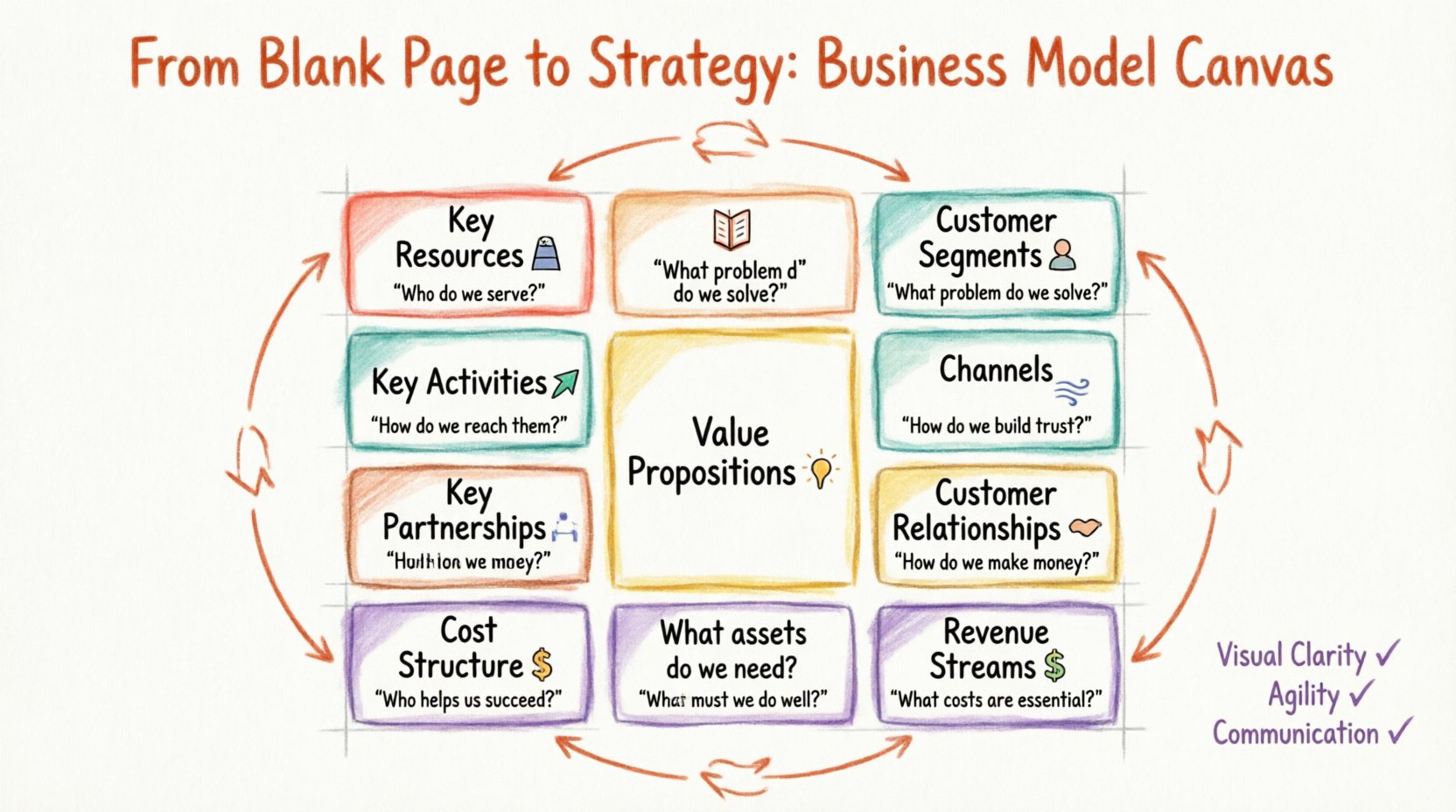
The Business Model Canvas is a one-page visual chart. It is designed to describe the rationale of a business. Created by Alexander Osterwalder, it divides the concept of a business model into four main areas: customers, offer, infrastructure, and financial viability. This structure forces clarity.
- Visual Clarity: It allows you to see the entire business on one screen.
- Agility: It is easy to update as you learn more about the market.
- Communication: It serves as a shared language for stakeholders.
Unlike a traditional business plan, which is often static, the BMC is dynamic. It is meant to be filled out, tested, and revised. This makes it ideal for startups and established companies undergoing transformation.
The 9 Building Blocks Explained 🏗️
Each block represents a core aspect of your business. To build a robust model, you must address every single one. Below is a breakdown of the components.
| Building Block | Focus Area |
|---|---|
| Customer Segments | Who are we serving? |
| Value Propositions | What problem are we solving? |
| Channels | How do we reach them? |
| Customer Relationships | How do we interact? |
| Revenue Streams | How do we make money? |
| Key Resources | What assets do we need? |
| Key Activities | What must we do daily? |
| Key Partnerships | Who helps us? |
| Cost Structure | What does it cost to run? |
Step 1: Define Customer Segments 👥
A business cannot exist without customers. This block identifies the different groups of people or organizations you intend to reach and serve. Every business model needs a clear definition of who its customers are.
- Mass Market: Focusing on a broad group without segmenting (e.g., consumer electronics).
- Niche Market: Focusing on a specific segment with unique needs.
- Segmented: Dividing customers into distinct groups based on different needs.
- Diversified: Serving two completely different customer groups.
- Multisided Platforms: Serving two or more interdependent customer groups.
When filling this out, ask specific questions. Who is your primary customer? Who is secondary? What are their demographics, behaviors, and pain points? If you try to serve everyone, you often end up serving no one effectively.
Step 2: Craft Value Propositions 💡
The value proposition is the reason why customers turn to your company over a competitor. It is a bundle of products and services that create value for a specific customer segment. It solves a customer problem or satisfies a need.
Consider the following types of value:
- Innovation: Creating entirely new products or services.
- Performance: The level of product performance.
- Customization: Tailoring services to individual client needs.
- Design: The aesthetic and functional appeal of the product.
- Brand/Status: The perception associated with the product.
- Price: Offering lower costs than competitors.
- Cost Reduction: Helping customers reduce their own costs.
- Risk Reduction: Mitigating risks for the customer.
- Accessibility: Making products available to those who previously could not access them.
- Convenience/Usability: Making the product easier to use.
Your value proposition must be distinct. It should not just be a feature list. It should explain the benefit. Why does this matter to the customer defined in the previous step?
Step 3: Choose Channels 📢
Channels are how a company communicates with and reaches its customer segments to deliver a value proposition. This includes both physical and digital touchpoints.
There are five stages of customer experience that channels must support:
- Awareness: How do customers discover the product?
- Evaluation: How do they decide if it meets their needs?
- Purchase: How do they buy the product?
- Delivery: How is the product physically or digitally delivered?
- After Sales: How is support handled?
Channels should be integrated. If a customer sees an ad online, they should be able to buy it online. If they visit a store, they should find the same pricing. The goal is to ensure a seamless customer journey from discovery to post-purchase support.
Step 4: Build Customer Relationships 🤝
Customer relationships represent the types of relationships a company establishes with specific customer segments. These relationships can range from personal to automated.
Consider the motivation behind the relationship:
- Acquisition: Convincing people to become customers.
- Retention: Keeping them as customers.
- Upselling: Increasing the value of their purchase.
Common relationship types include:
- Personal Assistance: Direct interaction with staff.
- Dedicated Personal Assistance: A dedicated account manager.
- Self-Service: No direct human interaction.
- Automated Services: Algorithms handling the interaction.
- Communities: Building a community around the product.
- Co-creation: Working with customers to build the product.
The relationship type must match the value proposition. If you sell high-end consulting, automated services will not suffice. If you sell a utility app, high-touch service is unnecessary.
Step 5: Define Revenue Streams 💰
Revenue streams represent the cash a company generates from each customer segment. It is the money that enters the business.
There are different types of revenue mechanisms:
- Asset Sale: Selling ownership of a product.
- Usage Fee: Charging for the use of a service.
- Subscription Fees: Recurring payments for continuous service.
- Lending/Renting/Leasing: Charging for temporary access.
- Licensing: Charging for intellectual property rights.
- Brokerage Fees: Charging for facilitating a transaction.
- Advertising: Charging for space or attention.
A business can have multiple revenue streams. For example, a media company might earn from subscriptions and advertising. You must identify which streams are most profitable and sustainable. Pricing strategy is also critical here. Are you a premium brand or a budget option?
Step 6: Identify Key Resources 🏢
Key resources are the most important assets required to make a business model work. These can be physical, intellectual, human, or financial.
- Physical: Buildings, vehicles, machines, or working facilities.
- Intellectual: Brands, patents, copyrights, customer databases, or proprietary knowledge.
- Human: The workforce, including specialized skills and expertise.
- Financial: Cash, lines of credit, or equity.
Depending on the business type, resources vary. A manufacturing business needs physical resources. A software company relies heavily on intellectual and human resources. Identify which resources are essential for the value proposition and customer relationships you defined earlier.
Step 7: Pinpoint Key Activities 🚀
Key activities are the most important things a company must do to make its business model work. These are the actions taken to deliver value.
Activities generally fall into three categories:
- Production: Designing, making, and delivering a product in significant numbers or quantities.
- Problem Solving: Creating new solutions to individual customer problems.
- Platform/Network: Maintaining and managing a platform or network.
For a manufacturing company, production is the key activity. For a consulting firm, problem-solving is central. For a social media platform, maintaining the network is the primary task. Without these activities, the value proposition cannot be delivered.
Step 8: Secure Key Partnerships 🤝
Key partners are the network of suppliers and partners that make the business model work. Companies form partnerships to optimize, reduce risk, or acquire resources.
Types of partnerships include:
- Strategic Alliances: Between non-competitors.
- Coopetition: Strategic partnerships between competitors.
- Joint Ventures: Partners to develop new businesses.
- Buyer-Supplier Relationships: To ensure reliable supplies.
Why partner? You might outsource non-core activities to focus on your strengths. You might need resources you do not possess. Or you might want to reduce risk. Partnerships can also unlock new customer segments.
Step 9: Structure Cost Structure 💸
The cost structure describes all costs incurred to operate a business model. It is the flip side of the revenue streams.
Cost structures can be categorized as:
- Cost Driven: Focusing on minimizing costs wherever possible (e.g., low-cost airlines).
- Value Driven: Focusing on creating value rather than cutting costs (e.g., luxury brands).
Key costs include fixed costs (salaries, rent) and variable costs (materials, shipping). Understanding your cost structure helps you determine profitability. If your costs are higher than your revenue streams, the model is not viable. You must identify which activities and resources are the most expensive.
The Iterative Process 🔄
Filling out the canvas is not a one-time task. It is a cycle of learning. Once you have drafted the initial model, you must test it in the real world.
This process involves:
- Hypothesis Testing: Assume each block is a hypothesis.
- Customer Interviews: Validate assumptions with real people.
- MVP Creation: Build a Minimum Viable Product to test the value proposition.
- Pivot or Persevere: If the data shows the model is wrong, change it. If it works, scale it.
Do not fall in love with your initial idea. Fall in love with the problem you are solving. The canvas allows you to change the solution without losing the structure of the business.
Common Mistakes to Avoid ⚠️
Even with a clear framework, teams often stumble. Here are common pitfalls to watch out for.
- Too Many Customer Segments: Trying to serve everyone dilutes the value proposition. Focus on one primary segment first.
- Vague Value Propositions: Avoid generic statements like “high quality.” Be specific about what “high quality” means to the customer.
- Ignoring Costs: It is easy to get excited about revenue and forget expenses. Ensure the math adds up.
- Static Planning: Treating the canvas as a final document rather than a living tool. Update it regularly.
- Lack of Alignment: If the team does not agree on the canvas, execution will fail. Ensure consensus across the organization.
Frequently Asked Questions ❓
Can I use the Business Model Canvas for a non-profit?
Yes. Non-profits use the canvas to define their social impact, funding sources, and target beneficiaries. The “Revenue Streams” block might be replaced with “Funding Sources,” including grants and donations.
How long does it take to fill out the canvas?
A first draft can take a few hours. A workshop with a team might take half a day. Refining it based on feedback can take weeks or months as you gather data.
Is the canvas only for startups?
No. Established companies use it to innovate new business lines, launch new products, or restructure existing operations. It is a tool for any organization seeking clarity.
What software should I use?
You do not need software. The power of the canvas lies in its simplicity. Many teams use whiteboards, sticky notes, and pens. Digital tools exist, but the analog process often sparks more creativity and discussion.
Final Thoughts on Strategic Planning 📌
The Business Model Canvas is a practical tool for organizing thought. It strips away the jargon of traditional strategy documents and focuses on the mechanics of value. By systematically addressing each of the nine blocks, you create a comprehensive view of your business.
Remember that strategy is not just about the plan. It is about execution. The canvas helps you align your team, but the work happens outside the document. Use this framework to guide your decisions, validate your assumptions, and navigate the complexities of the market. Keep it visible. Keep it updated. Let it drive your progress.