
In the dynamic landscape of entrepreneurship, the initial plan is rarely the final destination. Markets shift, customer preferences evolve, and competitors emerge unexpectedly. For founders and strategists, the ability to adapt is not just a soft skill; it is a survival mechanism. The Business Model Canvas (BMC) serves as the strategic blueprint for this journey, yet it often remains static on paper long after the market has moved on. When market feedback strikes, it signals a critical juncture known as a pivot. This process involves fundamentally rethinking how value is created, delivered, and captured without losing the core vision of the organization.
This guide explores the mechanics of pivoting using the Business Model Canvas. We will examine how to interpret feedback, identify which components of the canvas require adjustment, and execute a strategic shift that aligns with reality rather than assumption.
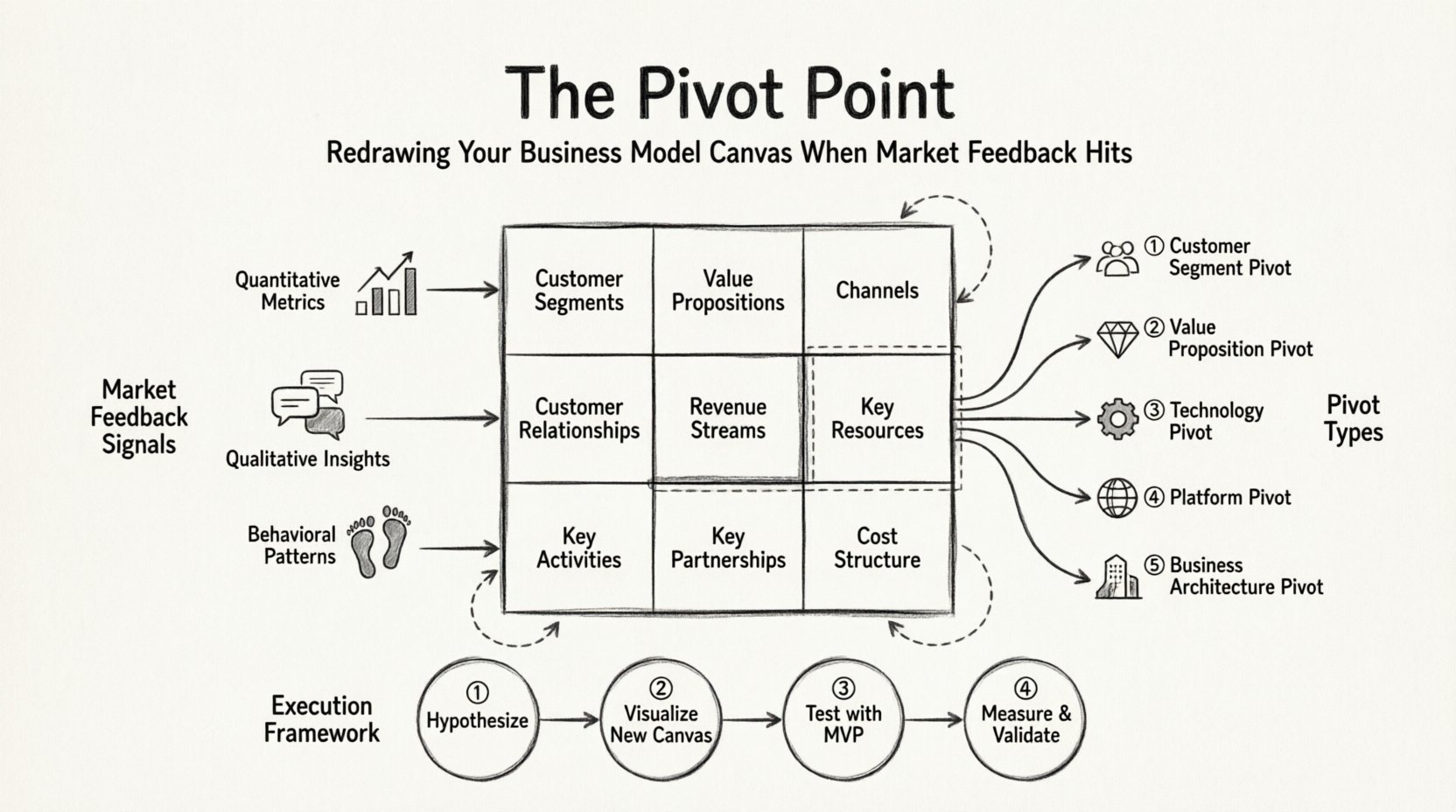
Recognizing the Signal: Decoding Market Feedback 📡
Feedback is often ambiguous. It can arrive as a direct complaint, a drop in sales, or a quiet churn rate. Ignoring these signals leads to a slow decline, while misinterpreting them can lead to unnecessary restructuring. To pivot effectively, one must distinguish between noise and actionable data.
- Quantitative Metrics: These are hard numbers that indicate performance. Look for declining retention rates, increasing customer acquisition costs, or stagnating monthly recurring revenue.
- Qualitative Insights: These come from direct conversations. Negative Net Promoter Scores (NPS), specific feature requests that are ignored, or comments about pricing sensitivity provide context to the numbers.
- Behavioral Patterns: How customers actually use the product often differs from how they say they use it. Low engagement on core features suggests a misalignment between the value proposition and user needs.
When these signals converge, they point to a specific block of the Business Model Canvas that has failed to resonate. The goal is not to discard the entire strategy, but to realign the specific building blocks that are causing friction.
Anatomy of a Pivot: Which Block Needs Redrawing? 🧱
The Business Model Canvas consists of nine building blocks. A pivot usually affects one or two of these blocks deeply, while others may remain stable. Understanding the specific impact on each block helps prevent scope creep during a strategic shift.
1. Customer Segments 👥
Feedback often reveals that the initial target audience is not the one willing to pay for the solution. A pivot here means shifting focus to a different demographic or market niche.
- Signs of Misalignment: High interest but zero conversion from the original segment.
- The Shift: Moving from a B2C model to B2B, or targeting early adopters instead of the mass market.
- Impact: Requires changes in channels, value propositions, and revenue streams to match the new segment’s purchasing behavior.
2. Value Proposition 💎
This is the heart of the canvas. If customers do not perceive the value, the model fails. Feedback indicating that a feature is “nice to have” rather than “must-have” suggests a value proposition pivot.
- Signs of Misalignment: Users love the product but refuse to pay, or they use it in a way not originally intended.
- The Shift: Changing from selling a tool to selling an outcome, or simplifying a complex solution into a single core function.
- Impact: Influences product development priorities and marketing messaging.
3. Channels 📢
Feedback might show that the product is great, but customers cannot find it or prefer a different method of interaction. This affects the reach and efficiency of the business.
- Signs of Misalignment: High traffic but low conversion, or customer complaints about access difficulty.
- The Shift: Moving from direct sales to a partner ecosystem, or shifting from online to offline presence.
- Impact: Alters the cost structure and customer relationship management approach.
4. Revenue Streams 💰
Sometimes the product works, but the monetization strategy is flawed. Customers may not be willing to pay upfront, or they prefer a subscription over a one-time purchase.
- Signs of Misalignment: High usage but low revenue per user.
- The Shift: Transitioning from a freemium model to a premium tier, or introducing usage-based pricing.
- Impact: Directly affects cash flow projections and unit economics.
Types of Strategic Pivots 🔄
Not all pivots are created equal. Some are minor adjustments, while others represent a complete change in direction. The table below outlines common pivot types and their implications for the Business Model Canvas.
| Pivot Type | Definition | Canvas Block Affected | Example Scenario |
|---|---|---|---|
| Customer Segment Pivot | Serving a different group of people with the same product. | Customer Segments | Software built for enterprises is found to be better suited for freelancers. |
| Value Proposition Pivot | Changing the core offering while keeping the customer base. | Value Proposition | A video platform pivots to offer live streaming capabilities for education. |
| Technology Pivot | Using a different technology to achieve the same goal. | Key Resources & Activities | Switching from native mobile app development to a web-based solution. |
| Platform Pivot | Transforming from a single product to an ecosystem. | Customer Relationships & Channels | A retail store launching a marketplace for third-party vendors. |
| Business Architecture Pivot | Changing the cost structure or revenue model. | Cost Structure & Revenue Streams | Moving from high fixed costs to a variable cost model via outsourcing. |
The Execution Framework: Steps to Redraw the Canvas 📝
Once the pivot is identified, the execution phase begins. This is where many organizations stumble by moving too fast or too slow. A structured approach ensures that changes are validated before full implementation.
Step 1: Hypothesize the Change
Before altering the canvas, write down the specific hypothesis. What assumption is being tested? For example, “We believe that charging a monthly subscription will increase revenue stability compared to one-time payments.” This clarity keeps the team focused.
Step 2: Visualize the New Canvas
Create a physical or digital representation of the new model. Use the same nine blocks to ensure nothing is overlooked. Map out how the change in one block ripples through the others. For instance, if the Revenue Stream changes, how does that impact the Cost Structure? If the Customer Segment changes, does the Channel need to change to reach them?
Step 3: Test with Minimal Viable Effort
Do not rebuild the entire business overnight. Create a minimum viable test. This could be a landing page for a new segment, a beta test for a new pricing model, or a pilot program for a new value proposition. The goal is to gather data quickly.
Step 4: Measure and Validate
Define success metrics before launching the test. Did retention improve? Did conversion rates rise? If the data supports the hypothesis, move to full implementation. If not, revisit the hypothesis.
Deep Dive: Adjusting Specific Blocks Based on Feedback 🛠️
Below is a detailed breakdown of how to approach changes in specific areas of the Business Model Canvas when feedback dictates a shift.
Adjusting the Value Proposition
The value proposition must solve a real problem. If feedback indicates customers are using your product for a different purpose than intended, do not force them back to your original use case. Instead, adjust the value proposition to support the emergent use case.
- Communication: Update marketing materials to reflect the new value.
- Product: Prioritize features that support the new use case.
- Support: Train support teams to understand the new context.
Adjusting Customer Relationships
Feedback often highlights friction in how customers interact with the company. If customers feel unsupported, the relationship block needs attention.
- Personal Assistance: Increase human touchpoints if automation is failing.
- Community: Build forums or groups if users crave peer interaction.
- Self-Service: Improve documentation if users want autonomy.
Adjusting Key Activities and Resources
These blocks define what you must do to deliver the model. If feedback shows that quality is suffering due to speed, resources must shift.
- Resource Reallocation: Move developers from new features to bug fixes if stability is the feedback.
- Partnerships: Outsource non-core activities if internal capacity is the bottleneck.
- Process Optimization: Streamline workflows to reduce time-to-market.
Risks and Mitigation Strategies ⚠️
Pivoting carries inherent risks. Changing direction too frequently can confuse stakeholders and dilute brand identity. Conversely, refusing to pivot when feedback is clear can lead to obsolescence.
Common Pitfalls
- The Sunk Cost Fallacy: Continuing to invest in a failing model because of past investment. Let go of what has been spent and focus on future value.
- Feature Creep: Adding too many changes to the value proposition at once. Keep the pivot focused on one core adjustment.
- Team Misalignment: If the team does not understand the new direction, execution will fail. Communication is key.
- Ignoring the Core: Pivoting should not mean abandoning the mission. Ensure the new model still serves the overarching vision.
Mitigation Tactics
- Set a Timeline: Decide how long a pivot will be tested before evaluating results.
- Involve Stakeholders: Include investors and key employees in the decision-making process to maintain trust.
- Document Everything: Keep a log of why changes were made. This creates a learning history for the organization.
Measuring Success Post-Pivot 📊
After the canvas is redrawn, the work is not done. Continuous monitoring is required to ensure the pivot delivered the intended results. Success metrics should be revisited to confirm alignment with the new strategy.
- Retention Rate: Are customers staying longer after the change?
- Customer Acquisition Cost (CAC): Did the pivot make it cheaper or easier to find customers?
- Lifetime Value (LTV): Is the new model generating more value per customer over time?
- Net Promoter Score (NPS): Are users more likely to recommend the revised offering?
It is crucial to distinguish between short-term volatility and long-term trends. A dip in performance immediately following a pivot is common as the market adjusts. However, if negative trends persist beyond the expected learning period, the pivot may need further refinement.
Final Thoughts on Strategic Agility 🚀
The Business Model Canvas is a tool for thinking, not just a document for filing. It is designed to be flexible. The most successful organizations are those that treat their business model as a hypothesis rather than a fact. When market feedback arrives, it is an opportunity to learn and improve, not a failure of the original plan.
By systematically analyzing which block of the canvas requires adjustment and executing changes with discipline, founders can navigate uncertainty with confidence. The goal is not perfection on the first try, but continuous adaptation. Redrawing the canvas is a skill that grows with practice. As you gather more feedback, your ability to interpret signals and adjust the model will become more intuitive.
Remember, the pivot is not the end of the story; it is a new chapter. Use the insights gained to build a resilient business structure that can withstand future market shifts. Stay curious, stay data-driven, and keep the customer at the center of every decision.
Summary of Key Actions 📌
- Monitor quantitative and qualitative feedback continuously.
- Identify which of the nine BMC blocks is misaligned.
- Select the appropriate pivot type for the situation.
- Validate changes with minimum viable tests before full rollout.
- Measure post-pivot performance against defined success metrics.
- Communicate changes clearly to the entire team and stakeholders.