
In the landscape of modern entrepreneurship, particularly within the technology sector, understanding the financial mechanics of a venture is as critical as the product itself. The Business Model Canvas (BMC) provides a structured framework for describing how an organization creates, delivers, and captures value. Among its nine building blocks, the Cost Structure is often the most complex to define accurately for high-margin tech products. This component dictates the most important costs incurred to operate a business model.
For technology companies aiming for high margins, the Cost Structure is not merely a list of expenses; it is a strategic lever. It determines the break-even point, influences pricing strategies, and defines the scalability of the operation. A clear understanding of where money flows is essential for sustainable growth. This guide explores the nuances of the Cost Structure block, focusing on the specific demands of digital products and software solutions.
Defining the Cost Structure Component 📊
The Cost Structure represents all costs incurred to operate a business model. In the context of the Business Model Canvas, it is the bottom half of the framework, sitting opposite the Revenue Streams. While Revenue Streams answer the question “What are customers willing to pay for?”, the Cost Structure answers “What does it cost to deliver that value?”
For high-margin tech products, this section is distinct from traditional manufacturing or service industries. Tech products often feature high upfront development costs followed by low marginal costs of replication. This unique economic profile requires a specific approach to categorization and management.
Key considerations when defining this block include:
- Cost Drivers: What factors cause costs to rise? Is it labor, infrastructure, or marketing?
- Value Orientation: Is the business driven by cost efficiency or value creation?
- Scale: How do costs behave as the user base expands?
Accurately mapping these elements ensures that the financial plan aligns with the operational reality of the technology being offered.
Fixed Costs vs. Variable Costs in Technology 📉
One of the primary tasks when analyzing the Cost Structure is distinguishing between fixed and variable costs. This distinction is vital for forecasting profitability as the business grows.
Fixed Costs
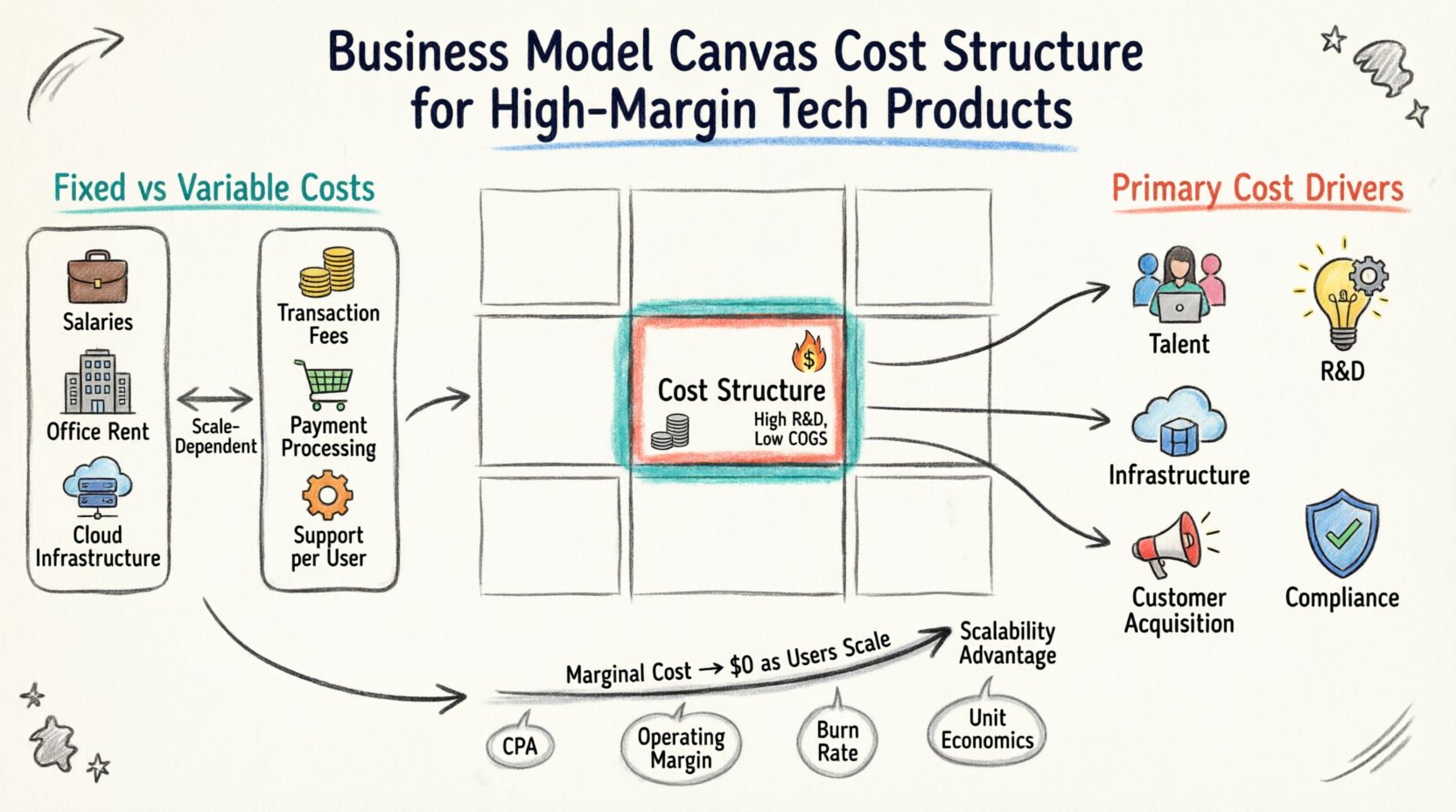
Fixed costs remain constant regardless of the number of units sold or users served. In the tech sector, these are often substantial during the early stages. They include salaries for core development teams, office rent, and initial software licensing fees. These costs must be covered before any profit is realized.
Variable Costs
Variable costs change in direct proportion to the volume of activity. For high-margin tech products, these are typically low. They might include server costs that scale with traffic, transaction fees for payment processing, or customer support hours tied to ticket volume.
| Cost Type | Description | Examples in Tech |
|---|---|---|
| Fixed Costs | Remain stable regardless of output volume | Salaries, R&D investment, office lease, core infrastructure |
| Variable Costs | Fluctuate based on usage or sales volume | Cloud hosting fees, transaction processing fees, support tickets, API usage charges |
| Semi-Variable | Has both fixed and variable components | Marketing budgets (base + performance), Maintenance contracts |
Understanding this split allows for better cash flow management. High-margin models rely on minimizing variable costs relative to revenue, ensuring that every additional user contributes significantly to the bottom line.
Primary Cost Drivers for Digital Ventures 🚀
Identifying the specific drivers of expenditure is the next step in decoding the Cost Structure. These drivers are the activities and resources that consume the majority of the budget.
- Talent Acquisition and Retention: Skilled engineers and product managers command high compensation. This is often the largest line item for tech startups. It includes salaries, benefits, and equity compensation.
- Research and Development (R&D): Continuous innovation requires investment. This covers prototyping, testing environments, and the time spent improving the product.
- Infrastructure and Hosting: Even if the product is digital, it requires a home. This includes data center costs, domain registrations, and security compliance measures.
- Customer Acquisition: Marketing and sales expenses are necessary to grow. While not part of product creation, they are essential costs to deliver value to the market.
- Legal and Compliance: Protecting intellectual property and adhering to regulations (such as data privacy laws) incurs legal fees and administrative overhead.
Each driver impacts the margin differently. For instance, heavy investment in R&D might increase fixed costs initially but can lead to lower variable costs later through automation or better efficiency.
The R&D Investment Factor 🧠
Research and Development is a cornerstone of the Cost Structure for technology companies. Unlike physical goods where tooling costs are one-time, software requires constant iteration.
High-margin products often invest heavily in R&D to create barriers to entry. This involves:
- Building proprietary algorithms or technology stacks.
- Conducting user research to refine the user experience.
- Ensuring security standards are met against evolving threats.
Accounting for R&D requires a strategic view. It is an investment in future value rather than a current expense. However, it increases the fixed cost base significantly. Companies must ensure their revenue streams are strong enough to absorb these upfront costs during the growth phase.
Optimizing R&D costs involves focusing on high-impact features and utilizing open-source tools where appropriate to reduce licensing fees. It also involves measuring the return on investment for every development cycle.
Infrastructure and Operational Expenses ⚙️
The physical and digital infrastructure required to run a tech product is a significant cost component. This includes the servers, databases, and networks that keep the application online.
Cloud vs. On-Premise
Most modern tech products utilize cloud infrastructure. This shifts the cost model from capital expenditure (buying hardware) to operational expenditure (paying for usage).
- Scalability: Cloud costs can scale up or down based on demand, which helps manage risk.
- Reliability: Paying for redundancy and uptime ensures the product remains available to customers.
- Security: Compliance certifications from infrastructure providers reduce the burden of securing data.
Operational expenses also cover day-to-day maintenance. This includes monitoring tools, backup systems, and technical support staff. Neglecting these costs can lead to system failures, which damage reputation and increase customer churn.
Customer Acquisition and Sales Costs 📢
While often categorized separately in some models, customer acquisition costs are a vital part of the overall cost structure for sustaining the business. In high-margin models, the goal is to keep these costs low relative to the Lifetime Value (LTV) of a customer.
Key elements include:
- Digital Marketing: Spending on search engines, social media, and content marketing.
- Sales Team: Salaries and commissions for personnel responsible for closing deals.
- Lead Generation Tools: Software used to capture and nurture potential client information.
- Partnerships: Costs associated with channel partners or affiliates.
For high-margin products, the focus should be on organic growth and product-led growth strategies where the product itself drives acquisition. This reduces the dependency on paid advertising and lowers the variable cost of acquiring each new user.
Achieving High Margins Through Scalability 📈
The defining characteristic of a high-margin tech product is its ability to scale without a proportional increase in costs. This is where the Cost Structure provides a competitive advantage.
When a product is replicated, the marginal cost approaches zero. A software license sold to one user costs the same to produce as one sold to a million users. This economy of scale allows for:
- Lower pricing: Competitive pricing while maintaining profitability.
- Higher reinvestment: Profits can be funneled back into R&D or marketing.
- Resilience: The business can withstand market fluctuations better than those with high variable costs.
To maintain this structure, the Cost Structure must be monitored closely. As the company grows, new cost drivers emerge. For example, customer support volume increases with user base. Managing this growth without inflating fixed costs is the key to sustaining high margins.
Outsourcing vs. In-House Development 🤝
A strategic decision in the Cost Structure is whether to build capabilities in-house or outsource them. This choice affects both fixed and variable costs.
In-House Development:
- Pros: Higher control over quality, IP security, and culture. Alignment with long-term goals.
- Cons: High fixed costs, recruitment overhead, and benefits management.
Outsourcing:
- Pros: Variable cost model, access to specialized skills without long-term commitment.
- Cons: Less control, potential communication barriers, and IP risks.
For high-margin products, a hybrid approach is often best. Core intellectual property and architecture should remain in-house to protect the value proposition. Non-core functions, such as specific testing phases or customer support, may be outsourced to keep fixed costs manageable during early stages.
Regulatory and Compliance Costs 🛡️
Technology operates within a legal framework. Compliance is not optional and represents a necessary cost of doing business. Ignoring this can lead to fines that devastate the cost structure.
Relevant areas include:
- Data Privacy: Regulations like GDPR or CCPA require specific security measures and legal oversight.
- Intellectual Property: Patent filings and trademark registrations protect the product.
- Industry Standards: Specific sectors (like healthcare or finance) have additional compliance requirements.
These costs are often fixed but can spike during audits or legal challenges. Building compliance into the product design phase is more cost-effective than retrofitting it later.
Monitoring Cost Efficiency Over Time 🔄
The Cost Structure is not static. It requires regular review and adjustment. As the market changes, costs may shift.
Key metrics for monitoring include:
- Cost Per Acquisition (CPA): How much is spent to gain a new customer?
- Operating Margin: The difference between revenue and operating expenses.
- Burn Rate: The rate at which the company spends its cash reserve.
- Unit Economics: Profitability per individual unit or customer.
Regular financial audits help identify inefficiencies. If variable costs rise faster than revenue, the high-margin model is at risk. Adjustments might involve renegotiating vendor contracts, automating processes, or reducing headcount in non-essential areas.
Aligning Costs with Value Proposition 🎯
The final piece of the puzzle is ensuring that the Cost Structure supports the Value Proposition. If the product promises premium quality, the costs associated with quality assurance and support must reflect that.
However, unnecessary costs should be eliminated. If a feature does not add value to the customer, the cost to build and maintain it is waste. This alignment ensures that every dollar spent contributes to the core mission of the business.
By maintaining a disciplined approach to the Cost Structure, technology companies can secure their financial health. This stability allows for strategic decision-making and long-term planning without the pressure of immediate financial survival. The goal is a lean, efficient operation that maximizes the return on every investment made.