
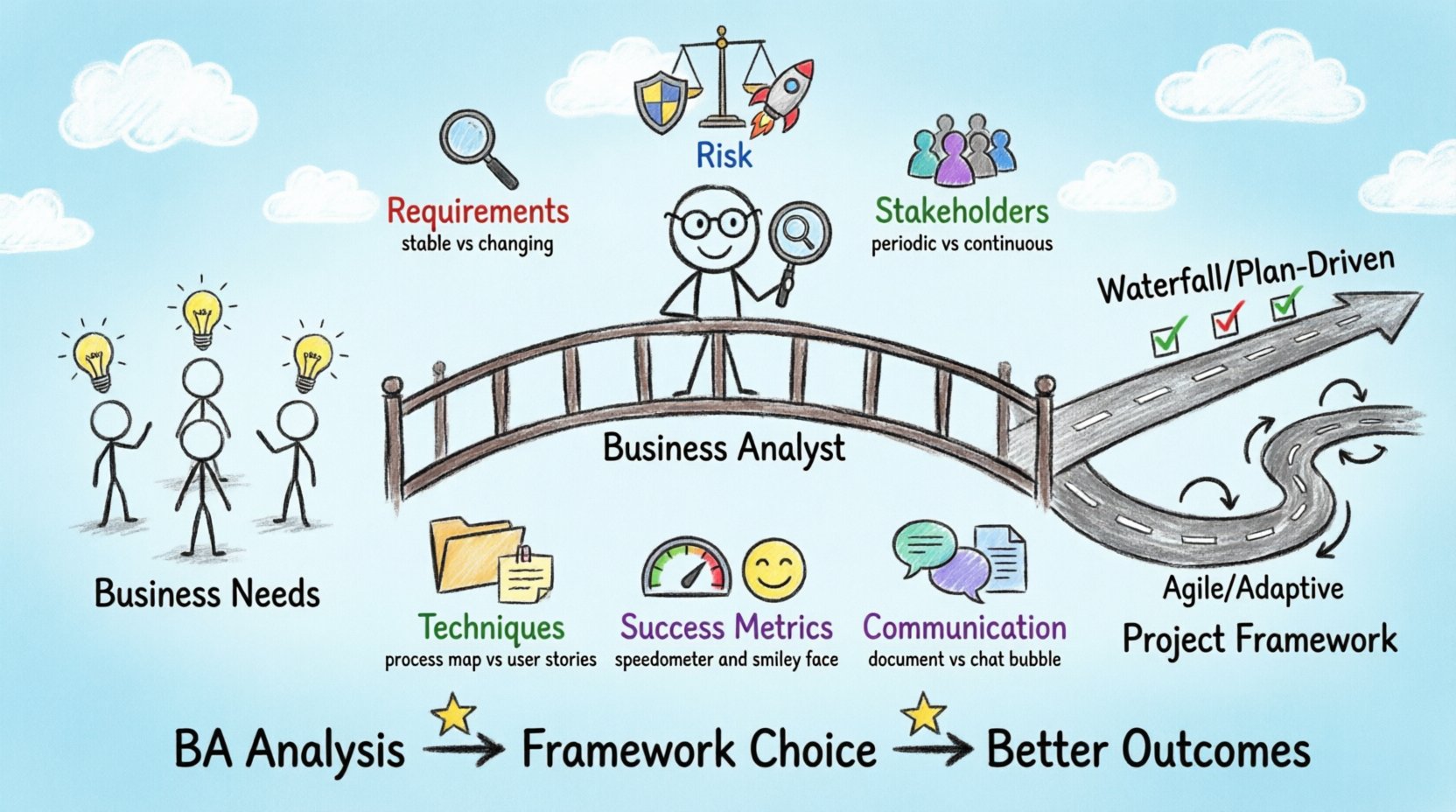
In the complex ecosystem of project management, the selection of a delivery framework is rarely a decision made in isolation. While leadership often sets the strategic direction, the technical and operational realities are defined by the Business Analyst. These professionals act as the critical link between stakeholder needs and the mechanics of execution. Their analysis of requirements, risks, and stakeholder dynamics directly dictates whether a project adopts a linear path or an iterative cycle.
A Business Analyst does not merely document what is needed; they interpret the environment in which the solution must live. This interpretation shapes the structure of the work. Whether a team moves toward a rigid, phase-gated approach or a flexible, adaptive model depends heavily on the clarity, stability, and complexity of the requirements presented by the analyst.
🔍 The Strategic Role of the Business Analyst
The influence of the Business Analyst extends beyond gathering requirements. It involves a deep diagnostic of the project environment. When a project begins, ambiguity is the norm. The BA’s first task is to reduce this ambiguity. This process determines the predictability of the project.
- Requirement Stability: If requirements are fixed and unlikely to change, a structured framework is often preferred.
- Stakeholder Availability: Continuous engagement is required for adaptive frameworks, while periodic reviews suit linear models.
- Regulatory Constraints: High compliance needs often demand documented trails and formal sign-offs.
By assessing these factors, the Business Analyst provides the data necessary for the Project Manager to select the appropriate methodology. This is not a suggestion; it is a foundational analysis that guides the project architecture.
📋 Analyzing Project Requirements and Volatility
One of the primary drivers for framework selection is the nature of the requirements themselves. Business Analysts utilize specific techniques to categorize and understand the volatility of these needs. The outcome of this categorization often signals which framework will yield the best results.
1. High Clarity and Low Change
When a BA determines that the scope is well-defined, the deliverables are clear, and the technology stack is mature, the project environment favors predictability. In this scenario:
- The scope is frozen early in the lifecycle.
- Changes are treated as exceptions rather than standard events.
- Testing occurs primarily after development is complete.
This environment aligns with traditional, plan-driven frameworks. The BA documents detailed specifications that serve as the contract between the business and the development team. Deviations from this plan require formal change control processes.
2. High Volatility and Uncertainty
Conversely, when the BA identifies that the business problem is evolving or the market context is shifting, a rigid structure becomes a liability. In these instances, the analyst advocates for:
- Shorter delivery cycles to validate assumptions quickly.
- Early and frequent stakeholder feedback loops.
- Incremental value delivery rather than a single final release.
Here, the framework must accommodate change. The BA shifts from documenting the entire solution upfront to maintaining a dynamic backlog. This flexibility allows the project to pivot without breaking the project governance.
🤝 Stakeholder Dynamics and Engagement Models
The human element of a project is often the deciding factor in framework choice. Business Analysts map stakeholder relationships, power structures, and communication preferences. This mapping reveals the level of engagement required for success.
Different frameworks demand different levels of stakeholder participation. A project requiring daily input from subject matter experts cannot function effectively with a methodology that only reviews progress monthly.
| Framework Type | Stakeholder Engagement | BA Responsibility |
|---|---|---|
| Plan-Driven | Periodic reviews and sign-offs | Comprehensive documentation prior to build |
| Adaptive | Continuous collaboration and prioritization | Facilitation and backlog refinement |
| Hybrid | Mixed: Phase gates plus sprint reviews | Transition management between phases |
When the BA identifies that key stakeholders are remote or have limited availability, they may influence the choice toward a model that allows for asynchronous work and detailed documentation. If stakeholders are co-located and eager to participate, a collaborative model is more feasible.
⚖️ Risk Assessment and Mitigation
Risk is the invisible force that shapes project structure. Business Analysts are trained to identify risks early in the requirements gathering phase. These risks often dictate the need for safeguards within the framework.
Consider a project involving financial data or patient records. The regulatory risk is high. The BA will identify the need for audit trails, version control, and strict validation steps. A framework that allows for rapid, unchecked changes poses a threat to compliance.
In high-risk environments, the BA pushes for a framework that includes:
- Formal Quality Gates: Mandatory checkpoints before moving to the next phase.
- Detailed Traceability: Linking every requirement to a test case and a design element.
- Controlled Changes: A rigorous process for approving scope modifications.
Conversely, in low-risk innovation projects, the BA may recommend a framework that encourages experimentation. The goal here is speed of learning. The cost of failure is low, so the framework should support rapid iteration and quick pivots based on user feedback.
🛠️ Techniques That Dictate Structure
The specific tools and techniques a Business Analyst employs can also sway the framework choice. The artifacts produced during the analysis phase often become the backbone of the project workflow.
Process Modeling
If the BA produces detailed process maps (such as BPMN diagrams), the project often leans towards a structured approach. These maps define the exact sequence of steps, implying a need for a sequential development plan. Teams follow the map to ensure the process is built correctly.
User Stories and Epics
If the BA focuses on user stories, value streams, and acceptance criteria, the project is primed for an iterative framework. These artifacts are designed to be small, testable, and prioritized. They naturally fit into cycles of work that last a few weeks rather than months.
Functional vs. Non-Functional Requirements
A heavy emphasis on non-functional requirements (performance, security, scalability) often necessitates a framework that includes dedicated time for these concerns. If the BA identifies that performance is critical, the team cannot simply code and hope for the best. They need a framework that allocates resources for load testing and optimization throughout the lifecycle.
🔄 Collaboration and Communication Patterns
The framework determines how information flows through the organization. Business Analysts analyze the communication needs of the team and the business. They assess whether the team prefers written documentation or face-to-face conversation.
In organizations where documentation is the primary source of truth, the BA will advocate for a framework that prioritizes documentation. This ensures that knowledge is retained even if team members change.
In contrast, in fast-moving technical environments, the BA might push for a framework that minimizes documentation in favor of working software. Here, the analyst acts as a bridge, translating technical constraints into business value without getting bogged down in excessive paperwork.
📈 Measuring Success and Continuous Improvement
The choice of framework is not static. It is subject to review based on performance metrics. Business Analysts track how well the chosen framework supports the delivery of value. They monitor:
- Delivery Speed: Is the team moving too slowly?
- Quality Output: Are defects slipping into production?
- Stakeholder Satisfaction: Are the users getting what they need?
If the metrics indicate misalignment, the BA provides the evidence needed to adjust the framework. This might mean shifting from a long release cycle to shorter sprints, or adding more formal reviews to a chaotic process.
The Business Analyst ensures that the methodology serves the project, not the other way around. When a framework no longer fits the project reality, the analyst identifies the friction points and recommends adjustments. This continuous feedback loop keeps the project on track.
🔗 Bridging the Gap Between Strategy and Execution
Ultimately, the Business Analyst is the guardian of alignment. They ensure that the project framework supports the strategic goals of the organization. If the strategy is innovation, the framework must allow for risk. If the strategy is stability, the framework must enforce control.
By deeply understanding the requirements, the stakeholders, and the risks, the Business Analyst provides the clarity needed to choose the right path. Their influence is not about control, but about enabling the team to work in the most effective way possible.
Project managers, developers, and stakeholders rely on this analysis to make informed decisions. Without the input of the Business Analyst, framework choices are often guesses based on preference rather than evidence. With their involvement, the choice becomes a strategic decision grounded in the reality of the business environment.
As projects become more complex, the role of the Business Analyst in shaping these choices becomes even more critical. They bring the discipline of analysis to the chaos of execution, ensuring that the framework chosen is the best fit for the task at hand.