
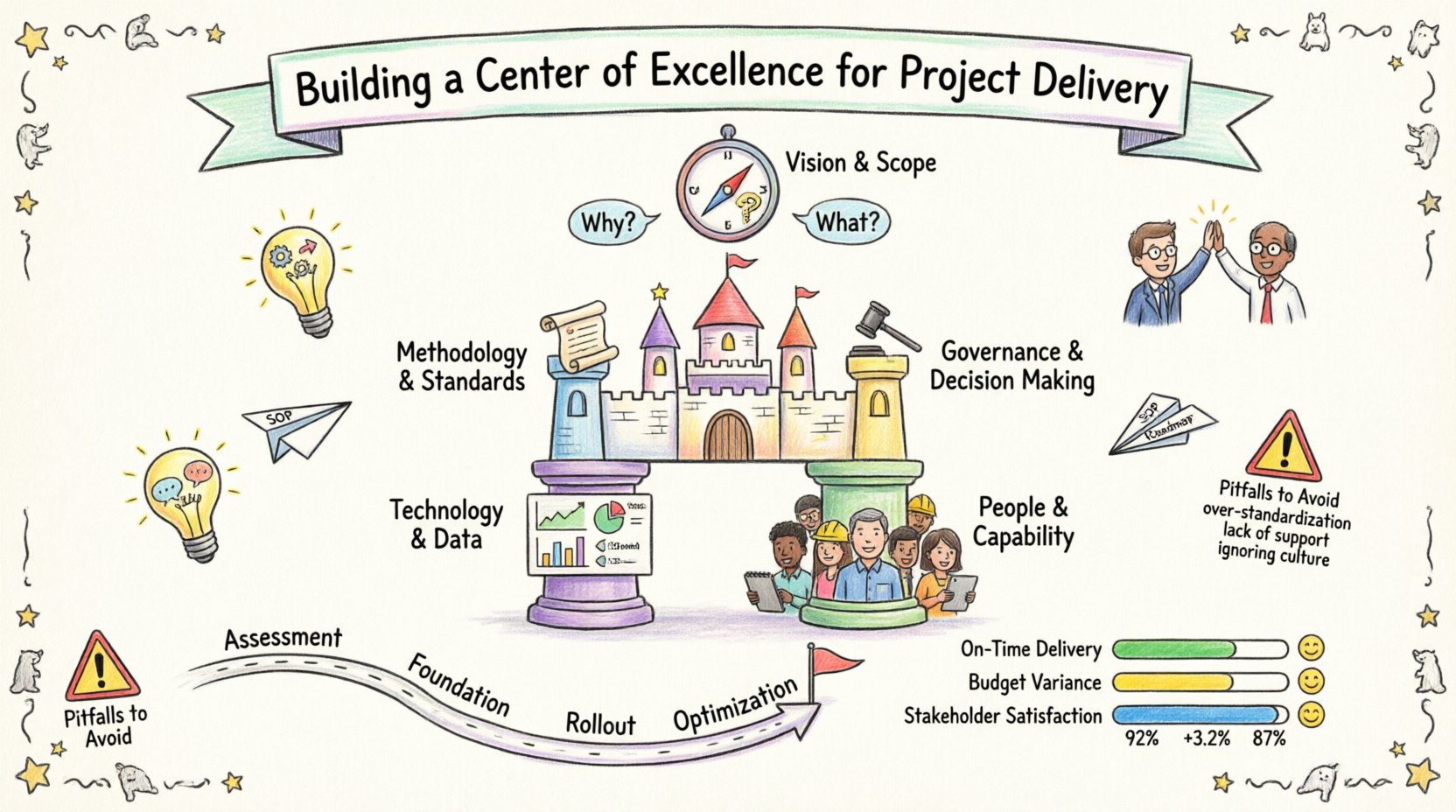
In the modern business landscape, project delivery often faces fragmentation. Teams operate in silos, methodologies vary by department, and success metrics remain inconsistent. To combat this, organizations establish a Center of Excellence for Project Delivery. This entity serves as a hub for standardization, knowledge sharing, and strategic alignment. It is not merely an administrative office; it is a driver of value and operational maturity.
Creating a CoE requires careful planning, resource allocation, and a clear understanding of organizational goals. It demands a shift from reactive management to proactive governance. This guide outlines the strategic framework necessary to build a robust project management ecosystem.
Defining the Vision and Scope 🧭
Before implementing any changes, the leadership team must articulate the purpose of the CoE. A vague mission leads to scope creep and confusion. The vision should answer three critical questions:
- Why does this exist? Is it to reduce costs, improve quality, or accelerate time-to-market?
- Who does it serve? Does it support internal teams, external clients, or both?
- What is the boundary? Does it cover only IT projects, or does it span all business units?
A clear scope prevents the CoE from becoming an unnecessary bureaucracy. It ensures that the team focuses on high-impact activities rather than administrative overhead. Stakeholders must agree on these boundaries early to maintain buy-in.
Core Pillars of Project Delivery 🏛️
A successful Center of Excellence rests on four foundational pillars. Each pillar supports the others, creating a stable structure for project execution.
1. Methodology and Standards
Consistency is key. Organizations should define a set of project management standards that align with industry best practices. This includes:
- Lifecycle Models: Define whether projects follow Waterfall, Agile, or Hybrid approaches.
- Documentation Requirements: Specify which artifacts are mandatory (e.g., charters, status reports, risk registers).
- Templates: Provide standardized tools for planning and reporting.
Standardization reduces cognitive load for project managers. They do not need to reinvent the wheel for every initiative. Instead, they focus on execution and delivery.
2. Governance and Decision Making
Governance structures ensure that projects remain aligned with strategic objectives. This involves establishing decision-making bodies, such as a Project Management Office (PMO) steering committee. Key elements include:
- Stage-Gate Reviews: Formal checkpoints where project continuation is evaluated based on performance and value.
- Risk Escalation Paths: Clear protocols for when issues exceed the project manager’s authority.
- Resource Allocation: Mechanisms to prioritize projects when capacity is limited.
Effective governance does not mean micromanagement. It means providing the right guardrails to keep teams moving in the correct direction.
3. People and Capability
Tools and processes are useless without skilled personnel. The CoE must focus on talent development and role definition. This includes:
- Role Clarity: Define responsibilities for Project Managers, Scrum Masters, and Product Owners.
- Training Programs: Offer certifications and workshops to upskill the workforce.
- Community of Practice: Create forums for practitioners to share lessons learned and solve problems collaboratively.
4. Technology and Data
While specific tools should not dictate strategy, a data-driven approach is essential. The CoE needs a centralized repository for project data. This enables:
- Visibility: Real-time dashboards showing portfolio health.
- Reporting: Automated generation of metrics for leadership.
- Analytics: Historical data analysis to predict future performance.
Establishing Governance Frameworks 📜
Implementing governance requires a structured approach. It is not enough to write a policy document and distribute it. The framework must be integrated into the daily workflow.
Key Governance Components
- Charter Approval: No project begins without signed authorization defining scope and budget.
- Portfolio Management: A view of all active initiatives to ensure resource balance.
- Compliance Checks: Regular audits to ensure adherence to internal policies and external regulations.
The Role of the Steering Committee
The steering committee acts as the brain of the operation. They review strategic alignment and approve major changes. To function effectively, the committee should meet regularly and have clear authority. Their decisions must be communicated transparently to the broader organization.
Talent Development and Culture 👥
A CoE is only as strong as its people. Culture often determines whether a methodology is adopted or ignored. Leaders must foster an environment where continuous improvement is valued.
Building a Community
Create spaces for knowledge exchange. This can be done through:
- Monthly brown-bag sessions for case studies.
- Online forums for peer-to-peer support.
- Mentorship programs pairing senior leaders with emerging talent.
Retention and Motivation
High-performing project managers are valuable assets. To retain them, the organization must offer:
- Clear career progression paths.
- Recognition for successful deliveries.
- Autonomy to choose appropriate methods for specific contexts.
When people feel supported and valued, they invest more effort into their work. This leads to better outcomes for the organization.
Implementation Roadmap 🗺️
Building a Center of Excellence is a journey, not a destination. A phased approach allows for adjustments based on feedback and results.
Phase 1: Assessment and Planning
- Audit current project practices.
- Identify pain points and gaps.
- Define the initial scope and budget.
Phase 2: Foundation Building
- Develop core methodologies and templates.
- Appoint key leadership roles.
- Launch initial training initiatives.
Phase 3: Rollout and Integration
- Introduce governance processes to active projects.
- Deploy necessary tools and reporting mechanisms.
- Gather feedback from users.
Phase 4: Optimization
- Analyze performance data.
- Refine processes based on metrics.
- Expand scope to new business units.
Measuring Success and KPIs 📊
Without measurement, improvement is impossible. The CoE must track specific Key Performance Indicators (KPIs) to demonstrate value. The following table outlines essential metrics.
| Category | Key Metric | Definition |
|---|---|---|
| Efficiency | On-Time Delivery Rate | Percentage of projects completed by the agreed deadline. |
| Quality | Defect Rate | Number of issues reported post-delivery relative to scope. |
| Financial | Budget Variance | Difference between planned budget and actual spend. |
| Resource | Resource Utilization | Percentage of available team capacity used for billable or strategic work. |
| Strategic | Strategic Alignment Score | Assessment of how well projects support organizational goals. |
| Customer | Stakeholder Satisfaction | Survey results from clients and internal stakeholders regarding delivery. |
Tracking these metrics allows the CoE to pivot strategies quickly. If the On-Time Delivery Rate drops, the team can investigate bottlenecks in the workflow. If Budget Variance increases, cost controls may need strengthening.
Common Pitfalls to Avoid ⚠️
Even well-intentioned initiatives can fail if common traps are not avoided. Leaders should remain vigilant against the following issues.
- Over-Standardization: Applying the same rules to every project regardless of size or complexity. Agile projects require flexibility that rigid frameworks may stifle.
- Lack of Executive Support: Without sponsorship from senior leadership, the CoE will struggle to enforce standards across departments.
- Ignoring Culture: Implementing new tools without addressing the underlying resistance to change.
- Poor Communication: Failing to explain the “why” behind new processes leads to confusion and non-compliance.
- Measuring the Wrong Things: Focusing on activity (hours logged) rather than outcomes (value delivered).
Sustaining Momentum 🚀
Maintaining the CoE requires ongoing effort. It is not a one-time setup. Continuous feedback loops ensure the organization evolves. Regular reviews of the governance model help keep it relevant. As the business changes, the delivery framework must adapt.
Investing in a Center of Excellence is an investment in organizational maturity. It transforms project management from a tactical function into a strategic asset. By focusing on standards, people, and data, leaders can build a delivery engine that drives consistent results.
The path forward involves patience and persistence. Success comes from incremental improvements and a commitment to excellence. With the right foundation, the organization can navigate complexity and deliver value reliably.