


Enhancing Accessibility in AI-Powered Visual Modeling
In the rapidly evolving landscape of software engineering and enterprise architecture, clear communication is paramount. Visual Paradigm has announced a significant update to its AI-Powered visual modeling software, the Visual Paradigm AI Chatbot. Released in late December 2025, this update introduces robust multi-language support, transforming how global teams interact with UML tools and AI diagram generators.

This enhancement is available for users of the Desktop Professional edition and VP Online Deluxe edition. By addressing localization, Visual Paradigm aims to reduce the friction often caused by language barriers, allowing users to create, refine, and analyze diagrams in their native tongues. This guide explores the depth of these new features, covering user interface (UI) localization and conversational AI capabilities.
Key Update: Localized User Interface (UI)
For many international professionals, navigating complex software interfaces in a second language can hinder productivity. The latest update directly addresses this by enabling a localized experience within the AI Chatbot environment.
How to Switch Languages
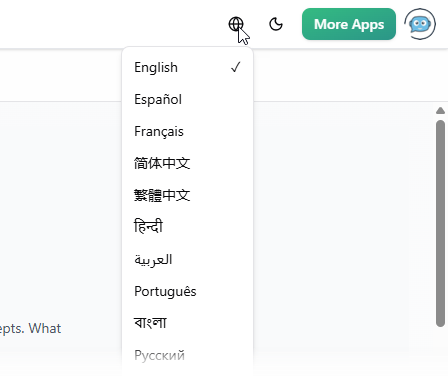
By default, the Visual Paradigm AI Chatbot launches in English. However, users now have the flexibility to toggle the interface to a wide variety of supported languages. To access this feature:
- Locate the Earth icon on the top navigation bar of the application.
- Click the icon to reveal a drop-down menu of available languages.
- Select your preferred language to instantly update the UI elements.
Supported Languages
The update covers a broad spectrum of global languages to ensure the software feels native to users worldwide. Supported options include, but are not limited to:
- Español (Spanish)
- Français (French)
- Simplified and Traditional Chinese
- Português (Portuguese)
- Japanese
- Deutsch (German)
- Polski (Polish)
Intelligent Multi-Language Conversations
The most impactful aspect of this update lies in the AI’s enhanced conversational abilities. The AI assistant has been refined to detect the language of the user’s input prompt automatically and align its response strategy accordingly. This creates a seamless workflow where the user does not need to mentally translate technical requirements into English before interacting with the tool.

Context-Aware Diagram Generation
When a user inputs a prompt in a specific language, the AI Chatbot does not merely respond with text in that language; it generates the diagram content in that language as well. This reduces the “inertia” often felt when AI tools default to English responses for non-English queries.
For example, if a user requests a SysML requirements diagram in Japanese, the AI will:
- Acknowledge the request in Japanese.
- Generate the diagram with Japanese labels and descriptions within the nodes.
- Provide any accompanying textual explanation or reports in Japanese.
Practical Walkthrough: Use Case Diagram in Spanish
To illustrate the power of these enhancements, consider a scenario where a user needs to model a library management system using Spanish.
1. The Initial Prompt
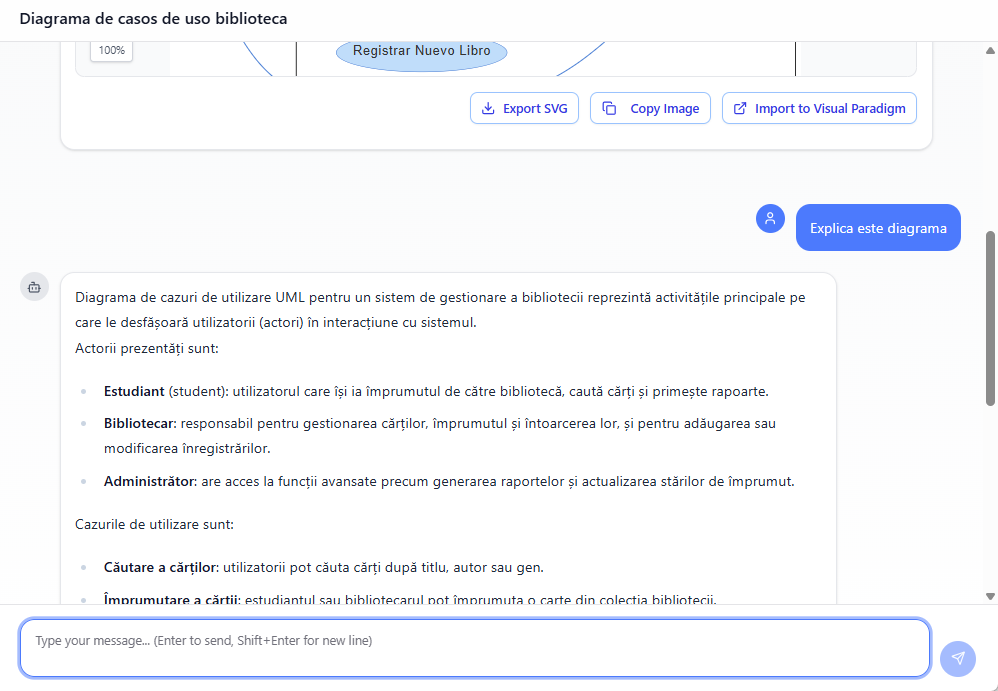
The user enters the command: “Dibuja un diagrama de casos de uso UML para un sistema de gestión de biblioteca.” (Draw a UML use case diagram for a library management system.)
The Result: The AI generates a fully formed Use Case Diagram. Crucially, the actors (e.g., “Bibliotecario”, “Usuario”) and the use cases (e.g., “Prestar libro”, “Devolver libro”) are labeled in Spanish, maintaining the linguistic context of the project.
2. Refinement and Explanation
Visual modeling is rarely a one-step process. The user can follow up with questions to deepen their understanding or refine the model. Continuing in Spanish, the user asks: “Explica este diagrama” (Explain this diagram).
The Response: The AI provides a detailed textual breakdown of the diagram’s logic, flows, and relationships, entirely in Spanish. This capability allows for diagram touch-ups, report generation, and in-depth analysis without language hurdles.
Supported Diagram Types and Strategic Tools
The multi-language support extends across the full breadth of Visual Paradigm’s diagramming capabilities. Professionals can leverage these language features for various standard and strategic models:
Technical Modeling
- UML Diagrams: Class, Sequence, Activity, Use Case, State Machine, and more.
- SysML: Essential for systems engineering requirements and structure.
- C4 Models: For visualizing software architecture at different levels of abstraction.
- ArchiMate: For enterprise architecture viewpoints.
Business and Strategy
- Strategic Analysis: SWOT, PEST, and value chain analyses.
- Brainstorming: Mind maps and various brainstorming charts.
- General Charts: Flowcharts, organizational charts, and data visualizations.
Workflow Integration and Global Collaboration
The implications of this update extend beyond individual productivity; they significantly enhance team collaboration. Diagrams generated in a specific language can be imported directly into the Visual Paradigm software for further professional editing. This allows teams to:
- Generate Reports: Create documentation in the stakeholder’s native language.
- Translate Content: Use the AI to assist in translating diagram elements for multi-regional deployment.
- Share Sessions: Share analysis sessions via URL, allowing team members to view the logic and conversation history.
By removing language barriers, Visual Paradigm enables educators, business analysts, and system architects to focus on the logic and structure of their models rather than linguistic translation.
Conclusion
The introduction of multi-language support in the Visual Paradigm AI Chatbot marks a pivotal step toward truly global visual modeling. By offering both UI localization and intelligent language detection for diagram generation, the tool empowers users to work naturally and efficiently. Whether drafting a complex UML sequence in French or analyzing a SWOT matrix in Chinese, users can now leverage the full power of AI diagram generation without compromise.