

Now Reading: Beyond a Thousand Words: Why UML is More Expressive Than Your Favorite Programming Language
-
01
Beyond a Thousand Words: Why UML is More Expressive Than Your Favorite Programming Language



Beyond a Thousand Words: Why UML is More Expressive Than Your Favorite Programming Language

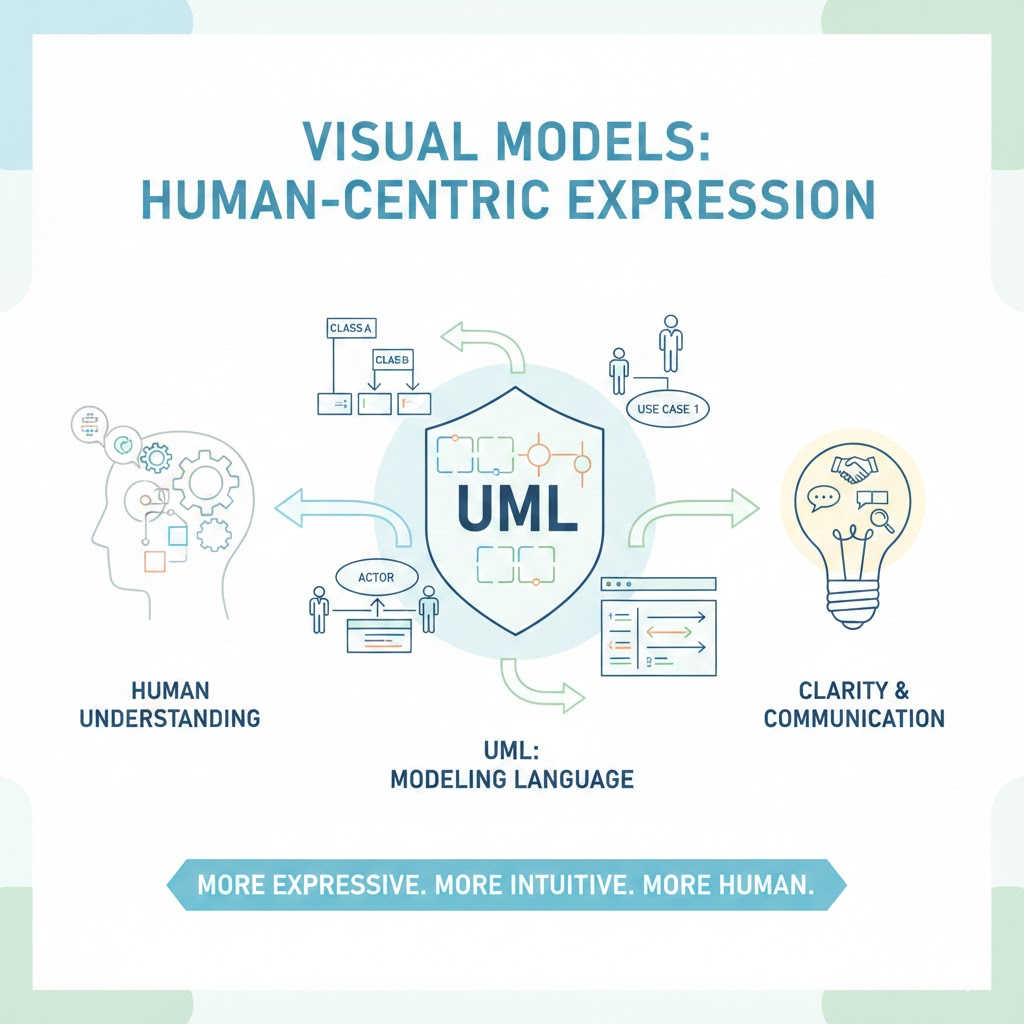
UML – More expressive. More Intuitive, More Human.
In the world of software development, code is king. We write, debug, refactor, and deploy—often in languages like C++, Java, or C#, which offer powerful capabilities and performance. Yet, despite their precision and expressiveness in execution, these languages often fall short when it comes to communication. When it comes to conveying the intent, structure, and behavior of a system at a high level, visual models—particularly those built with UML (Unified Modeling Language)—are not just more expressive, they are fundamentally more human-centric.
The Limitation of Code: Precision Without Clarity
Consider a complex class hierarchy in Java:
public class PaymentProcessor extends AbstractService {
    private final List<PaymentStrategy> strategies;
    private final Logger logger;
    private final Configuration config;

    public PaymentProcessor(Configuration config) {
        this.config = config;
        this.strategies = new ArrayList<>();
        this.logger = LoggerFactory.getLogger(this.getClass());
        initializeStrategies();
    }

    private void initializeStrategies() {
        if (config.isEnableCreditCard()) {
            strategies.add(new CreditCardStrategy());
        }
        if (config.isEnablePayPal()) {
            strategies.add(new PayPalStrategy());
        }
        // ... more conditions
    }

    public boolean processPayment(PaymentRequest request) {
        for (PaymentStrategy strategy : strategies) {
            if (strategy.canHandle(request)) {
                return strategy.handle(request);
            }
        }
        return false;
    }
}
This code is technically correct and functional. But to a new developer, it’s a maze of logic, dependencies, and conditional branching. Understanding why this class exists, how it fits into the broader system, and what it’s trying to achieve requires significant cognitive effort.
Now, imagine a UML class diagram showing:
-
PaymentProcessorwith its associations toPaymentStrategy,Configuration, andLogger -
Inheritance from
AbstractService -
A clear
processPayment()operation with a return type -
The
PaymentStrategyinterface and its concrete implementations
Suddenly, the structure becomes immediately comprehensible. The relationships, responsibilities, and behavior are laid out visually—no parsing required.
Why UML Outshines Code in Expressiveness
-
Higher-Level Abstraction: UML abstracts away implementation details (e.g.,
ArrayList,LoggerFactory) and focuses on what the system does, not how it does it. -
Shared Understanding: UML diagrams are language-agnostic. A developer in Python, Java, or C# can all interpret the same class diagram. This is invaluable in cross-functional or multi-language teams.
-
Visual Cognition: The human brain processes visual information up to 60,000 times faster than text. Diagrams engage spatial and pattern-recognition skills, making complex systems easier to grasp.
-
System-Level Insight: While code is best for detailing behavior, UML excels at showing architecture, interactions, and lifecycle. A sequence diagram, for example, reveals the flow of messages between objects in a way that lines of code cannot.
-
Documentation That Evolves: Unlike comments that become outdated, UML diagrams can be linked directly to code (via reverse engineering), ensuring documentation stays in sync.
Enter Visual Paradigm: The All-in-One UML Platform
While UML has long been a standard, its adoption has historically been hindered by fragmented tools, steep learning curves, and lack of integration with modern development workflows. That’s where Visual Paradigm steps in—not just as a UML tool, but as a unified platform for software design, documentation, and AI-powered development acceleration.
Why Visual Paradigm Stands Out
Visual Paradigm isn’t just a diagramming tool. It’s an all-in-one platform that seamlessly integrates:
-
UML modeling (class, sequence, state, component, deployment, activity, use case)
-
Code generation and reverse engineering
-
Agile and DevOps workflow support
-
Model-Driven Development (MDD)
-
AI-powered assistance
Let’s explore how this integration—especially AI—transforms the way we design and build software.
🤖 AI-Powered UML: From Idea to Diagram in Seconds
One of Visual Paradigm’s most transformative features is its AI-assisted modeling engine.
1. Natural Language to UML Diagrams
Want to describe a payment system in plain English? Simply type:
“Create a class diagram for a payment system with a PaymentProcessor, PaymentStrategy interface, and two implementations: CreditCardStrategy and PayPalStrategy.”
Visual Paradigm’s AI instantly generates a clean, accurate class diagram—complete with relationships, attributes, and methods—based on your description. This is not just a gimmick; it’s a paradigm shift in how we communicate software design.
✅ Benefit: Reduces time from hours to minutes to sketch out system architecture.
2. AI-Powered Code Generation
Once the diagram is created, Visual Paradigm can generate fully functional code in Java, C#, Python, or even TypeScript with a single click. The AI ensures the generated code:
-
Matches the class structure and relationships
-
Includes proper encapsulation and method logic
-
Adheres to best practices and naming conventions
✅ Benefit: Accelerates prototyping and reduces boilerplate.
3. Smart Suggestions and Refactoring
As you edit a diagram, AI analyzes the model and suggests:
-
Missing associations or constraints
-
Redundant or ambiguous relationships
-
Potential design flaws (e.g., high coupling, low cohesion)
It even suggests design pattern implementations—like recommending a “Strategy Pattern” when multiple behaviors are detected.
✅ Benefit: Proactively improves design quality and reduces technical debt.
4. AI-Driven Documentation & Requirements Traceability
Visual Paradigm can generate:
-
Natural language documentation from diagrams
-
Requirements traceability matrices (RTMs) automatically linking use cases to system components
-
API documentation (OpenAPI/Swagger) from component and sequence diagrams
This is especially powerful in regulated industries (finance, healthcare) where documentation is not optional.
✅ Benefit: Ensures compliance, reduces audit risk, and streamlines communication.
The Bigger Picture: UML as a Bridge Between Humans and Machines
While code is essential for execution, UML is essential for understanding. Visual Paradigm closes the gap between:
-
Human intuition (via diagrams)
-
Machine precision (via code)
-
AI intelligence (via smart automation)
By embedding AI directly into the modeling workflow, Visual Paradigm turns UML from a static documentation tool into a dynamic, intelligent design engine—one that learns from your input, anticipates your needs, and evolves with your project.
Conclusion: The Future of Software Design is Visual, Intelligent, and Unified
We’ve long believed that code is the ultimate language of software. But as systems grow more complex, the real challenge isn’t writing code—it’s understanding, communicating, and collaborating around it.
UML, when powered by AI and embedded in a unified platform like Visual Paradigm, becomes far more than a diagramming tool. It becomes:
-
A design canvas for architects
-
A communication bridge between developers, product owners, and stakeholders
-
A productivity engine powered by artificial intelligence
In a world where software complexity is rising faster than developer bandwidth, the most expressive language isn’t C++ or Python—it’s a well-crafted UML diagram, enhanced by AI, and built on a platform that understands both human intent and machine execution.
So the next time you’re drowning in nested classes and conditional logic, ask yourself:
Could a diagram—enhanced by AI—have saved me hours of confusion?
The answer, more often than not, is yes.
Ready to experience the future of software design?
Try Visual Paradigm today—where UML meets AI, and complexity becomes clarity.
👉 https://www.visual-paradigm.com
Because the best code isn’t just written—it’s visualized, understood, and imagined first.
-
AI-Powered UML Class Diagram Generator by Visual Paradigm: This advanced AI-assisted tool automatically generates UML class diagrams from natural language descriptions, significantly streamlining software design and modeling.
-
AI-Powered Sequence Diagram Refinement Tool: Discover how this feature enhances software design by automatically improving and optimizing sequence diagrams with intelligent suggestions.
-
AI Textual Analysis – Transform Text into UML Models Automatically: This resource explains how to use AI to analyze text documents and automatically generate UML diagrams for faster modeling and documentation.
-
Generate Activity Diagrams from Use Cases Instantly: Learn how the AI engine enables rapid and accurate conversion of use case descriptions into professional activity diagrams with minimal effort.
-
How AI Chatbot Can Help You Learn UML Faster: This article details how users can practice UML interactively, visualize concepts instantly, and receive immediate feedback to improve their modeling skills.
-
AI-Powered MVC System Architecture Generator: A specialized tool that leverages AI to automatically generate clean, scalable MVC (Model-View-Controller) system architectures through automated modeling.
-
Major Upgrade to AI UML Component Diagram Generation: An official update detailing enhancements that make the AI assistant an indispensable tool for generating modular software structures.
-
Definitive Guide to UML State Machine Diagrams with AI: A detailed technical guide on using AI-enhanced tools to model dynamic object behavior and complex state-driven logic.
-
AI Use Case Description Generator by Visual Paradigm: An AI-powered tool that automatically generates detailed use case descriptions from user inputs, accelerating system analysis and documentation.
-
Real-Life Case Study: Generating UML Class Diagrams with AI: A detailed case study demonstrating how an AI assistant successfully transformed textual requirements into accurate UML class diagrams for a real-world project.


