
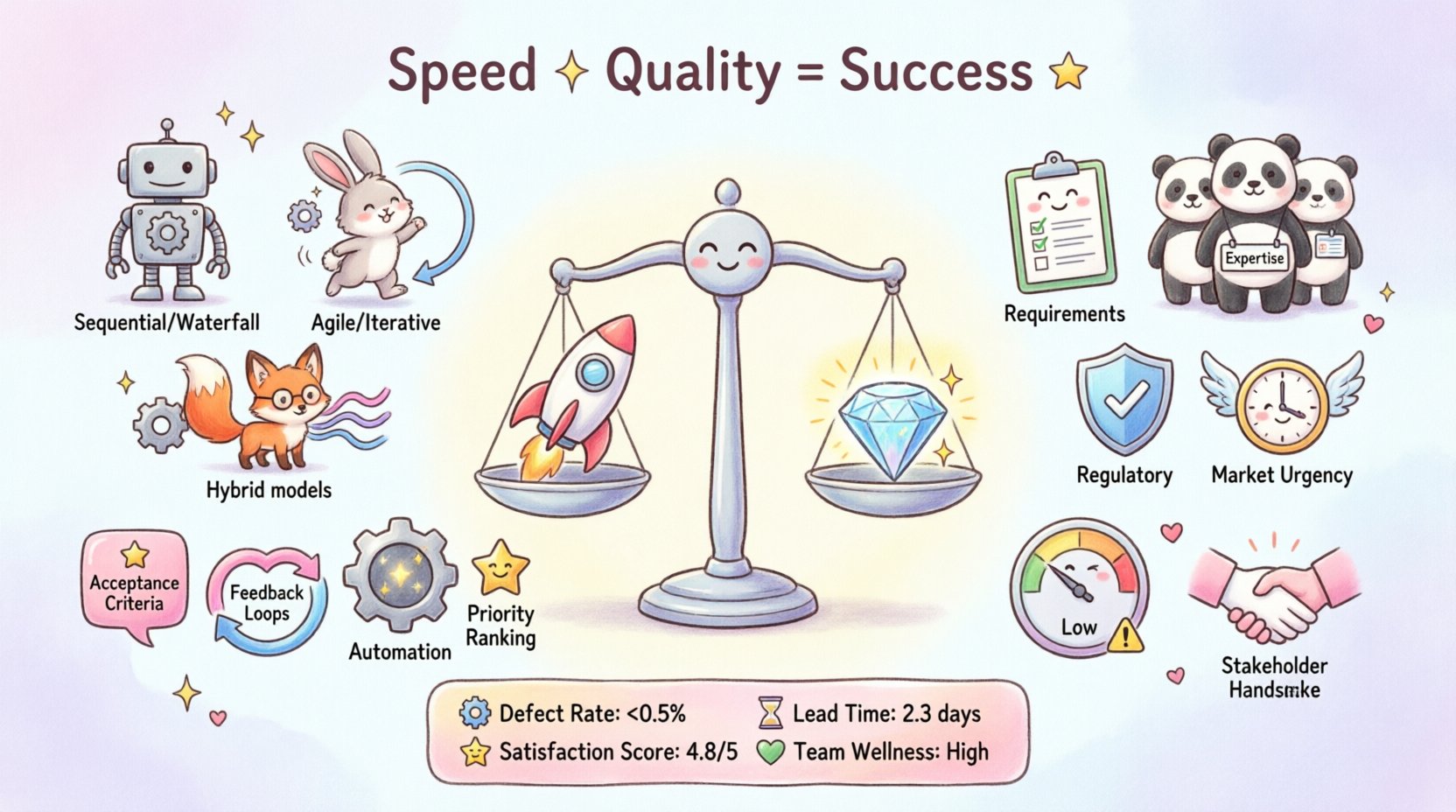
Every project manager faces a fundamental dilemma. On one side lies the demand for rapid delivery, driven by market pressure and competitive urgency. On the other sits the necessity for high-quality outcomes, ensuring stability, user satisfaction, and long-term viability. This tension is not merely a logistical challenge; it is a strategic imperative that defines the success of a project. Choosing the right framework for work is often the first decision that determines whether an organization can achieve both velocity and excellence simultaneously.
Understanding the Core Tension ⚖️
In the landscape of project management, speed and quality are frequently perceived as opposing forces. This perception often stems from a misunderstanding of how processes function. When a team rushes to meet a deadline without proper planning, defects increase, and technical debt accumulates. Conversely, when a team prioritizes perfection without regard for timelines, the product may become obsolete before release. The goal is not to choose one over the other but to find a sustainable equilibrium.
True efficiency comes from understanding that quality is not a final inspection step. It is embedded within the workflow. When processes are designed to catch errors early, speed actually increases because rework is minimized. Therefore, the selection of a methodology must account for how it handles feedback loops and error correction.
Common Methodologies and Their Impact 🛠️
Selecting a framework requires a clear understanding of the inherent trade-offs associated with each approach. Different organizations operate under different constraints, making a one-size-fits-all strategy ineffective.
- Sequential Approaches: These models rely on a linear progression of phases. Planning is exhaustive, design is finalized before execution begins, and testing occurs at the end. This offers high predictability and clear milestones but often struggles with flexibility. Changes late in the process are costly and time-consuming.
- Iterative Approaches: These models break work into smaller cycles. Each cycle produces a functional increment. Feedback is gathered immediately after each cycle. This allows for rapid adaptation to change but can make long-term cost estimation difficult.
- Hybrid Models: Many organizations blend these methods. They may use sequential planning for high-level architecture but iterative execution for feature development. This aims to secure the strategic vision while maintaining operational flexibility.
Factors Influencing Selection 🧭
To balance speed and quality effectively, leaders must evaluate specific variables before committing to a path. These factors dictate how much risk a project can absorb and how much uncertainty exists in the requirements.
- Requirement Stability: If requirements are fixed and well-understood, a structured approach often yields better quality control. If requirements are evolving, a flexible framework allows for course correction without derailing the project.
- Team Expertise: The maturity of the team plays a crucial role. Highly skilled teams can self-organize and maintain quality standards in less structured environments. Less experienced teams may require more guidance and defined processes to ensure consistency.
- Regulatory Constraints: Industries such as healthcare or finance often have strict compliance needs. These environments may necessitate more documentation and traceability, which can slow down initial delivery but ensures legal safety.
- Market Urgency: If time-to-market is the primary competitive advantage, speed becomes the dominant factor. In these cases, releasing a minimum viable product and iterating is often superior to waiting for a perfect solution.
Comparative Analysis of Frameworks 📊
The following table outlines how different methodologies typically perform regarding speed of delivery and quality assurance mechanisms.
| Methodology | Speed of Delivery | Quality Assurance | Flexibility to Change |
|---|---|---|---|
| Sequential (Waterfall) | Low to Medium | High (End-focused) | Low |
| Iterative (Agile) | High (Incremental) | High (Continuous) | High |
| Hybrid | Medium to High | Medium to High | Medium |
| Lean | High | Medium (Focus on Value) | High |
Strategies for Optimizing the Balance 🛡️
Once a methodology is selected, specific tactics must be employed to ensure the balance is maintained throughout the lifecycle. These practices prevent the drift toward either reckless speed or paralyzing perfectionism.
1. Define Clear Acceptance Criteria
Before any work begins, the definition of what constitutes a completed task must be established. This prevents the ambiguity that leads to scope creep and rework. When everyone agrees on the criteria, the team can move faster because there are fewer debates about whether work is done.
2. Implement Continuous Feedback Loops
Speed without feedback is dangerous. Regular reviews allow the team to identify quality issues early. Catching a defect during the design phase is exponentially cheaper and faster than fixing it after deployment. Short feedback cycles keep the product aligned with user needs.
3. Automate Routine Checks
Manual testing and verification consume significant time. By automating standard checks, teams can reduce the time spent on repetitive tasks. This frees up human resources to focus on complex problem-solving and creative aspects of the work. Automation ensures consistency without sacrificing velocity.
4. Prioritize Ruthlessly
Not all features hold equal value. Prioritization frameworks help teams focus on high-impact items first. This ensures that if time runs short, the core functionality remains intact. Quality is preserved for the most critical paths, while lower-priority items can be deferred.
Managing Technical Debt and Risk 📉
Accelerating delivery often introduces technical debt. This is the cost of choosing an easy, quick solution now instead of a better approach that would take longer. While some debt is acceptable to gain speed, it must be managed actively.
- Track Debt Explicitly: Do not hide technical debt. It should be listed alongside feature requests. This ensures stakeholders understand the trade-off between speed and long-term stability.
- Schedule Refactoring: Dedicate specific time blocks for improving code and architecture. This prevents the debt from becoming unmanageable over time.
- Monitor Stability Metrics: Track incident rates and bug frequencies. If these metrics spike, it is a signal that speed is compromising quality. The process should be adjusted immediately.
Aligning Stakeholder Expectations 🤝
One of the biggest sources of friction is the misalignment between what leadership expects and what the team can realistically deliver. Leaders often demand speed without understanding the implications for quality. Transparent communication is essential here.
Project managers must present data-driven insights. Instead of saying a deadline is risky, show the historical data on similar tasks. Explain the specific trade-offs involved. When stakeholders understand the connection between process choices and outcomes, they are more likely to support a balanced approach.
Measuring Success Beyond the Deadline 📏
Traditional success metrics often focus solely on delivery dates and budget adherence. However, these metrics do not capture the quality of the experience or the sustainability of the product. A project can be on time but fail because the product is unusable.
Consider adding the following metrics to your dashboard:
- Defect Escape Rate: How many issues are found by users after release?
- Lead Time: How long does it take to move a task from start to finish?
- Customer Satisfaction Score: Does the end-user feel the product meets their needs?
- Team Burnout Rate: Is the pace sustainable for the staff?
These indicators provide a holistic view of performance. They highlight when speed is becoming detrimental to the human element of the project or the stability of the output.
Adapting to Change and Uncertainty 🔄
No methodology is static. The environment changes, and the plan must evolve with it. A rigid adherence to a chosen framework can be just as harmful as a lack of structure. Leaders must be willing to pivot if the current approach is not yielding the desired balance.
This might mean shifting from a sequential plan to iterative sprints if requirements become unclear. It could mean slowing down to stabilize the product if quality metrics drop. The ability to adapt is the ultimate safeguard against failure. It ensures that the project remains viable regardless of external pressures.
Building a Culture of Quality and Efficiency 🏗️
Finally, tools and processes are only as effective as the culture that supports them. A culture that punishes mistakes encourages hiding them. A culture that rewards speed over quality encourages cutting corners. To balance both, the organization must value integrity.
Encourage open discussions about challenges. When a team member identifies a risk to quality, it should be seen as a contribution, not a delay. This psychological safety allows issues to be raised early, preserving both time and standards. Training should focus on not just technical skills but also on decision-making and risk assessment.
Ultimately, the choice of methodology is a reflection of organizational values. If speed is valued above all, the framework will reflect that. If quality is paramount, the process will prioritize verification. The most successful projects find a way to honor both, recognizing that they are not mutually exclusive but interdependent.