
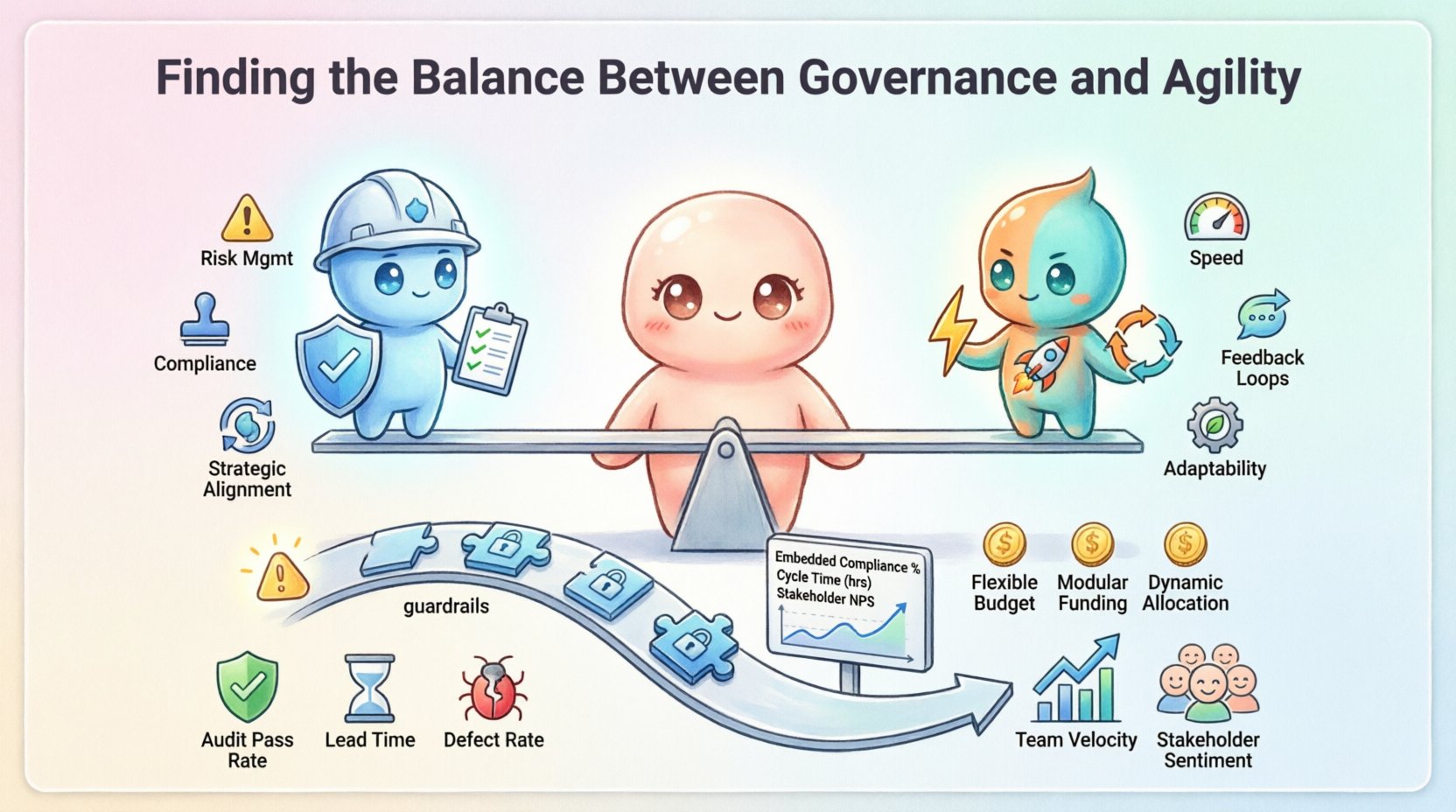
In the landscape of modern project management, two forces often pull in opposite directions. On one side, there is the need for control, oversight, and compliance. On the other, there is the demand for speed, adaptability, and rapid delivery. This tension is not a bug in the system; it is a fundamental characteristic of complex work. Finding the balance between governance and agility is not about choosing one over the other. It is about integrating them so they support each other.
When teams feel stifled by rules, innovation stalls. When teams move too fast without guardrails, risk accumulates silently until it becomes a crisis. The goal is a state of controlled flexibility. This article explores how to structure your projects to allow for both rigorous oversight and nimble execution.
Understanding the Core Dynamics ⚖️
Before diving into solutions, it is necessary to define what we mean by these terms in a practical context. Neither side is inherently good or bad. They serve different purposes.
- Governance: This refers to the framework of rules, processes, and decisions. It ensures that the project aligns with organizational strategy, meets regulatory requirements, and manages risk effectively. It answers the question: Are we doing the right thing?
- Agility: This refers to the ability to respond quickly to change. It emphasizes iterative delivery, customer feedback, and adaptive planning. It answers the question: Are we doing things right?
When these two concepts are treated as enemies, the result is friction. Governance teams demand documentation before coding begins. Agile teams demand the freedom to change direction based on user feedback. The solution lies in reframing governance not as a gatekeeper, but as a support structure.
Why Governance Matters Even in Agile 🛡️
There is a misconception that agile means no rules. This is dangerous. Without governance, a project can drift away from business objectives or violate critical safety and compliance standards. Governance provides the boundaries within which agility can safely operate.
Key reasons to maintain strong governance include:
- Risk Management: Identifying potential financial, legal, or reputational risks early prevents costly failures later.
- Resource Allocation: Ensuring that budget and personnel are used efficiently across the organization.
- Strategic Alignment: Verifying that the work being done contributes to the broader company goals.
- Compliance: Adhering to industry regulations (such as GDPR, HIPAA, or financial standards) is non-negotiable.
Governance is not about slowing down. It is about ensuring that when you speed up, you do not crash.
Why Agility Wins 🚀
Conversely, traditional governance models often rely on heavy upfront planning. In a volatile market, a plan created six months ago may be obsolete by the time the project launches. Agility allows teams to learn and adapt.
The benefits of an agile approach include:
- Faster Time to Market: Delivering value in small increments allows users to benefit sooner.
- Feedback Loops: Regular reviews with stakeholders ensure the product meets actual needs.
- Improved Morale: Teams have more autonomy, leading to higher engagement and creativity.
- Better Risk Visibility: Frequent releases expose issues early, when they are cheaper to fix.
The Friction Points ⚠️
Where does the balance break? Usually, it happens at the handoff points between teams. For example, when an agile team hands off code to a compliance team, the process can stall. Here are common areas where tension arises:
| Area | Governance Concern | Agile Concern |
|---|---|---|
| Documentation | Need for complete records for audit. | Too much writing slows down development. |
| Change Management | Changes need approval to control scope. | Changes happen naturally and need immediate acceptance. |
| Budgeting | Fixed budgets required for fiscal planning. | Emerging requirements need flexible funding. |
| Reporting | Weekly status reports for leadership. | Daily standups are enough; extra meetings waste time. |
Recognizing these specific friction points allows you to target your integration efforts where they are needed most.
Strategies for Integration 🧩
How do we move from friction to flow? The following strategies help bridge the gap without sacrificing the core values of either approach.
1. Shift from Gates to Guardrails 🚦
Traditional governance uses gates. A project cannot move to the next phase until a committee signs off. This creates bottlenecks. Instead, use guardrails. Define the boundaries of safety and compliance, but allow teams to navigate the space within them autonomously.
- Example: Instead of requiring a full architecture review before every sprint, set standards for security and scalability that must be met by the end of the project. Teams can iterate as long as they stay within the architectural guardrails.
2. Embed Compliance in the Workflow 🔗
Do not make compliance a separate phase. Integrate it into the daily work. If a specific regulation requires data encryption, that requirement becomes a Definition of Done for a user story.
- Checklist Integration: Add compliance checks to your task management workflow.
- Automated Testing: Use automated tools to verify security standards without manual intervention.
- Training: Ensure developers understand the regulations so they can build them in from the start.
3. Adaptive Reporting 📊
Leadership needs visibility, but daily status meetings can feel redundant. Shift reporting to what matters.
- Outcome over Output: Report on value delivered, not just hours worked or tasks completed.
- Visual Dashboards: Use burn-down charts or cumulative flow diagrams to show progress and bottlenecks instantly.
- Exception Reporting: Only report when a metric falls outside the acceptable range. This reduces noise and focuses attention on real issues.
4. Flexible Budgeting Models 💰
Fixed-price contracts often kill agility. If the requirements change, the budget must change, but the contract says it cannot. Consider alternative models.
- Time and Materials: Allows scope to evolve while tracking costs.
- Outcome-Based: Tie payments to the achievement of specific milestones or value metrics.
- Incremental Funding: Release funds in tranches based on the success of previous iterations.
Implementation Steps 🛠️
Changing the culture takes time. Here is a practical roadmap to implementing a balanced governance model.
- Assess the Current State: Survey your teams. Where do they feel most blocked? Is it paperwork? Approval chains? Budget rigidity?
- Identify High-Risk Areas: Not all parts of a project need the same level of oversight. Focus governance on high-risk areas like financial data or security protocols.
- Co-Create the Framework: Involve both project managers and agile practitioners in designing the rules. If the team helps write the rules, they are more likely to follow them.
- Pilot the Approach: Start with one team or one project. Test the new governance model. Gather feedback. Adjust.
- Scale Gradually: Once the pilot succeeds, expand the model to other teams. Share the lessons learned.
Measuring Success 📈
How do you know if you have found the right balance? You need metrics that reflect both stability and speed. Avoid vanity metrics. Look for indicators that show the organization is healthy.
- Compliance Audit Results: Are there fewer findings or violations over time? This shows governance is working.
- Lead Time: Is the time from idea to delivery decreasing? This shows agility is working.
- Defect Rate: Are bugs or issues found in production decreasing? This shows quality controls are effective.
- Team Velocity: Is the team maintaining a consistent pace of delivery? This shows the process is sustainable.
- Stakeholder Satisfaction: Are business leaders and end-users happy with the outcomes? This shows alignment.
The Human Element 👥
Technology and processes are only half the equation. The culture matters most. Trust is the currency of this balance. If leadership does not trust teams to make decisions, they will create more rules. If teams do not trust leadership to support them, they will hide problems.
To build trust:
- Encourage Transparency: Make risks visible immediately. Do not punish the messenger.
- Define Decision Rights: Clearly state who can make which decisions. This reduces ambiguity.
- Foster Psychological Safety: Ensure that admitting a mistake is seen as a learning opportunity, not a failure.
Long-Term Sustainability 🌱
The balance between governance and agility is not a one-time fix. It is a continuous practice. Markets change. Regulations change. Teams change. The framework must evolve to stay relevant.
Regularly review your governance processes. Ask yourself: Is this rule still adding value? Does it protect us? Is it slowing us down unnecessarily? Be willing to cut or modify rules that no longer serve a purpose.
Remember, the goal is not a perfect system. It is a resilient system. A system that can withstand change while maintaining integrity. By treating governance as an enabler rather than an obstacle, you create an environment where innovation can thrive safely.
When governance and agility work together, you do not have to choose between speed and safety. You get both. This is the true power of integrated project management.