
Understanding market dynamics is the bedrock of any successful venture. For startups, the difference between a thriving business and a failed experiment often lies in how accurately they assess their competitive environment. The Porter’s Five Forces framework remains one of the most reliable tools for this assessment. However, applying this framework to a Business-to-Business (B2B) startup yields different results than applying it to a Business-to-Consumer (B2C) startup. The underlying economics, buyer behavior, and competitive pressures shift significantly between these two models. This guide provides a detailed examination of these shifts, offering a clear path for founders to analyze their specific market context.
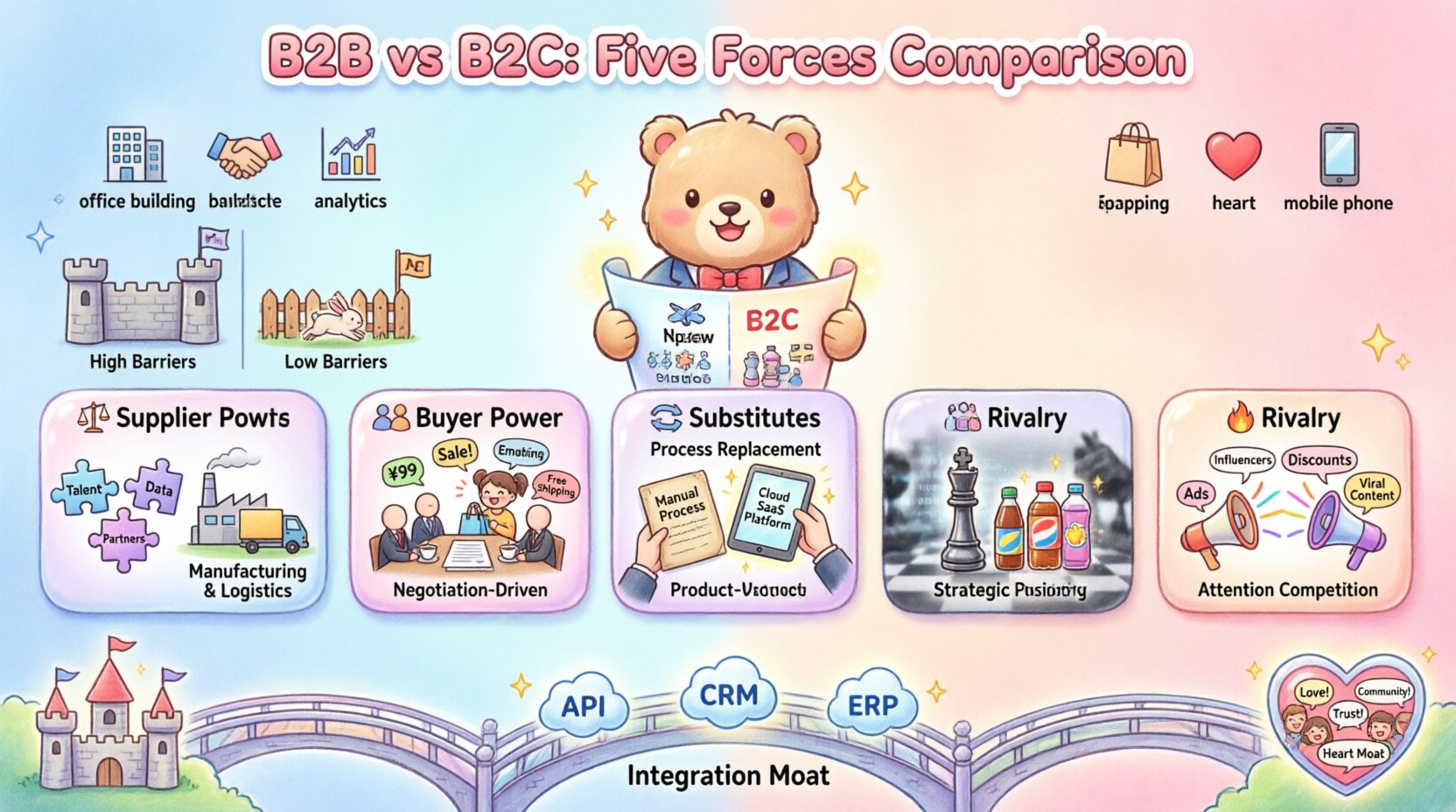
Understanding the Framework: Porter’s Five Forces 🛠️
Before dissecting the differences between B2B and B2C, it is essential to establish what the framework actually measures. Developed by Michael Porter, this model evaluates the intensity of competition and the profitability of an industry. It looks at five distinct forces that shape the market:
- Threat of New Entrants: How easy is it for new competitors to enter the market?
- Bargaining Power of Suppliers: How much control do providers of raw materials or services have over pricing?
- Bargaining Power of Buyers: How much leverage do customers have to drive prices down?
- Threat of Substitute Products: Are there alternative solutions that fulfill the same need?
- Rivalry Among Existing Competitors: How intense is the competition between current players?
While the definitions remain constant, the variables that influence these forces differ drastically depending on whether you sell to other businesses or to individual consumers. A B2B startup often deals with complex decision-making units, long sales cycles, and high switching costs. A B2C startup faces high marketing visibility, brand loyalty challenges, and rapid purchasing decisions.
Deep Dive: B2B Market Dynamics 💼
In the B2B space, transactions are typically rational, value-driven, and relationship-heavy. The stakes are often higher for the buyer because a failure in the product can disrupt their entire operation. This context changes how each force manifests.
1. Threat of New Entrants 🚧
In B2B, the barrier to entry is often higher due to the complexity of the product or service. A startup selling enterprise software must demonstrate security compliance, integration capabilities, and ROI over time. New entrants face significant hurdles:
- Technical Complexity: B2B solutions often require deep customization and integration with existing legacy systems.
- Sales Cycles: Deals can take months to close, requiring substantial capital reserves to sustain operations before revenue hits.
- Trust and Reputation: Existing players have established case studies and references. New startups must prove reliability to risk-averse procurement teams.
- Regulatory Compliance: Industries like healthcare, finance, and logistics have strict regulations that new entrants must navigate immediately.
For a B2B startup, the threat of new entrants is generally lower than in B2C, provided they secure early adoption from key industry players. However, once a foothold is gained, incumbents can leverage their installed base to lock in customers.
2. Bargaining Power of Suppliers ⚖️
Supplier power in B2B is often nuanced. If a startup relies on specialized hardware or niche intellectual property, suppliers hold significant leverage. However, many B2B startups operate on a software-first model, reducing hardware dependency.
- Specialized Talent: In tech-heavy B2B, the “supply” is human capital. The ability to hire skilled engineers can be a bottleneck.
- Cloud Infrastructure: Dependence on major cloud providers (AWS, Azure, Google) gives those platforms pricing power, though the market is competitive.
- Data Sources: Access to proprietary data sets can be critical. If only one provider has the data, they control the pricing.
Unlike B2C, where a supplier might be a raw material vendor, B2B suppliers are often partners in the value chain. Negotiations focus on long-term contracts and service level agreements rather than unit price alone.
3. Bargaining Power of Buyers 👥
Buyers in B2B usually have more power than individual consumers. This is because the purchase represents a significant portion of their budget, and the decision involves multiple stakeholders.
- Consolidation: Large enterprises often consolidate vendors to reduce complexity. A startup selling to a Fortune 500 company faces a buyer with immense leverage.
- Switching Costs: If a startup makes it easy to switch to a competitor, the buyer has high power. If the startup creates high friction (e.g., data migration, workflow changes), power shifts to the vendor.
- Price Sensitivity: While B2B buyers care about cost, they care more about total cost of ownership and risk mitigation than a B2C consumer cares about a 5% discount.
Startups must demonstrate value through efficiency gains or revenue growth to counter this power. Price wars are dangerous in B2B as they signal desperation and can devalue the solution.
4. Threat of Substitute Products 🔄
Substitutes in B2B are often internal processes. A company might solve a problem with an in-house team rather than buying a software solution. This is a significant competitive force.
- Do-It-Yourself: The biggest competitor to a B2B startup is often the status quo. “We already do this manually” is a common objection.
- Legacy Systems: Competing against established ERP or CRM systems is difficult. These systems are deeply embedded in company workflows.
- Service Alternatives: Consulting firms or agencies can offer the same outcome as a software product, but with a different delivery model.
For a startup, the substitute threat is high unless the product offers a transformative efficiency that manual processes cannot match.
5. Rivalry Among Existing Competitors 🔥
B2B rivalry is often less visible than B2C but more intense. Competitors are not always advertising against you; they are often competing for the same budget allocation.
- Niche Focus: Many B2B startups compete in specific verticals. Rivalry is high within that niche but low in adjacent ones.
- Relationship Selling: Competitors often win on relationships with procurement officers rather than product features.
- Innovation Pace: If a competitor releases a new feature, it can quickly erode your advantage. The pace of innovation dictates market share.
Deep Dive: B2C Market Dynamics 🛍️
B2C markets operate on volume, speed, and emotion. The buyer is an individual making a personal decision, often influenced by brand perception, price, and convenience. The Five Forces play out differently here.
1. Threat of New Entrants 🚧
In B2C, the barrier to entry is often lower, leading to a crowded marketplace. It is easier to launch a product, market it, and get sales.
- Low Capital Requirements: E-commerce and digital products require less upfront capital than enterprise infrastructure.
- Marketing Channels: Social media and search ads allow new brands to reach audiences quickly, though costs are rising.
- Copycat Products: If a B2C product gains traction, competitors can replicate the concept rapidly.
The threat of new entrants is high in B2C. Success depends on building brand moats and customer loyalty quickly before copycats emerge.
2. Bargaining Power of Suppliers ⚖️
For many B2C startups, suppliers are manufacturers or logistics providers. The power dynamic depends on the product type.
- Private Label: If a startup manufactures its own goods, supplier power is low.
- Dropshipping: If a startup relies on third-party manufacturers, suppliers hold power over inventory and shipping times.
- Platform Dependency: Startups selling on marketplaces (like Amazon) face high supplier power from the platform itself, which controls traffic and fees.
B2C startups must secure reliable supply chains to avoid stockouts, which destroy trust faster than in B2B.
3. Bargaining Power of Buyers 👥
Buyer power in B2C is high due to low switching costs. A consumer can switch brands instantly with a click.
- Price Comparison: Customers can compare prices across dozens of sites in seconds.
- Brand Loyalty: Loyalty is fragile. A bad experience or a better price elsewhere leads to immediate churn.
- Information Access: Reviews and social proof heavily influence decisions, giving buyers significant power to validate or reject a claim.
B2C startups must invest heavily in customer experience and brand differentiation to reduce this power. Loyalty programs and community building are essential defenses.
4. Threat of Substitute Products 🔄
Substitutes in B2C are abundant. A consumer looking for a way to relax might choose a movie, a book, or a gym membership.
- Category Creep: Your product might compete with an entirely different category (e.g., a meal kit competing with restaurants).
- Free Alternatives: In digital B2C, free versions of products are common substitutes.
- Trend Volatility: Consumer tastes change quickly. A substitute might become popular due to a viral trend.
Startups must define their value proposition clearly so the customer sees no viable alternative for their specific need.
5. Rivalry Among Existing Competitors 🔥
B2C rivalry is visible, loud, and constant. Marketing spend is a primary weapon in this battle.
- Price Wars: Discounting is common and can erode margins quickly.
- Marketing Spend: Customer acquisition costs (CAC) are often high as competitors bid against each other for attention.
- Feature Parity: Products in B2C often become commoditized. Differentiation comes from branding and customer service.
Comparative Analysis: B2B vs B2C Forces 📊
To visualize the differences clearly, consider the following comparison of how each force typically manifests in both models.
| Force | B2B Startup Focus | B2C Startup Focus |
|---|---|---|
| New Entrants | High barriers due to complexity, trust, and sales cycles. | Low barriers; easy to launch but hard to scale. |
| Supplier Power | Focus on talent, data access, and integration partners. | Focus on manufacturing, logistics, and platform fees. |
| Buyer Power | High leverage due to consolidation and high contract value. | High leverage due to instant switching and price transparency. |
| Substitutes | Internal processes and legacy systems are the main threat. | Other categories and free alternatives are the main threat. |
| Competitive Rivalry | Hidden, relationship-based, focused on long-term contracts. | Visible, marketing-driven, focused on immediate sales. |
Strategic Implications for Founders 🧭
Knowing these differences allows founders to allocate resources effectively. A B2B founder should focus on product reliability, security, and integration. A B2C founder should focus on brand perception, user experience, and customer acquisition efficiency.
Building Moats in B2B 🏰
To defend against buyer power and substitutes, B2B startups should aim for:
- High Switching Costs: Embed your product into the client’s workflow so deeply that leaving is difficult.
- Network Effects: If your product becomes more valuable as more companies use it (e.g., marketplaces, collaboration tools), you build a strong defense.
- Ecosystem Partnerships: Integrate with the tools your clients already use to become indispensable.
Building Moats in B2C 🛡️
To defend against rivals and substitutes, B2C startups should aim for:
- Brand Identity: Create an emotional connection that price alone cannot break.
- Community: Build a group of loyal users who advocate for the product.
- Exclusive Content or Features: Offer something that cannot be easily copied by competitors.
Common Pitfalls in Market Analysis ⚠️
Even with a solid framework, founders often make mistakes when applying Five Forces to their startups.
- Ignoring the Customer Journey: Analyzing the market without understanding the specific steps a customer takes to buy leads to inaccurate assessments of buyer power.
- Overestimating Competitors: In B2B, competitors are often large incumbents. In B2C, they are often agile new brands. Treating them the same creates wrong strategy.
- Static Analysis: Markets change. A force that is weak today (e.g., supplier power) might become strong tomorrow if a bottleneck emerges.
- Confusing Needs with Wants: In B2C, emotional needs drive purchases. In B2B, functional needs drive purchases. Mixing these up leads to poor positioning.
Implementation Steps 📝
To conduct this analysis for your specific startup, follow these steps:
- Define Your Market: Clearly state who your customer is and what problem you solve.
- Map the Players: Identify existing competitors, potential substitutes, and key suppliers.
- Interview Customers: Ask them why they choose you over alternatives. This reveals true buyer power and substitute threats.
- Analyze Costs: Understand your cost structure to determine pricing flexibility against supplier power.
- Review Trends: Look at industry reports to see if barriers to entry are rising or falling.
- Formulate Strategy: Adjust your product, pricing, and marketing based on the findings.
By rigorously applying this framework, founders can move beyond intuition and build strategies grounded in market reality. Whether you are selling to a corporation or a consumer, the forces shaping your business are real and measurable. Understanding them is the first step to navigating them successfully.
Final Thoughts on Market Positioning 🌐
The distinction between B2B and B2C is not just about who writes the check; it is about the entire ecosystem surrounding the transaction. B2B is a marathon of relationships and value demonstration. B2C is a sprint of attention and conversion. Both require a clear understanding of the competitive landscape.
Startups that fail to adapt their Five Forces analysis to their specific model often waste resources on the wrong levers. A B2C team might spend too much time on technical integration details that a B2B customer would prioritize. A B2B team might neglect brand sentiment that a B2C customer would demand.
Use this framework as a living document. Revisit it quarterly as your market evolves. The forces do not stay static, and neither should your strategy. With a deep understanding of these dynamics, you can position your startup to withstand competitive pressure and capture long-term value.