
In the landscape of software development, the structural integrity of an application determines its longevity. When components are tightly interwoven, a small change in one area can cause cascading failures elsewhere. This is the essence of coupling. For architects and developers, designing a system with loose coupling is not merely a preference; it is a necessity for sustainable growth. This guide explores how to use package diagrams effectively to minimize dependencies and maximize flexibility. 🛡️
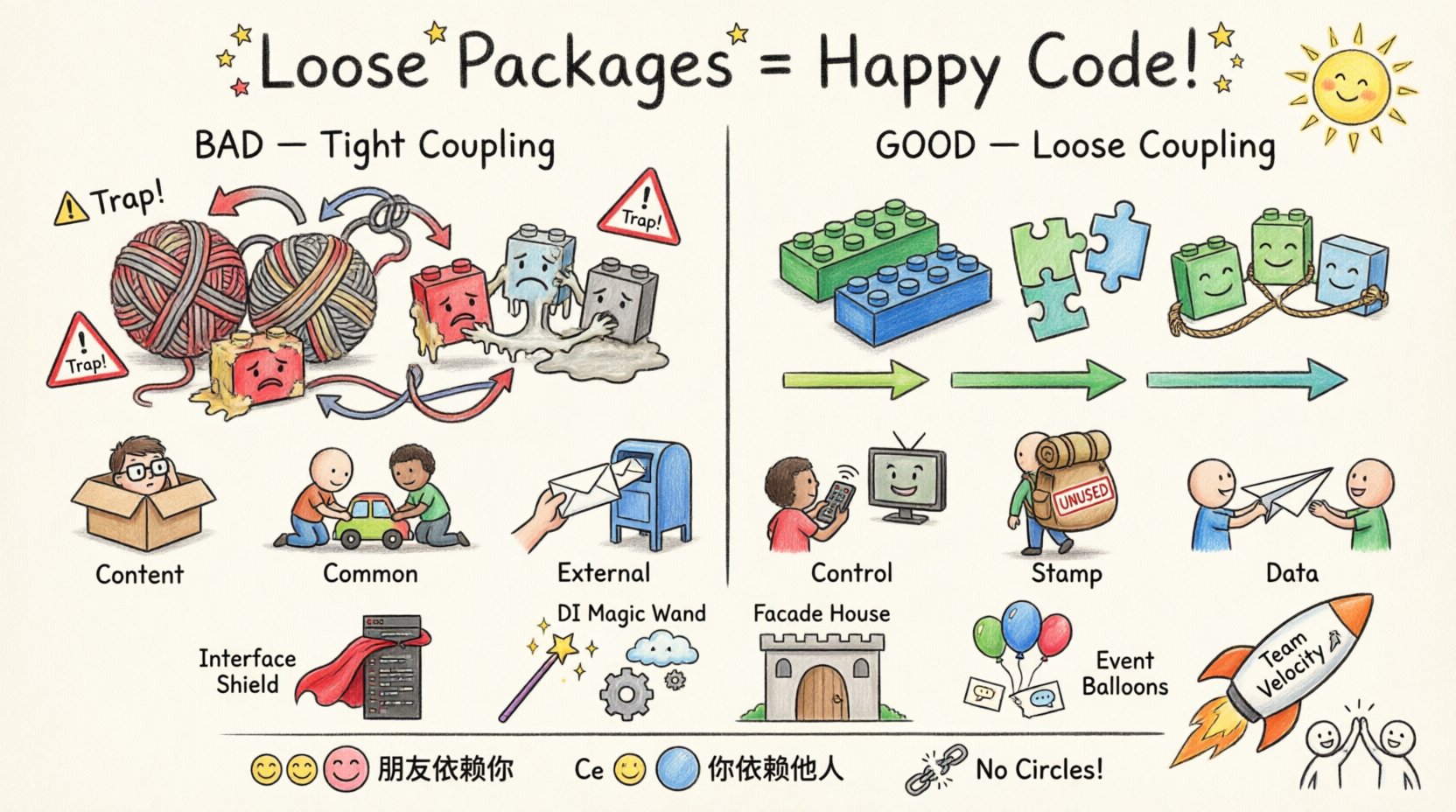
Understanding Coupling in Software Architecture 🔗
Coupling describes the degree of interdependence between software modules. It measures how closely connected two routines or modules are. When coupling is high, modules rely heavily on the internal implementation details of other modules. This creates a fragile system where changes require extensive refactoring. Conversely, low coupling implies that modules interact through well-defined interfaces, shielding internal logic from external influence.
Why does this distinction matter? Consider a scenario where a module needs to communicate with a database. If it connects directly to the database driver, it is tightly coupled. If it communicates through an abstraction layer, it is loosely coupled. The latter allows you to switch database technologies without rewriting the business logic.
Types of Coupling
Not all coupling is created equal. Understanding the spectrum helps in identifying which interactions to minimize.
- Content Coupling: One module directly modifies or relies on the internal data of another. This is the strongest form of coupling and should be avoided.
- Common Coupling: Modules share the same global data. Changes to the data structure affect all modules.
- External Coupling: Modules share an external interface, such as a file format or communication protocol.
- Control Coupling: One module passes control information to another to dictate its logic.
- Stamp Coupling: Modules share a complex data structure (a record or object), but only use part of it.
- Data Coupling: Modules share only data needed for their operation. This is the desired state.
The Role of Package Diagrams 📐
A package diagram is a UML (Unified Modeling Language) diagram that shows the organization of packages within a system. Packages act as namespaces for grouping related elements. In the context of architecture, they represent logical modules or subsystems. These diagrams are crucial for visualizing dependencies between packages.
Visualizing Dependencies
Dependencies are shown as arrows pointing from the client package to the supplier package. The direction of the arrow indicates that the client depends on the supplier. If this relationship is bidirectional, it creates a circular dependency, which is a significant structural flaw.
Key Objectives of Package Diagrams:
- To identify cycles in the dependency graph.
- To ensure that high-level policies do not depend on low-level details.
- To enforce separation of concerns.
- To provide a blueprint for refactoring.
Common Coupling Traps to Avoid ⚠️
Even experienced developers fall into traps that introduce tight coupling. Recognizing these patterns is the first step toward a healthier architecture. Below are the most frequent pitfalls found in package structures.
1. Direct Instantiation of Concrete Classes
When a class creates an instance of another concrete class directly using the new operator, it becomes tightly bound to that specific implementation. If the concrete class changes or needs to be replaced, the creating class must be modified.
- The Trap:
Service service = new ConcreteService(); - The Fix: Depend on an interface or abstract class.
Service service = new InterfaceBasedService();
2. Circular Dependencies
A circular dependency exists when Package A depends on Package B, and Package B depends on Package A. This creates a cycle where neither package can be compiled or loaded independently. It leads to complex initialization sequences and makes testing difficult.
- Impact: Build failures, memory leaks, and infinite recursion during startup.
- Resolution: Extract shared functionality into a third package that both original packages depend on, but which depends on nothing.
3. Publicizing Internal Details
Exposing internal data structures or helper methods in the public API forces consumers to rely on implementation details. If you change an internal field name, any code accessing it breaks.
- Principle: The package should only export what is necessary for clients to function.
- Rule: Private and protected members should remain hidden within the package boundary.
4. Ignoring the Dependency Inversion Principle
This principle states that high-level modules should not depend on low-level modules. Both should depend on abstractions. When high-level logic is tied to low-level database access or file I/O, the system becomes rigid.
5. Over-fragmentation
While loose coupling is good, splitting packages too finely can create overhead. If every small function requires its own package, the system becomes difficult to navigate. The goal is a balance between cohesion and coupling.
Strategies for Achieving Loose Coupling 🛠️
Building a resilient system requires deliberate design choices. The following strategies help maintain loose packages without sacrificing functionality.
1. Use Interfaces and Abstractions
Interfaces define a contract without specifying implementation. By programming to an interface, you allow the implementation to change without affecting the client code. This is the cornerstone of flexible architecture.
- Define clear interfaces for all major services.
- Ensure implementations are interchangeable.
- Use abstract classes where shared behavior is needed, but favor interfaces for capability definitions.
2. Dependency Injection
Instead of a module creating its own dependencies, they are provided from the outside. This decouples the module from the creation process of its collaborators.
- Constructor Injection: Dependencies are passed via the constructor.
- Setter Injection: Dependencies are set via public methods.
- Interface Injection: Dependencies are provided through a specific interface.
3. Facade Pattern
A facade provides a simplified interface to a complex subsystem. Clients interact with the facade rather than the underlying classes. This reduces the number of direct dependencies clients have on the system.
4. Event-Driven Architecture
Modules can communicate via events rather than direct calls. A publisher sends an event without knowing who listens. A subscriber reacts to the event without knowing who sent it. This removes direct coupling entirely.
- Decouples sender and receiver.
- Allows for asynchronous processing.
- Improves scalability.
Measuring and Maintaining Package Health 📊
Designing for loose coupling is an ongoing process. Metrics help quantify the quality of the architecture over time. Several standard metrics exist to evaluate package dependencies.
Key Metrics for Coupling
| Metric | Definition | Desired Trend |
|---|---|---|
| afferent Coupling (Ca) | Number of packages that depend on the current package. | High for stable core packages. |
| Efferent Coupling (Ce) | Number of packages that the current package depends on. | Low for all packages. |
| Instability (I) | Ratio of Ce to (Ca + Ce). | Values close to 1 are unstable; values close to 0 are stable. |
| Absence of Circular Dependencies | Count of circular paths in the dependency graph. | Zero is the target. |
Refactoring Techniques
When metrics indicate high coupling, specific refactoring techniques can restore balance.
- Move Method: Move a method to the class where it is used more frequently or where it belongs logically.
- Extract Interface: Create an interface for a class to allow other classes to depend on the abstraction.
- Push Down Method: Move a method from a superclass to a specific subclass if it only applies there.
- Pull Up Method: Move a method from a subclass to a superclass to reduce duplication.
The Impact on Team Velocity and Quality 🚀
The structural quality of the codebase directly influences the human element of software development. Teams working with tightly coupled systems experience friction. Changes take longer to implement, and the risk of introducing bugs increases.
Maintainability
Loose packages make it easier to understand the code. Developers can focus on one package without needing to understand the internals of every other package. This reduces cognitive load and speeds up onboarding for new team members.
Testability
Testing is significantly easier when dependencies are injected. Mock objects can replace real implementations during unit testing. This allows for rapid feedback loops without needing to spin up external services like databases or message queues.
Scalability
As the system grows, new features can be added to existing packages without breaking existing functionality. Loose coupling ensures that the architecture can evolve to meet new requirements without a complete rewrite.
Parallel Development
When packages are independent, multiple developers can work on different parts of the system simultaneously. This reduces merge conflicts and allows for parallel delivery of features.
Real-World Scenarios and Application 🌍
To fully grasp these concepts, consider how they apply to typical architectural layers. In a standard layered architecture, the presentation layer depends on the business layer, which depends on the data layer. The data layer should not know about the business logic.
If the business logic calls database methods directly, it violates the dependency rule. The business layer should call a repository interface. The repository implementation handles the database interaction. This separation allows the database technology to change (e.g., from SQL to NoSQL) without touching business logic.
Handling Legacy Systems
Refactoring legacy code is challenging. It is often better to introduce a new package that acts as a wrapper around the legacy code. This creates a boundary. Over time, the legacy code can be replaced while the new package maintains the contract.
- Do not refactor everything at once.
- Create interfaces for legacy components.
- Gradually migrate functionality to new packages.
- Use adapters to bridge gaps between old and new systems.
Best Practices for Package Organization 📂
Organizing packages requires discipline. There is no single correct way, but several guidelines help maintain order.
- Group by Function: Place related functionality together. A package named
Paymentshould contain all payment-related logic. - Group by Domain: If using domain-driven design, organize packages by business domain rather than technical layer.
- Respect Boundaries: Do not allow packages to import each other unnecessarily. Use
internalvisibility modifiers where available. - Limit Depth: Avoid deep inheritance hierarchies that make navigation difficult.
- Consistent Naming: Use clear, descriptive names for packages. Avoid abbreviations that are not standard.
Final Thoughts on Architectural Integrity 🧠
Designing for loose coupling is a continuous effort. It requires vigilance during code reviews and a willingness to refactor when technical debt accumulates. The goal is not perfection but progress. By understanding the types of coupling, utilizing package diagrams, and applying strategies like dependency inversion, teams can build systems that withstand change.
Remember that architecture is not a one-time event. It evolves with the product. Regularly review package dependencies to ensure they remain valid. Use automated tools to detect violations of dependency rules. This proactive approach prevents small issues from becoming structural failures.
Ultimately, the value of loose coupling lies in the freedom it provides. It allows teams to innovate without fear of breaking the foundation. It turns software from a rigid block into a flexible framework capable of adapting to future needs. 🏗️