
Object Oriented Analysis and Design (OOAD) remains the backbone of modern software architecture. It provides a structured approach to modeling systems where data and behavior are encapsulated within objects. However, the path to a robust system is often paved with subtle architectural decisions that can degrade over time. Developers frequently fall into patterns that seem efficient initially but create significant technical debt later.
This guide explores the specific pitfalls that compromise design integrity. By understanding the symptoms and causes of these traps, teams can maintain flexibility and reduce maintenance costs. We will examine the structural weaknesses that lead to brittle codebases and how to structure systems for longevity.
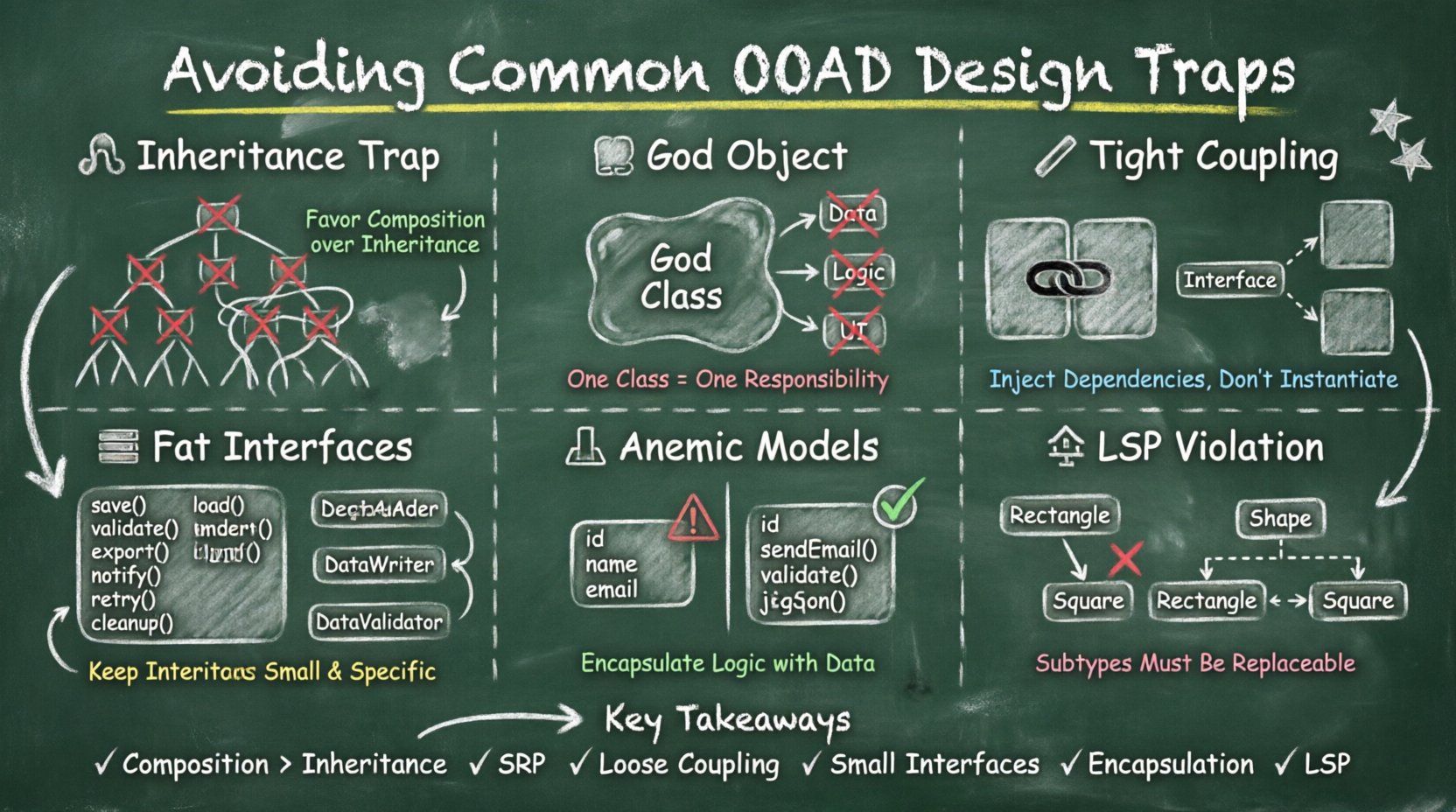
🧬 The Inheritance Trap: Deep Hierarchies
One of the most pervasive issues in OOAD is the misuse of inheritance. While inheritance allows for code reuse and polymorphism, it creates a rigid dependency chain. When developers rely too heavily on class hierarchies, they often end up with deep trees of classes that are difficult to navigate or modify.
Why Inheritance Becomes a Problem
- Brittle Base Classes: A change in a base class can break functionality in every derived class. This is known as the fragile base class problem.
- Hidden Dependencies: Derived classes often rely on the internal implementation details of their parents, which should remain private.
- Limited Flexibility: Inheritance is a compile-time relationship. It is static and does not allow for dynamic behavior changes at runtime.
Recognizing the Symptoms
If you find yourself creating classes simply to share code without a clear “is-a” relationship, you are likely misusing inheritance. Look for:
- Classes with hundreds of lines of code dedicated to overriding methods.
- Complex logic scattered across parent and child classes.
- Methods that throw exceptions because they are not applicable to a specific subclass.
Recommendation: Favor composition over inheritance. Create objects that contain other objects. This allows behavior to be swapped dynamically without altering the class hierarchy.
🏛️ The God Object Anti-Pattern
A “God Object” is a class that knows too much or does too much. It typically acts as a central hub for the application, handling everything from data retrieval to business logic and UI rendering. While this might simplify initial development, it creates a massive bottleneck for testing and maintenance.
Characteristics of a God Object
| Feature | Impact on System |
|---|---|
| Size | Often exceeds hundreds or thousands of lines. |
| Coupling | Depends on almost every other class in the system. |
| Responsibility | Mixes data access, logic, and presentation. |
| Maintainability | High risk of regression when modified. |
The Cost of Monolithic Classes
When a single class manages the state of the entire application, it becomes impossible to isolate changes. If a bug appears, it is difficult to trace the source. Furthermore, multiple developers working on the same file will encounter constant merge conflicts in version control.
Recommendation: Apply the Single Responsibility Principle (SRP). Ensure every class has only one reason to change. Split large classes into smaller, focused units. Use dependency injection to provide necessary services rather than creating them internally.
🔗 Tight Coupling and Dependency Management
Coupling refers to the degree of interdependence between software modules. High coupling means that a change in one module necessitates changes in others. In OOAD, this often manifests as classes creating instances of their dependencies directly.
Direct Instantiation Issues
When a class uses new to create a dependency, it binds itself to a specific concrete implementation. This prevents the use of alternative implementations, such as mocks for testing or different strategies for different environments.
- Testing Difficulty: Unit tests become integration tests because you cannot easily mock the dependency.
- Refactoring Cost: Changing the underlying technology requires sweeping changes across the codebase.
- Reusability: The class cannot be easily moved to another project without dragging its dependencies along.
Solutions for Loose Coupling
To mitigate this, rely on interfaces or abstract classes. Define what a class needs rather than how it gets it. This allows the dependency to be injected from the outside. This approach is often called Dependency Injection.
- Use interfaces to define contracts.
- Construct objects with their dependencies passed in via constructors or setters.
- Keep implementation details hidden behind public contracts.
📜 Interface Segregation and Fat Interfaces
Interfaces are meant to define contracts. However, when an interface grows too large, it becomes a burden. This is often referred to as violating the Interface Segregation Principle. Clients should not be forced to depend on methods they do not use.
The Fat Interface Problem
Imagine an interface with twenty methods. A class implementing this interface must provide all twenty, even if it only uses two. This leads to:
- Empty Implementations: Methods that throw
NotImplementedExceptionor do nothing. - Confusion: Developers cannot tell which methods are relevant to their specific use case.
- Compilation Errors: If the interface changes, all implementations must be updated, even if the change is irrelevant to them.
Best Practices for Interfaces
Keep interfaces small and focused. Group related functionality into distinct interfaces. This allows classes to implement only what they need. It also makes the system more modular and easier to understand.
📊 Data Structures vs. Objects
A common confusion in OOAD is treating objects as mere data containers. While objects encapsulate data, they should also encapsulate behavior. Treating objects as data structures leads to “Anemic Domain Models” where the object has public fields but no logic.
The Anemic Model Trap
When data and logic are separated, you end up with Service classes that contain all the business rules. This violates encapsulation. The data becomes vulnerable to inconsistent states because there is no invariant enforcement within the object itself.
Encapsulation Best Practices
- Make fields private and expose state via methods.
- Ensure methods modify state in a way that maintains object validity.
- Move logic that belongs to the data into the object itself.
By keeping data and behavior together, you reduce the surface area for bugs. The object itself becomes the guardian of its own integrity.
🎯 The Liskov Substitution Principle (LSP)
LSP states that objects of a superclass shall be replaceable with objects of its subclasses without breaking the application. Violating this principle leads to unpredictable behavior when polymorphism is used.
Subtype Violations
Consider a square class inheriting from a rectangle class. If you set the width, the height must remain the same. If you set the height, the width must remain the same. A square cannot satisfy this constraint. Therefore, a square is not a valid subtype of a rectangle in this context.
This kind of semantic mismatch breaks the expectations of the code using the object. It forces the consumer to check the specific type before using it, which defeats the purpose of polymorphism.
Ensuring LSP Compliance
- Ensure subclasses do not strengthen preconditions.
- Ensure subclasses do not weaken postconditions.
- Ensure subclasses do not change the invariants of the superclass.
⚖️ Single Responsibility Principle (SRP) Nuances
SRP is frequently misunderstood as “one class, one job.” In reality, it means “one reason to change.” A class might handle multiple tasks, but if those tasks are driven by different stakeholders or changing requirements, they should be separated.
Identifying Responsibilities
Ask yourself: “What causes this class to change?” If the answer is multiple distinct factors, the class has multiple responsibilities. Common culprits include:
- Database access logic mixed with business rules.
- Formatting logic mixed with calculation logic.
- Logging logic mixed with core functionality.
Separating these concerns allows teams to work in parallel. One team can update the data layer without affecting the calculation layer.
🔄 The Iterator Trap
Iterators allow traversal of collections. However, custom iterators can introduce complexity if not managed correctly. Exposing the internal structure of a collection through a custom iterator couples the client to that specific structure.
When to Use Standard Iterators
Unless you have a specific need for custom traversal, rely on standard collection iterators. They are well-tested and predictable. Creating a new iterator for every collection type adds unnecessary boilerplate and potential for bugs.
🔒 Encapsulation and Visibility
Encapsulation is the principle of hiding internal state. However, excessive encapsulation can hinder development, while insufficient encapsulation exposes the system to errors. Finding the balance is key.
Visibility Modifiers
- Public: Use sparingly. Only expose what is necessary for the contract.
- Protected: Use for inheritance, but be aware of the fragility it introduces.
- Private: Default to this. Hide implementation details.
Do not make methods public just because they are convenient. If a method is not part of the public contract, keep it private. This reduces the surface area for bugs.
📈 Impact on Technical Debt
Every design trap discussed above contributes to technical debt. Technical debt is the implied cost of additional rework caused by choosing an easy solution now instead of using a better approach that would take longer.
Long-Term Consequences
- Slower Development Velocity: More time is spent fixing bugs than adding features.
- Higher Onboarding Costs: New developers struggle to understand complex, coupled systems.
- Refactoring Risk: Fear of breaking existing functionality prevents necessary improvements.
Investing time in clean design pays dividends over the lifecycle of the software. It reduces the cognitive load on the team and makes the system more adaptable to change.
🛡️ Summary of Design Stability
Building robust software requires vigilance. The traps outlined in this guide are common because they offer short-term convenience. However, the long-term cost is high. By prioritizing loose coupling, high cohesion, and adherence to established principles, teams can create systems that endure.
Remember that design is not a one-time activity. It is an iterative process. Continuously review your architecture against these criteria. Refactor when necessary. Do not let the “working code” mindset overshadow the “maintainable code” goal.
📝 Key Takeaways for OOAD
- Avoid Deep Inheritance: Use composition to achieve reuse.
- Prevent God Objects: Keep classes focused on a single responsibility.
- Manage Dependencies: Inject dependencies rather than creating them.
- Simplify Interfaces: Keep them small and specific.
- Protect State: Encapsulate data and enforce invariants.
- Respect LSP: Ensure subclasses can replace parent classes seamlessly.
Adopting these practices requires discipline. It is easier to write a quick script than to design a system. But the difference between a prototype and a product is often the quality of the underlying design. Stay mindful of the structure, and your software will serve its purpose reliably for years to come.