
Modern project environments rarely operate within a single methodology. Organizations often juggle Agile teams, Waterfall streams, and Hybrid approaches simultaneously. This fragmentation creates significant visibility gaps. Without a unified approach to measurement, leadership cannot accurately assess risk, resource allocation, or delivery timelines. A project health audit becomes the critical mechanism for bringing clarity to complexity.
This guide outlines a structured approach to auditing project health across diverse frameworks. We will explore the specific indicators required for each methodology, how to standardize reporting, and the strategies needed to maintain governance without stifling flexibility.
🧩 The Challenge of Hybrid Environments
Managing a portfolio where some teams move in sprints while others follow strict phase gates is inherently difficult. Each framework prioritizes different aspects of delivery. Agile focuses on adaptability and incremental value, while Waterfall emphasizes predictability and upfront planning. When these collide, standard metrics often fail to capture the true state of a project.
Key friction points include:
- Data Inconsistency: Velocity does not translate directly to milestone completion.
- Resource Contention: Shared resources may be tracked differently depending on the team’s workflow.
- Risk Visibility: Agile risks are often dynamic and immediate, whereas Waterfall risks are identified early and tracked formally.
- Communication Overhead: Different teams speak different languages regarding status and progress.
A successful audit must bridge these gaps without forcing a single methodology onto all teams. The goal is normalization of data, not normalization of process.
📊 Defining Health Indicators by Framework
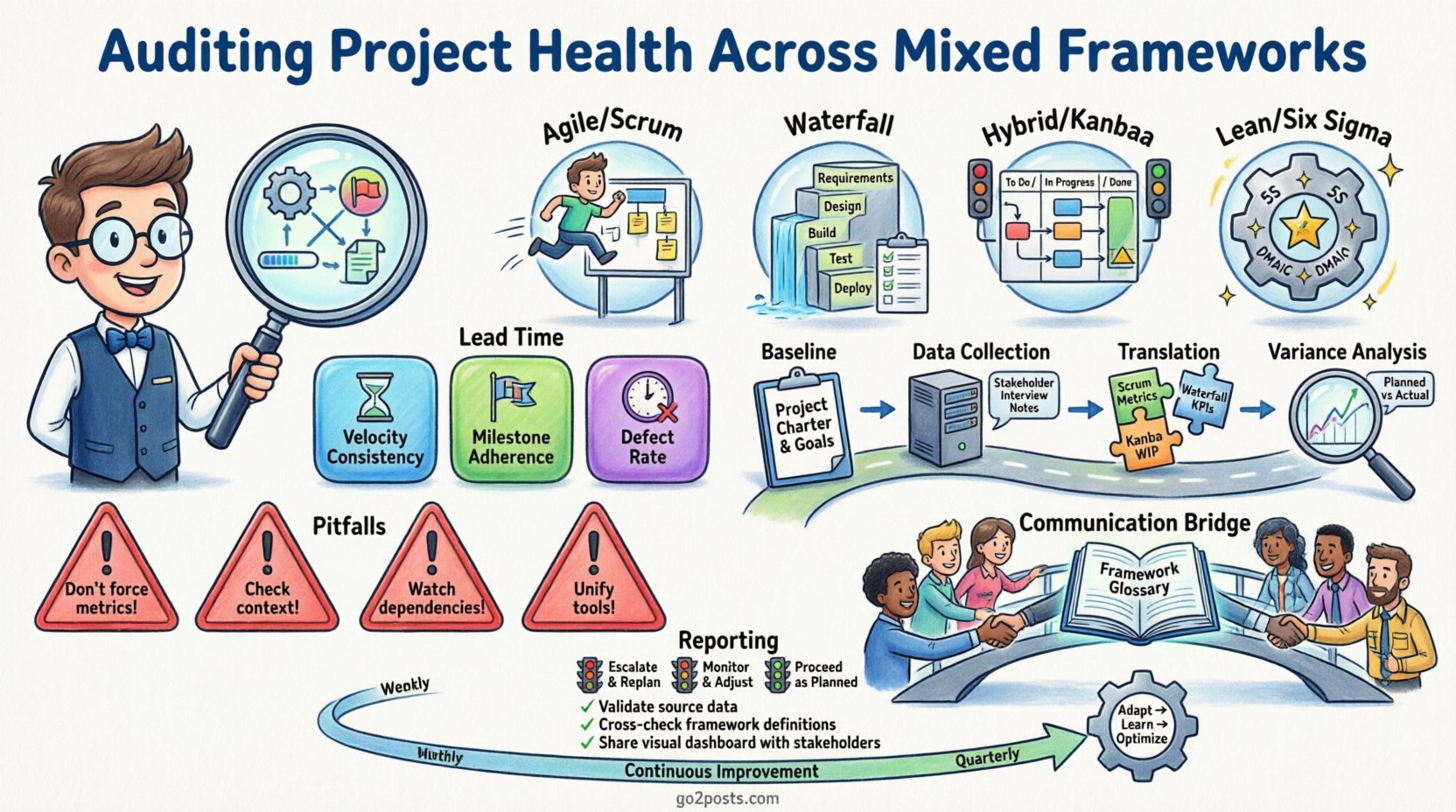
To audit effectively, you must understand what constitutes “health” in each specific context. A team using iterative development cannot be judged by the same criteria as a team executing a linear construction plan. The following table outlines the primary indicators for each common framework.
| Framework Type | Primary Health Indicator | Secondary Indicator | Risk Focus |
|---|---|---|---|
| Agile / Scrum | Velocity Consistency | Team Morale & Burnout | Scope Creep / Technical Debt |
| Waterfall | Milestone Adherence | Budget Variance | Requirement Gaps / Dependencies |
| Hybrid / Kanban | Lead Time & Cycle Time | Work In Progress (WIP) Limits | Bottlenecks / Flow Efficiency |
| Lean / Six Sigma | Process Defect Rate | Value Stream Efficiency | Waste Identification |
When conducting an audit, you must map these indicators to a unified dashboard. For example, “Milestone Adherence” in Waterfall should correlate with “Sprint Goal Success” in Agile, even if the time scales differ.
🔍 Conducting the Audit: Step-by-Step
A robust audit is not a one-time event. It is a recurring process that involves data collection, analysis, and stakeholder review. Follow this structured workflow to ensure accuracy.
1. Establish a Baseline
Before measuring health, define what success looks like for the specific project. This involves reviewing the charter or project initiation documents.
- Identify critical success factors (CSFs).
- Document agreed-upon definitions of done.
- Set thresholds for acceptable variance in budget and timeline.
2. Data Collection Strategy
Automated collection is preferred to reduce manual error. However, in mixed environments, manual verification is often necessary.
- Quantitative Data: Extract metrics from task boards, time tracking logs, and financial systems.
- Qualitative Data: Conduct interviews with team leads to gauge sentiment and identify hidden blockers.
- Artifact Review: Check documentation completeness, especially for compliance-heavy Waterfall phases.
3. Cross-Framework Translation
This is the most critical step. You must translate specific metrics into a common language for leadership.
- Convert velocity points into estimated hours for resource planning.
- Map sprint cycles to project phases for timeline alignment.
- Normalize risk scores using a standard severity scale (Low, Medium, High, Critical).
4. Variance Analysis
Compare actual performance against the baseline. Identify where the divergence is occurring.
- Is the delay caused by scope changes or efficiency issues?
- Is the budget overrun due to resource costs or scope creep?
- Are dependencies between teams causing the bottleneck?
🚧 Common Pitfalls in Multi-Method Audits
Auditors often make mistakes when trying to apply uniform standards to diverse teams. Avoid these common errors to maintain credibility and accuracy.
- Forcing Agile Metrics on Waterfall: Do not ask a Waterfall team to track velocity if their process relies on fixed milestones. This creates noise rather than signal.
- Ignoring Context: A drop in velocity might indicate technical debt in one team, but a scope change in another. Investigate the root cause before declaring failure.
- Overlooking External Dependencies: Projects rarely exist in a vacuum. Supply chain issues, regulatory changes, or market shifts can impact health regardless of internal process efficiency.
- Tool Fragmentation: Using different tracking tools for different teams can make aggregation difficult. Ensure data export formats are compatible.
🤝 Bridging Communication Gaps
Data is useless if stakeholders do not trust it. Communication barriers often arise between teams using different frameworks. The audit process should also serve as a communication tool.
Implement the following strategies:
- Unified Terminology: Create a glossary that defines terms like “Complete,” “In Progress,” and “Blocked” across all methodologies.
- Regular Syncs: Hold a unified steering committee meeting where all frameworks are reviewed simultaneously.
- Visual Management: Use dashboards that visualize progress without requiring deep technical knowledge of the underlying methodology.
- Transparency: Share both good and bad news. Hiding negative indicators in mixed environments leads to surprise failures later.
⚖️ Mitigating Bias in Assessment
Audit bias can occur when the auditor favors one methodology over another. For example, favoring Agile might lead to undervaluing the stability provided by Waterfall planning. Conversely, favoring Waterfall might penalize necessary Agile pivots.
To maintain neutrality:
- Calibrate Evaluators: Ensure all auditors understand the strengths and weaknesses of each framework.
- Use Objective Criteria: Rely on hard data (dates, budgets, counts) rather than subjective feelings about progress.
- Seek Diverse Perspectives: Include team members from different frameworks in the audit review process to validate findings.
📈 Actionable Reporting
The final output of an audit must drive action. A report that simply lists metrics is insufficient. It must provide clear directives.
Structure your reports with the following sections:
- Executive Summary: A high-level view of portfolio health. Use traffic light indicators (Red, Amber, Green) for quick scanning.
- Deep Dive Analysis: Specific details for projects flagged as Red or Amber.
- Recommendations: Concrete steps to improve health. Avoid vague suggestions like “improve communication.” Instead, specify “establish weekly dependency syncs between Team A and Team B.”
- Resource Implications: Identify if additional budget or personnel is required to resolve identified issues.
- Timeline Adjustments: Propose realistic replanning based on current velocity or milestone status.
🔄 Continuous Improvement
Project health is dynamic. An audit performed today may be obsolete in a week if market conditions shift. Establish a cadence for auditing that matches the pace of your delivery.
- High Frequency: For Agile teams, weekly or bi-weekly micro-audits keep the pulse on velocity and blockers.
- Medium Frequency: For Hybrid projects, monthly health checks align with sprint cycles and phase gates.
- Low Frequency: For long-term Waterfall initiatives, quarterly reviews prevent scope drift over extended timelines.
By standardizing the audit process while respecting the nuances of each framework, organizations can achieve true visibility. This allows leadership to make informed decisions, allocate resources efficiently, and mitigate risks before they become critical failures.
The complexity of mixed frameworks is not a barrier to management; it is a reality of modern delivery. With the right audit structure, you can navigate this complexity with precision and confidence.