
In the landscape of Object-Oriented Analysis and Design (OOAD), one of the most persistent challenges developers face is managing dependencies between components. When objects know too much about each other, the system becomes rigid, difficult to test, and prone to cascading failures. To address this structural fragility, the Observer Pattern stands out as a fundamental behavioral design pattern. It establishes a subscription mechanism that allows objects to communicate without creating direct, hard-coded links. This guide explores the mechanics, implementation, and strategic application of the Observer Pattern to achieve true loose coupling in your software architecture.
🧩 Understanding the Observer Pattern
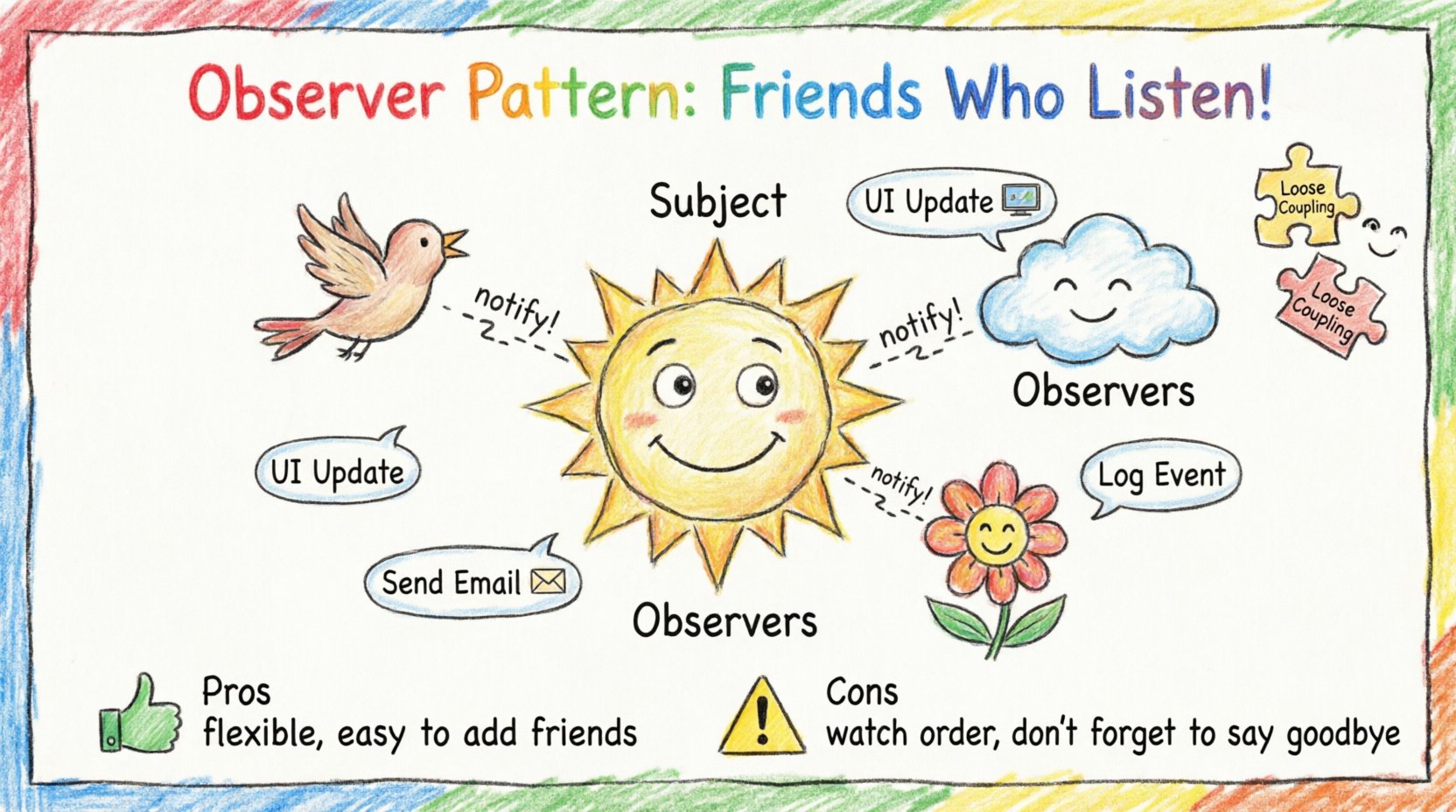
At its core, the Observer Pattern defines a one-to-many dependency between objects. When one object, known as the Subject, changes its state, all its dependents, known as Observers, are notified and updated automatically. This relationship is dynamic, meaning objects can subscribe or unsubscribe from the relationship at runtime. The primary goal is to decouple the Subject from its Observers. The Subject does not need to know the concrete classes of the Observers; it only needs to know that they implement a specific interface.
This pattern is particularly valuable in systems where the state of a component triggers actions in other parts of the system. For example, consider a data processing pipeline where a change in a source record must trigger updates in a cache, a log file, and a user interface display. Without this pattern, the source record would need to hold references to the cache, the logger, and the display logic. This creates tight coupling. By introducing the Observer Pattern, the source record simply notifies an interface, and the specific implementations handle the notification logic.
🔧 Core Components of the Pattern
To implement this pattern effectively, you must identify and define the specific roles within the architecture. These roles ensure the separation of concerns remains intact.
- Subject: This is the object being observed. It maintains a list of Observers and provides methods to attach, detach, and notify them. The Subject is responsible for broadcasting state changes.
- Observer: This is the interface or abstract class that defines the update method. Any class wishing to receive notifications must implement this interface. It ensures a consistent contract for receiving updates.
- ConcreteSubject: This is the actual implementation of the Subject. It holds the state and triggers the notification logic when that state changes.
- ConcreteObserver: These are the specific implementations of the Observer interface. They contain the logic for reacting to the notification from the Subject.
- Client: This is the part of the application that creates the ConcreteSubjects and ConcreteObservers and establishes the relationship between them.
By strictly adhering to these roles, you ensure that the Subject never depends on the internal workings of the Observer. It only depends on the interface. This is the definition of interface segregation and dependency inversion in action.
🌉 Mechanism for Loose Coupling
The primary advantage of this pattern is the reduction of coupling. In a traditional object-oriented design, Object A might directly instantiate Object B to perform an action. If Object B changes, Object A must be recompiled or refactored. With the Observer Pattern, Object A (the Subject) interacts with a list of interfaces. Object B (the Observer) implements that interface.
Consider the following scenarios regarding coupling:
- Tight Coupling: The Subject holds a concrete reference to the Observer. Changes to the Observer class require changes to the Subject class.
- Loose Coupling: The Subject holds a reference to the Observer interface. The ConcreteObserver is registered at runtime. The Subject remains unaware of the ConcreteObserver’s specific logic.
This decoupling allows for greater flexibility. You can add new observers to a subject without modifying the subject’s code. You can remove observers dynamically. This aligns with the Open/Closed Principle, which states that software entities should be open for extension but closed for modification.
🛠️ Implementation Strategy
Implementing the Observer Pattern requires careful attention to the lifecycle of the subscription. The process generally follows these steps:
- Define the Interface: Create a common interface for the Observer. This interface should contain an
updatemethod that accepts the state or a reference to the Subject. - Implement the Subject: Create the Subject class with a collection to store Observers. Implement
attach,detach, andnotifymethods. - Implement ConcreteObservers: Create classes that implement the Observer interface. Inside the
updatemethod, define the specific logic required for that observer type. - Establish Relationships: In the Client code, instantiate the Subject and the Observers. Call the attach method on the Subject to link them.
- Trigger Updates: When the Subject’s state changes, call the notify method. The Subject iterates through its list of Observers and calls their update methods.
It is crucial that the notification process does not block the Subject indefinitely. If one Observer takes a long time to process the update, it can degrade the performance of the Subject. Therefore, the notification loop should be efficient.
📊 Advantages and Disadvantages
Like all design patterns, the Observer Pattern has trade-offs. Understanding these helps in deciding when to apply it.
| Aspect | Details |
|---|---|
| Loose Coupling | The Subject and Observers are independent. You can change one without affecting the other significantly. |
| Dynamic Relationships | Observers can be added or removed at runtime without recompiling the Subject. |
| Broadcasting Support | A single state change can trigger updates across multiple objects simultaneously. |
| Unpredictable Updates | The order in which Observers receive notifications is not guaranteed. This can lead to inconsistent state if observers depend on each other. |
| Performance Overhead | Notifying a large number of observers can be expensive if the update logic is complex. |
| Memory Leaks | If Observers are not properly detached, they may persist in memory even if they are no longer needed. |
📂 Practical Application Scenarios
While the theory is sound, practical application requires context. Here are specific scenarios where the Observer Pattern adds significant value.
1. User Interface Updates
In graphical user interfaces, data models often need to reflect changes to the view. If a user edits a value in a text box, the label displaying that value must update. If the label, the button status, and the validation message all need to update, the Observer Pattern allows the model to broadcast the change without knowing about the UI components.
2. Event-Driven Systems
Systems that process events, such as logging or monitoring, benefit from this pattern. When a specific event occurs (e.g., a security breach), multiple subsystems might need to react (e.g., send an alert, log the incident, lock the account). The Observer Pattern ensures these reactions happen automatically without the security module hardcoding logic for every reaction.
3. Data Synchronization
In distributed systems, data consistency is key. If a primary database is updated, secondary caches or read-replicas need to refresh. Observers can listen for the commit event and trigger the synchronization process, keeping the system consistent without tight integration.
4. Notification Services
Applications that send emails, push notifications, or SMS messages often use this pattern. When a user status changes, the system can notify the email service, the push service, and the internal audit log. All these services are decoupled from the core user logic.
⚠️ Common Pitfalls and Solutions
Even with a clear pattern, implementation errors can lead to system instability. Below are common issues and how to mitigate them.
1. Circular Dependencies
It is possible for two Observers to depend on each other. If Observer A updates Observer B, and Observer B updates Observer A, a circular reference loop can occur. This leads to stack overflow errors or infinite loops.
- Solution: Ensure the notification logic does not trigger state changes that require the original Observer to update again. Use flags to track processing state.
2. Memory Leaks
In languages with garbage collection, if a ConcreteObserver holds a reference to the Subject, and the Subject holds a reference to the Observer, neither can be collected if they are not explicitly removed.
- Solution: Always provide a
detachmethod. Ensure that when an Observer is destroyed, it removes itself from the Subject’s list.
3. Notification Order
The pattern does not guarantee the order in which Observers are notified. If Observer B depends on Observer A having updated first, the system might behave unpredictably.
- Solution: If order matters, consider a variation like the Chain of Responsibility or ensure the Subject manages a specific order list. Alternatively, design the observers to be stateless or self-sufficient regarding the update data.
4. Performance Bottlenecks
Notifying hundreds of observers for every single state change can slow down the application significantly.
- Solution: Implement batching. Instead of notifying on every tiny change, group changes and notify once per batch. Or, use a lazy evaluation strategy where observers only update when explicitly requested.
🔄 Related Patterns and Variations
The Observer Pattern is not an isolated concept. It exists alongside other patterns that solve similar problems but with different trade-offs.
1. Publish-Subscribe Pattern
This is a variation of the Observer Pattern that introduces an intermediary, known as a Message Broker or Event Bus. Subjects publish events to the broker, and Observers subscribe to topics on the broker. This decouples the Subject from the Observer even further, as they do not know each other exist. This is ideal for distributed systems.
2. Mediator Pattern
The Mediator Pattern centralizes communication between objects. While Observer distributes notifications, Mediator encapsulates the interactions. Use Mediator when the relationship between objects is complex and many-to-many, rather than one-to-many.
3. Event Bus
Similar to Publish-Subscribe, the Event Bus is often implemented as a singleton object that manages event registration. It is widely used in modern frameworks to decouple modules that should not communicate directly.
🛡️ Best Practices for Maintenance
To keep your implementation robust over time, follow these guidelines.
- Keep the Interface Simple: The
updatemethod should ideally receive the data needed to update, not a reference to the Subject. This prevents Observers from querying the Subject’s internal state, which reintroduces coupling. - Handle Exceptions Gracefully: If one Observer throws an exception during the
updatecall, it should not crash the notification loop for the remaining Observers. Wrap the update calls in try-catch blocks. - Use Weak References: In some environments, using weak references for Observer storage can prevent memory leaks automatically when the Observer is garbage collected.
- Avoid Heavy Logic: The notification process should be lightweight. Move heavy processing to asynchronous threads or background jobs to keep the Subject responsive.
- Document Dependencies: Even though the code is decoupled, the logical dependencies remain. Document which Observers are expected to handle specific events to aid future developers.
📝 Summary of Key Takeaways
The Observer Pattern is a cornerstone of modern object-oriented design. It provides a structured way to handle dynamic dependencies between objects. By separating the Subject from the Observers, you create a system that is easier to extend, test, and maintain. However, it introduces complexity regarding notification order and performance. Use it when you need to decouple state changes from reactions. Avoid it when the relationship is static or when performance is critical and the overhead of notification cannot be tolerated.
Implementing this pattern requires discipline. You must strictly enforce the interface contract and manage the lifecycle of subscriptions. When done correctly, it transforms a rigid codebase into a flexible ecosystem where components can evolve independently. This flexibility is the essence of robust software engineering.
As you design your next system, consider where tight coupling exists. Identify the points where one change ripples through the codebase. Apply the Observer Pattern to those areas to insulate the core logic from peripheral concerns. This approach will lead to cleaner architecture and more resilient applications.