
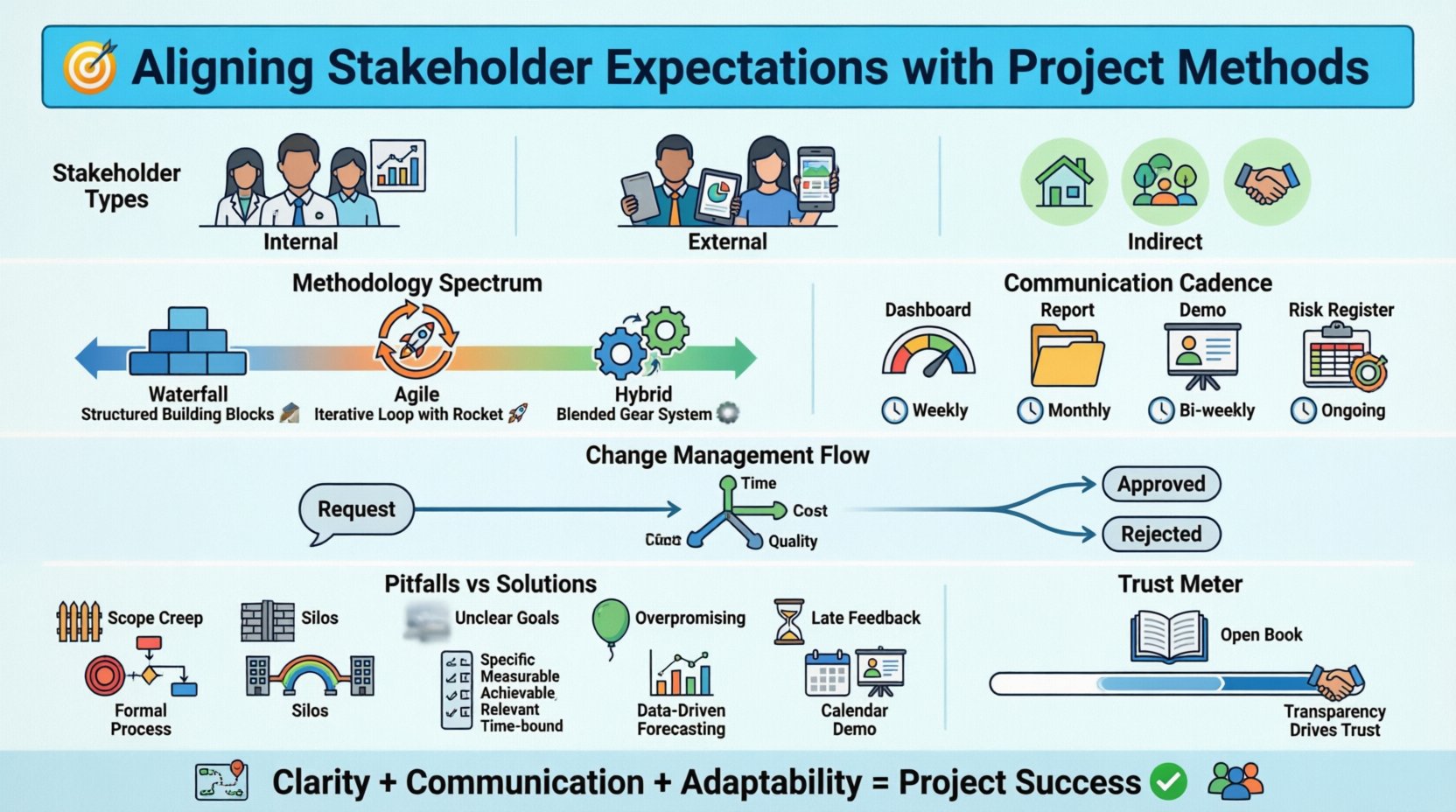
Project management is often described as the art of balancing constraints, but at its core, it is a discipline of communication and alignment. A project can be technically flawless yet fail if the deliverables do not match what the stakeholders envisioned. Conversely, a project that meets expectations can be doomed if the execution method creates unnecessary friction. The intersection of stakeholder psychology and project methodology is where true success is found. 🎯
This guide explores how to bridge the gap between what people expect and how the work gets done. We will examine the nuances of different management frameworks, communication cadences, and the mechanisms required to maintain alignment throughout the project lifecycle. 🛡️
🧠 Understanding the Core of Expectation Management
Expectations are not merely wishes; they are beliefs about future outcomes held by individuals involved in or affected by the project. These beliefs drive satisfaction. When reality meets or exceeds these beliefs, satisfaction follows. When there is a discrepancy, frustration ensues. To manage this, one must first identify who holds these expectations.
- Internal Stakeholders: Team members, department heads, and executive sponsors who provide resources.
- External Stakeholders: Clients, end-users, regulators, and partners who consume the final output.
- Indirect Stakeholders: Communities or groups impacted by the project’s existence without direct involvement.
Each group prioritizes different outcomes. Executives often prioritize ROI and timeline. Users prioritize usability and features. Regulators prioritize compliance and risk mitigation. Recognizing these divergences is the first step toward alignment. 🗺️
🛠️ Choosing the Right Methodology for the Audience
The project method you select dictates the rhythm of delivery and the visibility of progress. If the stakeholders expect predictability, a flexible, iterative approach might feel like chaos. If they expect rapid innovation, a rigid, phased approach might feel like bureaucracy. Matching the method to the expectation is critical.
1. Predictive Methods (Waterfall) 🏗️
Traditional predictive methods rely on detailed upfront planning. Requirements are defined before work begins, and changes are managed through formal control processes. This suits stakeholders who need certainty regarding budget, scope, and schedule early in the project.
- Best For: Construction, regulatory compliance, hardware manufacturing.
- Expectation Met: Fixed scope, known costs, clear milestones.
- Risk: Late discovery of requirements gaps if users cannot visualize the end product early.
2. Adaptive Methods (Agile) 🚀
Adaptive frameworks prioritize flexibility and customer collaboration. Work is delivered in small increments, allowing for feedback loops at every stage. This suits stakeholders who know the problem but not the solution, or who need to react quickly to market changes.
- Best For: Software development, product innovation, marketing campaigns.
- Expectation Met: Rapid value delivery, adaptability to change, continuous feedback.
- Risk: Uncertainty in final cost and timeline if scope is not controlled.
3. Hybrid Approaches 🔀
Hybrid models combine the structure of predictive methods with the flexibility of adaptive ones. This is common in large enterprises where governance is strict, but product teams need autonomy.
- Best For: Complex integrations, regulated software, large-scale transformations.
- Expectation Met: Governance compliance mixed with iterative delivery.
📢 Communication Protocols and Cadence
Even with the right method, alignment fades without consistent communication. Stakeholders need to know the status of the project without micromanaging the team. Establishing a communication plan ensures the right information reaches the right people at the right time.
Key Communication Channels:
- Executive Dashboards: High-level metrics (budget burn, milestone status) for sponsors.
- Progress Reports: Detailed updates for functional managers and team leads.
- Demos/Showcases: Live demonstrations for end-users to validate functionality.
- Risk Registers: Transparent logs of potential issues and mitigation plans.
Frequency matters. A weekly status email may suffice for long-term infrastructure projects, while daily stand-ups might be necessary for critical software releases. The goal is to prevent surprises. If a stakeholder learns about a major issue in a meeting rather than a report, the trust is already damaged. 🤝
🔄 Handling Scope and Change
Change is inevitable. Stakeholders often realize new needs once they see the work in progress. The method you use determines how you handle these requests without derailing the project.
- Change Control Board (CCB): A formal group that reviews and approves changes in predictive environments.
- Backlog Grooming: A continuous process in adaptive environments where new requests are prioritized against existing work.
When a stakeholder requests a change, the response should not be a simple “yes” or “no.” It should be an analysis of impact.
Impact Analysis Steps:
- Timeline: Will this delay the launch date?
- Cost: Does this require additional budget or resources?
- Quality: Does this introduce technical debt or risk?
Presenting these trade-offs empowers stakeholders to make informed decisions. It shifts the dynamic from “the team won’t do it” to “here is the cost of doing it.” This transparency is vital for maintaining authority and trust. 📉
🛑 Common Pitfalls & Solutions
Avoiding misalignment requires recognizing patterns of failure. Below is a breakdown of common issues and how to address them structurally.
| Pitfall | Root Cause | Solution |
|---|---|---|
| Scope Creep | Informal approval of small changes | Implement a formal change request process |
| Communication Silos | Departmental barriers | Establish cross-functional liaison roles |
| Unclear Goals | Vague project charter | Define SMART objectives before kickoff |
| Overpromising | Desire to please stakeholders | Use data to set realistic baselines |
| Late Feedback | Infrequent stakeholder reviews | Schedule regular milestone demos |
📏 Measuring Alignment
How do you know if alignment is working? Metrics beyond time and budget are necessary. You must measure satisfaction and engagement.
- Stakeholder Satisfaction Surveys: Conduct periodic surveys to gauge sentiment regarding project health and communication.
- Decision Velocity: Measure how quickly stakeholders approve decisions. Delays often indicate confusion or lack of trust.
- Requirement Stability: Track the rate of requirement changes. High churn indicates poor initial discovery.
- Adoption Rates: Post-launch, measure how well the solution is being used by the intended audience.
🤝 Building Trust Through Transparency
Trust is the currency of stakeholder management. It is built when you deliver bad news early. If a milestone is at risk, communicate it immediately. Hiding problems until the deadline creates a crisis that destroys credibility. 🚨
Transparency also involves admitting when assumptions were wrong. If the initial estimate was based on incomplete data, acknowledge the gap and present a revised plan. This honesty reinforces the professional relationship and reduces the likelihood of conflict later.
🏁 Final Thoughts on Methodology and People
The tools and frameworks we use are secondary to the human element of project management. Whether you use a predictive, adaptive, or hybrid approach, the goal remains the same: ensuring that the output delivers value to those who need it. Aligning expectations is not a one-time meeting at the start of a project. It is a continuous practice of listening, communicating, and adjusting.
By understanding the needs of your stakeholders and selecting the execution method that supports those needs, you create an environment where projects can thrive. Focus on clarity, maintain open channels, and respect the constraints of your resources. This disciplined approach leads to successful outcomes without the need for hype or shortcuts. ✅
Remember, the most sophisticated project plan is useless if the people funding and using the result are not on board. Prioritize the relationship as much as the roadmap. 🗺️👥