Now Reading: Crack Project Delivery Failures with AI: The 5 Whys Tool
-
01
Crack Project Delivery Failures with AI: The 5 Whys Tool



Crack Project Delivery Failures with AI: The 5 Whys Tool
Ever feel like you’re just putting out fires instead of solving the root cause? That’s where the AI-Powered 5 Whys Root Cause Analysis Tool from Visual Paradigm comes in. This powerful online tool is your secret weapon for cutting through the noise and getting to the real problem behind recurring issues like missed project deadlines. Instead of guessing, you can systematically drill down with AI to find the true root cause and build a plan to fix it for good. It’s not just a tool; it’s a game-changer for teams tired of quick fixes that never stick.
Imagine a world where your team can analyze a problem, identify its true cause, and create a professional, shareable report in minutes, not weeks. That’s the reality with this tool. It guides you through a structured, step-by-step process, from defining the problem to implementing a solution. The best part? It leverages AI to generate a complete first draft, saving you hours of brainstorming and typing. You can then easily refine the AI’s suggestions to fit your unique context. It’s like having an expert analyst on your team, but it’s all done right in your browser.
Ready to stop being reactive and start being proactive? Let’s dive into how this tool works, step by step, using a real-world example of tackling missed project delivery deadlines.
-
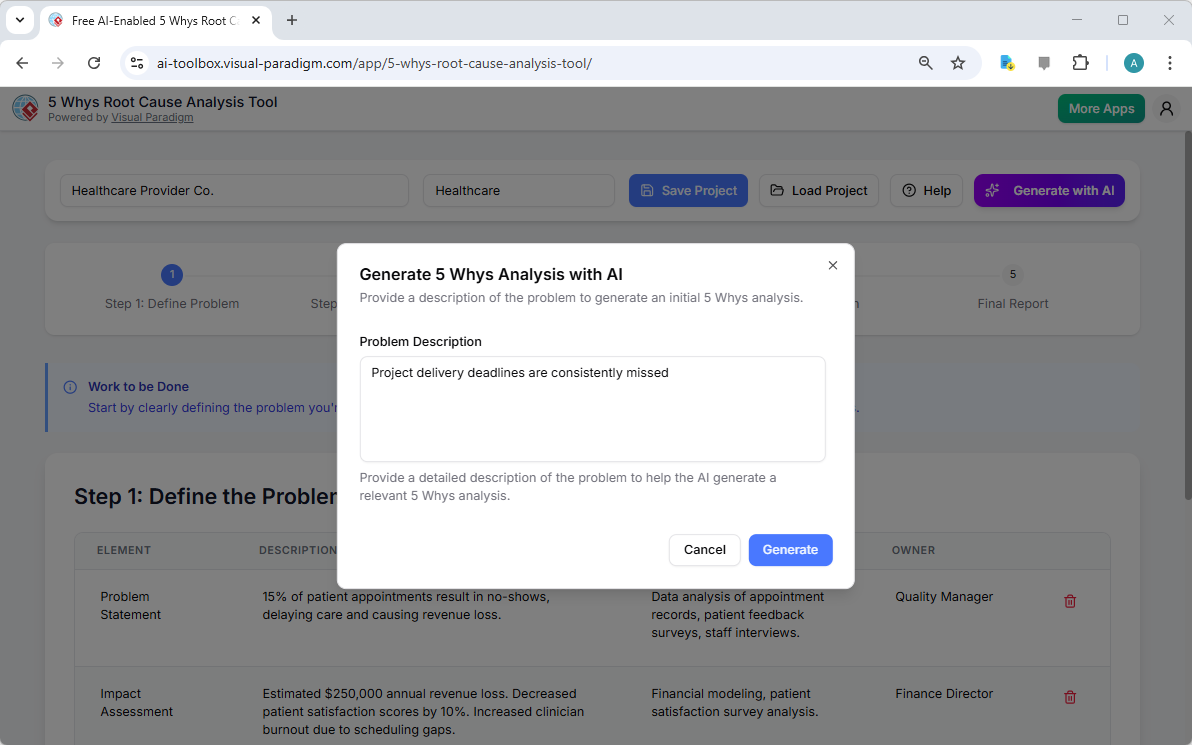
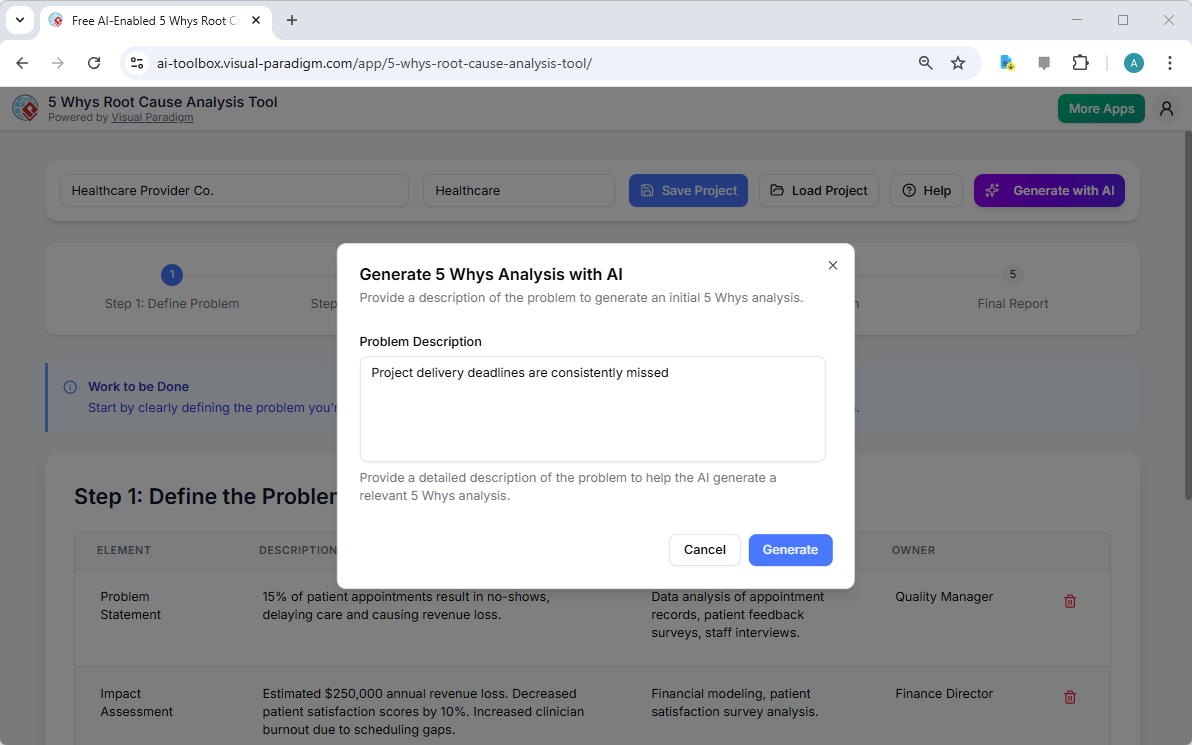
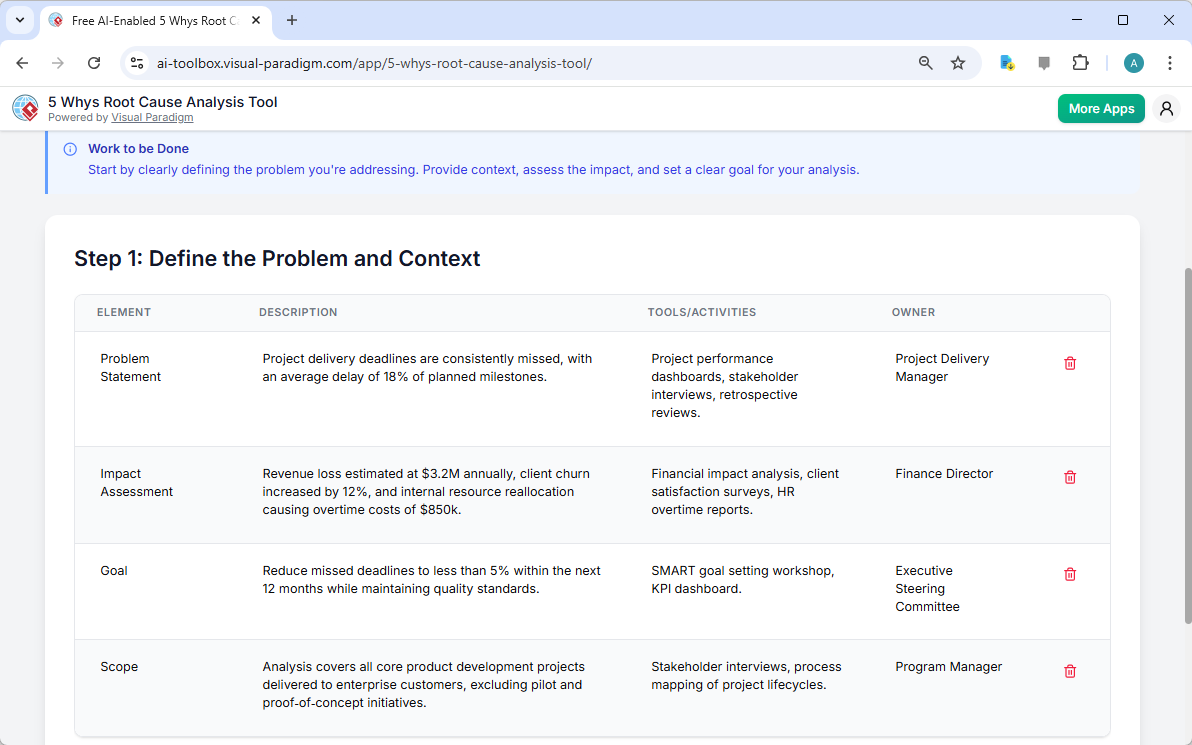
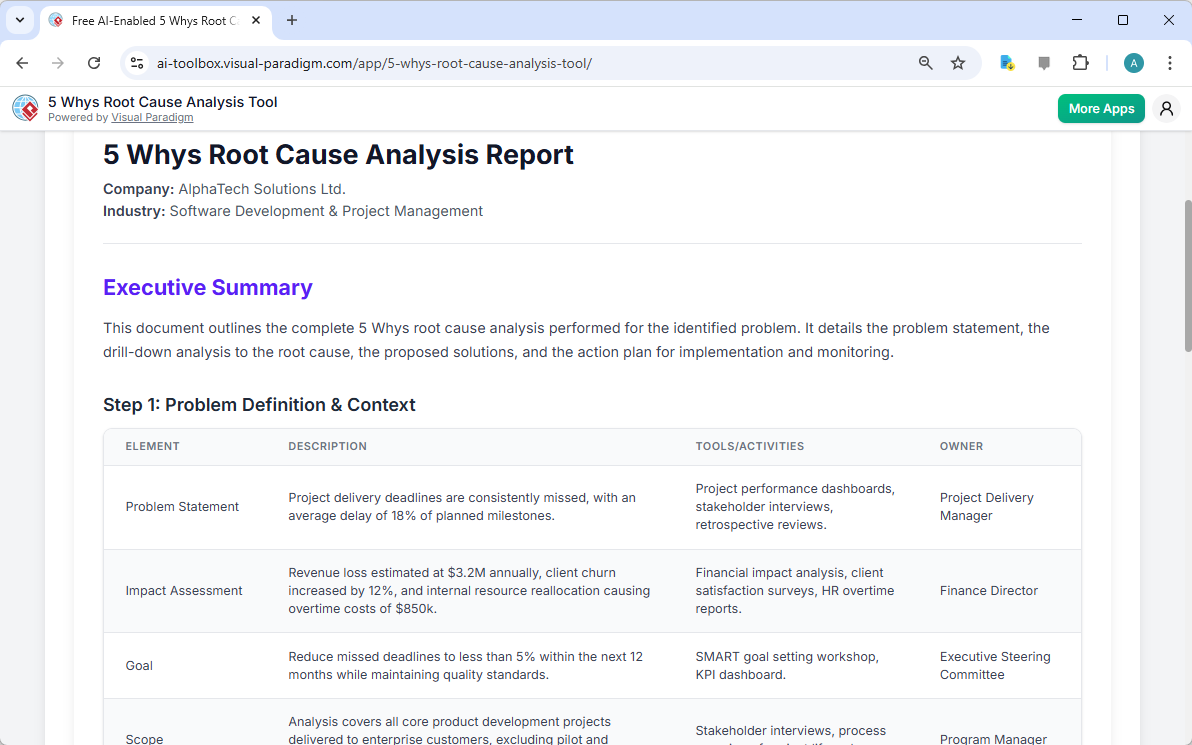
Define the Problem: The first step is crystal clear. You start by defining the problem statement. In the image, the user has input “Project delivery deadlines are consistently missed.” The AI immediately generates a detailed context, including the impact (revenue loss, client churn), the goal (reduce missed deadlines to <5%), and the scope (all core product development projects). This creates a shared understanding for the entire team.
-
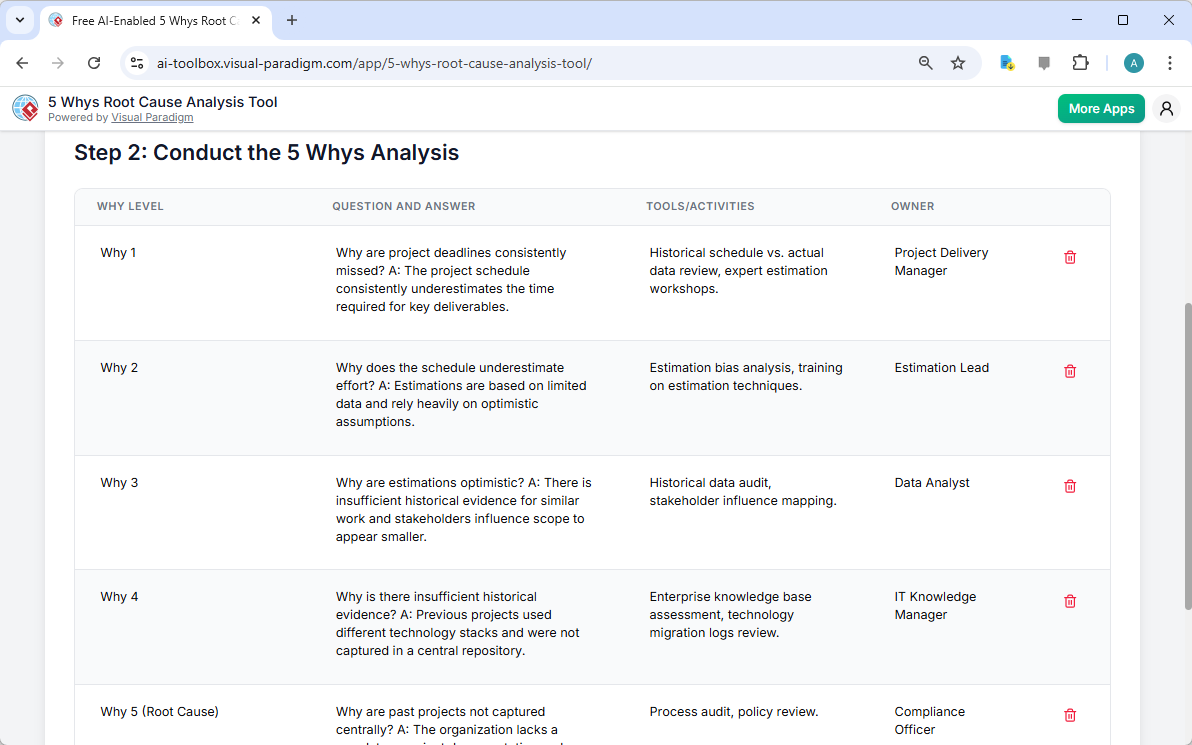
Conduct the 5 Whys: Now, the tool guides you through the core of the analysis. The AI generates a series of “Why?” questions, each one peeling back a layer of the problem. For example, the first “Why?” might be “Why are project deadlines consistently missed?” The answer could be “The project schedule consistently underestimates the time required for key deliverables.” The AI then asks “Why?” again, leading to the next level of insight. This process continues until you reach the true root cause, which in this case might be a lack of a central repository for past project data.
-
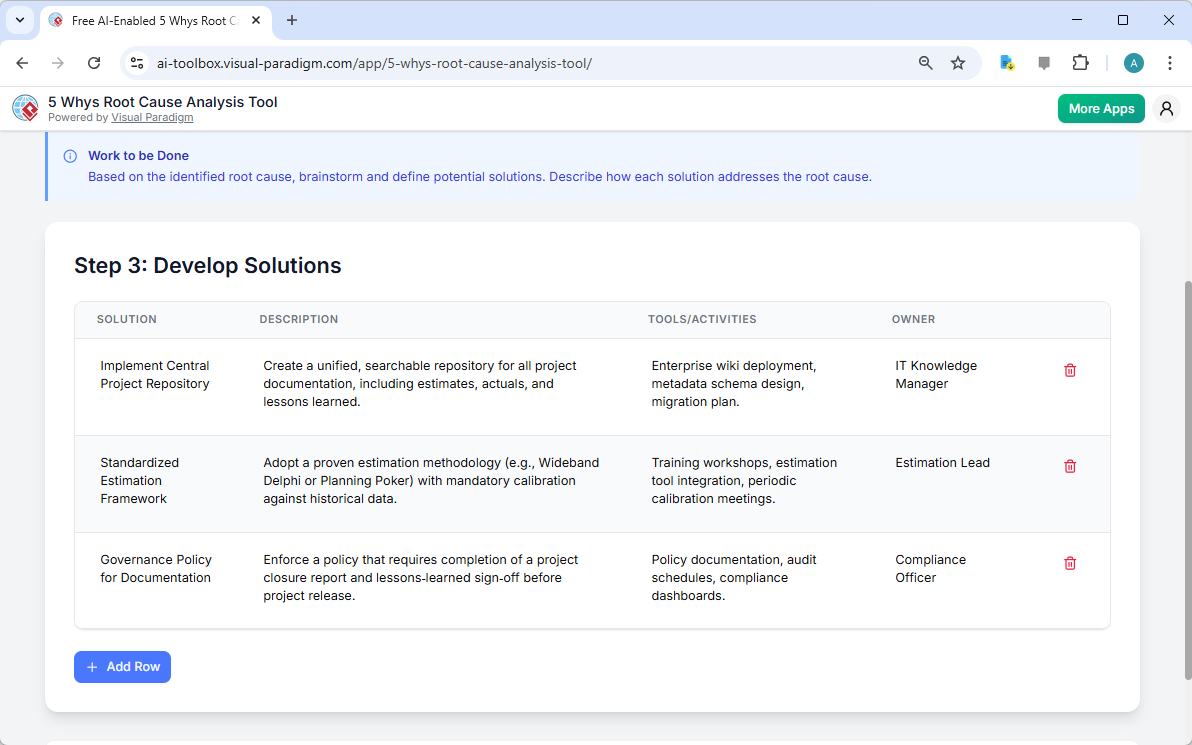
Develop Solutions: Once the root cause is identified, the tool helps you brainstorm solutions. The AI suggests ideas like implementing a central project repository or standardizing estimation frameworks. You can easily add, edit, or delete these suggestions to create a tailored action plan.
-
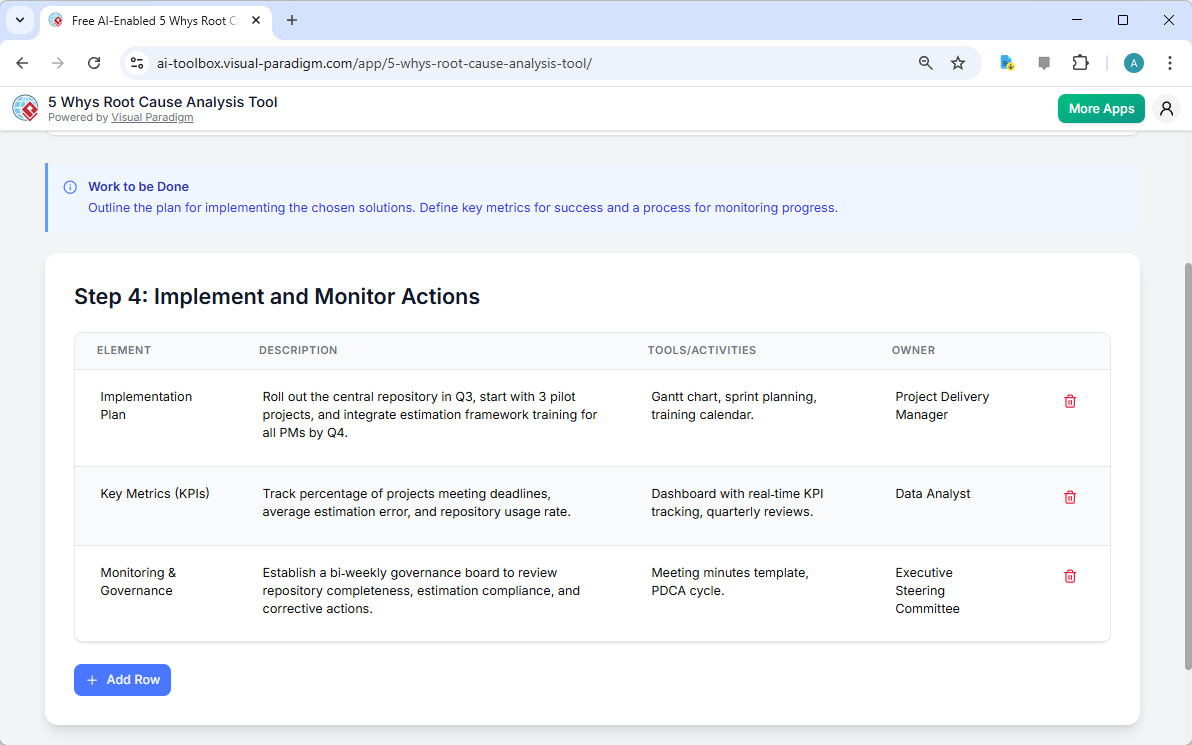
Implement and Monitor: The final step is about execution. You define the implementation plan, set key metrics (KPIs) to track success, and establish a monitoring process. This ensures that the solutions are actually implemented and their impact is measured.
-
Generate a Professional Report: The tool compiles all your work into a polished, professional report. This is the final product—a clear, concise document that can be shared with stakeholders, management, or used for your own records.
With this tool, you’re not just solving a problem; you’re building a culture of continuous improvement. You can use it to analyze any recurring issue, from technical failures to customer service complaints. The structured approach ensures you don’t miss anything, and the AI makes the process fast and efficient. It’s a must-have for any team that wants to move beyond symptoms and fix the root cause of their problems.
-
Get to the Root Cause Fast: The AI-powered analysis saves you hours of manual work, giving you a professional report in minutes.
-
Build a Shared Understanding: The structured format ensures everyone on the team is on the same page, reducing miscommunication and confusion.
-
Develop Effective Solutions: By identifying the true root cause, you can create solutions that prevent the problem from ever happening again.
-
Improve Team Alignment: The final report serves as a single source of truth, ensuring everyone understands the problem and the plan to fix it.
-
Keep Your Data Private: Your analysis is saved locally on your computer, ensuring your sensitive business information stays secure.
Stop wasting time on quick fixes that don’t last. It’s time to tackle your biggest problems head-on with the 5 Whys Root Cause Analysis Tool.
Don’t just guess at the cause of your issues—use a powerful, AI-powered tool to find the real answer. Try the 5 Whys Root Cause Analysis Tool today and start turning your team’s problems into opportunities for growth and improvement. It’s the fastest way to get to the root cause and build a better future for your business.
Ready to transform your problem-solving process? Click the link below to get started with the 5 Whys Root Cause Analysis Tool and see the difference it can make for your team.
Visual Reference:
Visual Reference:
Visual Reference:
Visual Reference:
Visual Reference:
Visual Reference:
Related Links
The 5 Whys technique is an iterative interrogative method used to explore the cause-and-effect relationships underlying a particular problem. In project management and quality control, it is frequently combined with fishbone (Ishikawa) diagrams to perform comprehensive root cause analysis, allowing teams to move beyond surface-level symptoms to identify the actual source of an issue,. Modern platforms now offer AI-powered generators that can automate the creation of these diagrams from text descriptions, instantly uncovering root causes and organizing them into structured visual models,.
-
Fishbone Diagram and 5 Whys – Enhancing Root Cause Analysis: A specialized guide on integrating the 5 Whys technique with fishbone diagrams to improve problem-solving accuracy.
-
AI-Powered Fishbone Diagram Generator – Uncover Root Causes in Seconds: This tool leverages artificial intelligence to automate the identification of root causes and build structured diagrams instantly.
-
Unraveling Complex Issues: The Power of Cause and Effect Analysis: An article explaining how structured analysis enables teams to solve difficult business and operational problems.
-
Fishbone Analysis: Ishikawa Diagram Concepts and AI-Powered Tools: A detailed exploration of key analysis concepts and how generative AI enhances traditional root cause methodologies.
-
Free Online Fishbone Diagram Tool – Collaborative Problem Solving: A browser-based platform for creating professional diagrams to visually map cause-and-effect without software installation.
-
Practical Guide to Creating Cause and Effect Diagrams: A step-by-step tutorial for building effective diagrams to support systematic root cause analysis.
-
Cause and Effect Analysis Toolkit – Best Practices and Templates: A comprehensive resource providing templates and best practices for conducting in-depth problem analysis.
-
Step-by-Step Guide to Creating a Fishbone Diagram: A hands-on guide for identifying root causes within processes, projects, or complex systems.
-
Cause and Effect Diagram Gallery – Real-World Examples: A curated collection of diagrams showing how root causes are identified across engineering and quality management.
-
Fishbone (Ishikawa) Diagram Template – Ready-to-Use Resources: Access customizable templates to quickly visualize causal relationships and streamline the analysis process.