
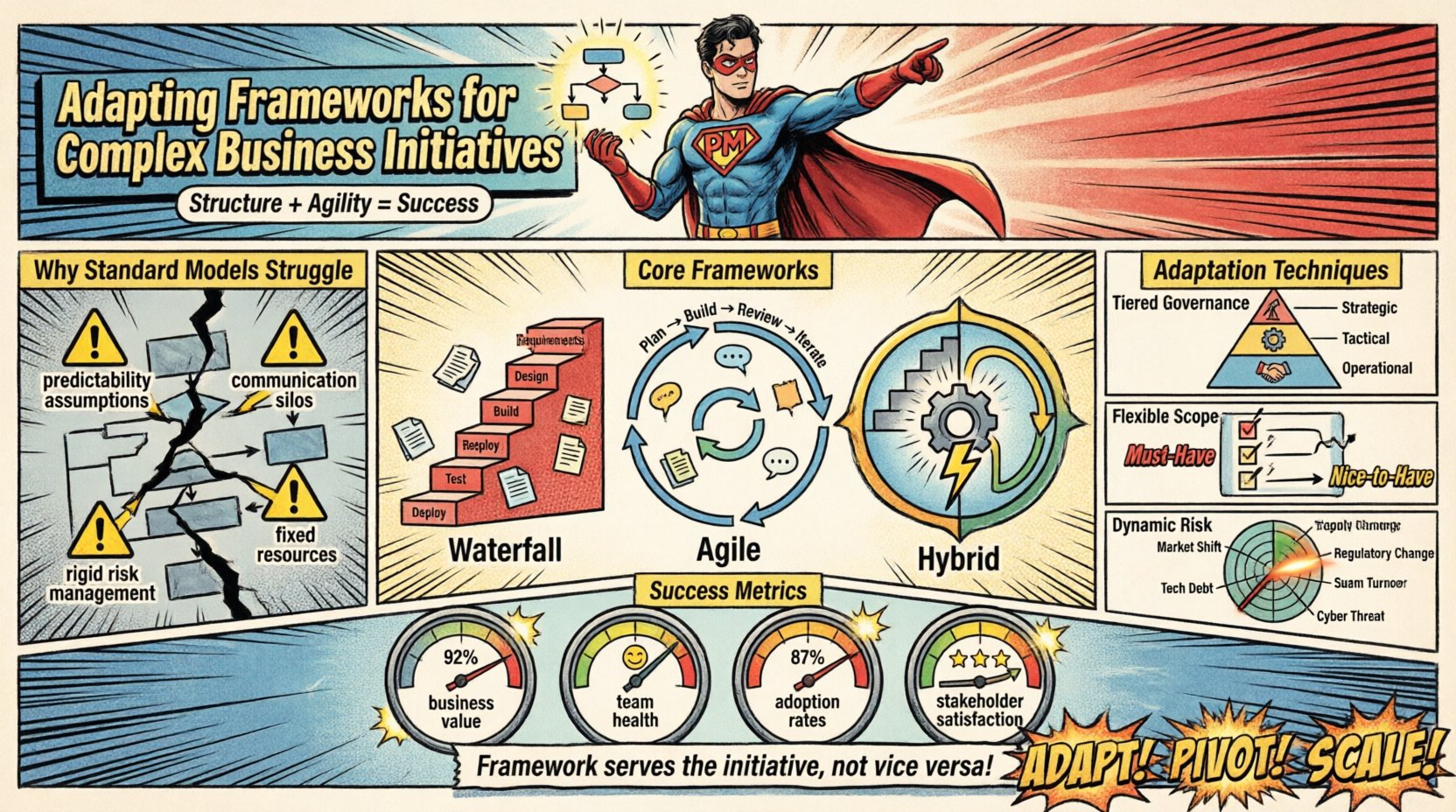
When organizations embark on large-scale projects, the path forward is rarely linear. Traditional project management methodologies often rely on predictable environments where requirements are clear and scope remains stable. However, complex business initiatives introduce layers of uncertainty, cross-departmental dependencies, and shifting market conditions. To succeed, leaders must move beyond rigid adherence to a single methodology. Instead, they must tailor frameworks to fit the specific nuances of the initiative. This approach ensures structure without stifling the agility needed to navigate ambiguity.
This guide explores how to effectively adapt project management frameworks for high-stakes environments. We will examine the limitations of standard models, discuss hybrid strategies, and outline governance structures that support complexity. The goal is not to abandon process but to refine it.
Why Standard Models Struggle with Complexity 📉
Standard frameworks were designed for specific contexts. A methodology built for software development may not translate well to organizational change management. Similarly, a rigid planning model often fails when external factors dictate rapid pivots. Understanding why these models fail is the first step toward adaptation.
- Predictability Assumptions: Many models assume requirements are known upfront. Complex initiatives often involve discovery phases where requirements evolve.
- Communication Silos: Standard hierarchies can slow down decision-making when cross-functional collaboration is required.
- Risk Management: Traditional risk registers often focus on known risks. Complex environments introduce unknown unknowns that require dynamic mitigation.
- Resource Constraints: Fixed resource allocation models do not account for the fluid nature of talent and budget in large-scale initiatives.
Recognizing these friction points allows leaders to identify where the framework needs reinforcement or relaxation. Adaptation is not about discarding the method; it is about modifying the application of its principles.
Core Frameworks and Their Suitability 🧩
Before adapting, one must understand the baseline. Different frameworks offer different strengths regarding control, flexibility, and speed. Selecting the right starting point is critical.
1. Predictive (Waterfall) Approaches
Best suited for initiatives with fixed scope, regulatory constraints, or physical construction elements. The focus is on detailed planning and sequential execution.
- Requires comprehensive upfront documentation.
- Change control processes are strict.
- Success is measured against the original baseline.
2. Adaptive (Agile) Approaches
Best suited for initiatives where the solution is unknown or the market is volatile. The focus is on iterative delivery and feedback loops.
- Embraces changing requirements.
- Delivers value in small increments.
- Relies on frequent stakeholder collaboration.
3. Hybrid Models
Combines elements of predictive and adaptive methods. This is often the default choice for complex business initiatives.
- Uses predictive planning for governance and budget.
- Uses adaptive execution for development or implementation.
- Requires clear boundaries between the two modes.
Strategic Adaptation Techniques 🛠️
Once a baseline framework is selected, specific adjustments are necessary to handle complexity. These adjustments span governance, communication, and delivery.
1. Tiered Governance Structures
Complex initiatives often involve multiple workstreams. A single governance board cannot oversee every detail. Implementing a tiered approach allows for efficient oversight.
- Strategic Level: Focuses on alignment with business goals, budget approval, and major risk acceptance.
- Tactical Level: Manages cross-workstream dependencies, resource allocation, and milestone tracking.
- Operational Level: Handles daily tasks, stand-ups, and immediate issue resolution.
2. Flexible Scope Management
In complex environments, scope must be treated as a variable rather than a constant. Define the “value” of the initiative rather than just the “features”.
- Establish a “Must-Have” vs. “Nice-to-Have” hierarchy.
- Allow scope to be reprioritized at defined checkpoints.
- Ensure stakeholders understand the trade-offs between time, cost, and scope.
3. Dynamic Risk Registers
Risk management cannot be a one-time activity at the start of a project. It must be continuous.
- Review risks at every major milestone.
- Include emerging risks from external market shifts.
- Assign ownership for every identified risk, not just the mitigation plan.
Framework Adaptation Matrix 📊
The following table outlines common adaptation strategies based on the type of complexity encountered.
| Complexity Driver | Adaptation Strategy | Outcome |
|---|---|---|
| High Uncertainty | Shift to shorter feedback loops and iterative planning. | Earlier detection of misalignment. |
| High Dependency | Implement integrated master schedules and dependency boards. | Reduced bottlenecks and delays. |
| Regulatory Constraints | Retain predictive phases for compliance checkpoints. | Ensured audit readiness without slowing delivery. |
| Multi-Team Coordination | Adopt scaling frameworks with clear role definitions. | Improved communication and reduced redundancy. |
Governance in Hybrid Environments ⚖️
Hybrid environments introduce specific governance challenges. The primary conflict usually arises between the need for control and the need for speed. Resolving this requires clear definitions of authority.
- Decision Rights: Clearly define who has the authority to approve changes at each tier. Ambiguity here causes delays.
- Reporting Cadence: Align reporting frequencies with the rhythm of work. Operational teams may need daily updates, while leadership needs monthly summaries.
- Tool Standardization: Ensure all teams use compatible data structures, even if they use different workflows.
Without consistent governance, hybrid models can devolve into chaos. The framework must provide guardrails that allow teams to move quickly within safe boundaries.
Measuring Success Beyond Delivery 📊
In complex initiatives, delivery is only one metric of success. The value realized must be tracked to ensure the adaptation was effective. Traditional metrics like “on time” and “on budget” are insufficient on their own.
- Business Value Realization: Track the actual impact on revenue, efficiency, or customer satisfaction post-implementation.
- Team Velocity and Health: Monitor burnout rates and throughput to ensure sustainability.
- Adoption Rates: For initiatives involving change management, measure how quickly the new processes are adopted.
- Stakeholder Satisfaction: Regular surveys to gauge confidence in the leadership and the direction of the initiative.
Common Pitfalls to Avoid 🚫
Even with a well-thought-out adaptation plan, organizations often stumble. Awareness of common traps helps maintain momentum.
- Over-Engineering: Creating processes that are too complex for the actual size of the team. Keep documentation lean.
- Partial Adoption: Adopting the terminology of a framework without the underlying discipline. This creates false confidence.
- Ignoring Culture: Forcing a framework that contradicts the organizational culture. Adaptation must respect how people actually work.
- Lack of Training: Assuming the team understands the adapted framework without proper onboarding.
Building Organizational Resilience 🧠
The ultimate goal of adapting frameworks is not just to complete a single initiative but to build an organization capable of handling future complexity. This requires institutionalizing the lessons learned.
- Post-Initiative Reviews: Conduct thorough retrospectives to identify what worked and what did not.
- Knowledge Repositories: Document the adapted processes so they can be reused for similar future projects.
- Capability Building: Invest in training that focuses on the principles of the framework rather than just the tools.
Complex business initiatives demand a thoughtful approach to project management. By selecting the right baseline and applying strategic adaptations, leaders can navigate uncertainty with confidence. The framework serves the initiative, not the other way around. This flexibility is the key to sustainable success in dynamic environments.
When the plan meets reality, the ability to pivot while maintaining control distinguishes successful organizations from those that struggle. Continual refinement of the management approach ensures that the organization remains agile enough to respond to change while stable enough to deliver results.
Final Thoughts on Framework Evolution 🔄
Project management is not a static discipline. As business environments evolve, so must the tools used to manage them. Adapting frameworks is a continuous process of learning and adjustment. It requires humility to admit when a standard model does not fit and the courage to change course. By prioritizing value delivery and maintaining clear communication, teams can transform complexity from a barrier into a competitive advantage.