


Introduction
The Program Evaluation and Review Technique (PERT) is a project management tool originally developed for complex, uncertain projects such as software development and engineering. While often associated with high-risk, time-critical projects, PERT is equally valuable in real-world, human-centered planning — such as organizing a wedding.
This case study explores how a PERT chart can be effectively applied to plan a wedding over a three-month period (January to March 2025), highlighting its utility in managing dependencies, estimating durations, identifying the critical path, and ensuring timely delivery.
Project Overview: A Wedding in March/April 2025
Objective:
To successfully plan and execute a wedding by March 30, 2025, with key milestones achieved in a logical, timely sequence.
Timeline:
-
Planning Window: January 10 – March 30, 2025 (~80 days)
-
Wedding Date: Targeted for late March / early April 2025
Core Phases:
| Phase | Key Activities |
|---|---|
| Pre-Planning | Finalize date, create guest list |
| Venue & Catering | Book venue, select caterer |
| Invitations & Decor | Design invites, arrange flowers & decor |
| Final Preparations | Finalize guest count, coordinate logistics |
-
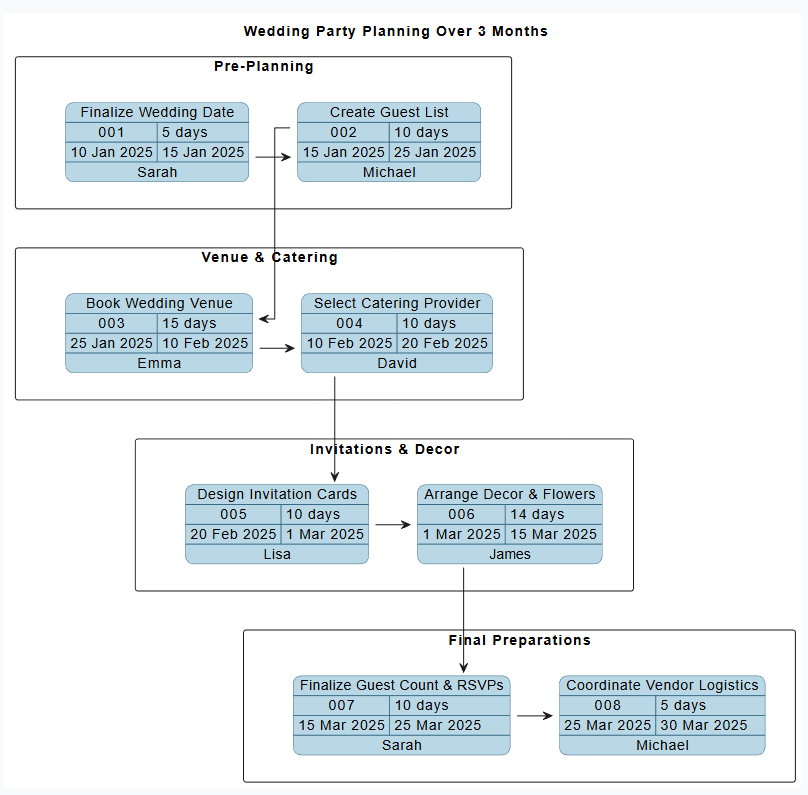
the pert chart generated by the Visual Paradigm AI Chatbot
Key Tasks and Assignments
The following eight tasks have been identified and logically sequenced based on dependency and workflow:
| Task ID | Task Description | Duration | Responsible Person | Start Date | Finish Date |
|---|---|---|---|---|---|
| 001 | Finalize Wedding Date | 5 days | Sarah | 10 Jan | 15 Jan 2025 |
| 002 | Create Guest List | 10 days | Michael | 15 Jan | 25 Jan 2025 |
| 003 | Book Wedding Venue | 15 days | Emma | 25 Jan | 10 Feb 2025 |
| 004 | Select Catering Provider | 10 days | David | 10 Feb | 20 Feb 2025 |
| 005 | Design Invitation Cards | 10 days | Lisa | 20 Feb | 1 Mar 2025 |
| 006 | Arrange Decor & Flowers | 14 days | James | 1 Mar | 15 Mar 2025 |
| 007 | Finalize Guest Count & RSVPs | 10 days | Sarah | 15 Mar | 25 Mar 2025 |
| 008 | Coordinate Vendor Logistics | 5 days | Michael | 25 Mar | 30 Mar 2025 |
Dependency Structure & Logical Flow
All tasks follow a linear, sequential dependency chain:
001 → 002 → 003 → 004 → 005 → 006 → 007 → 008
This creates a clear critical path, meaning any delay in an earlier task will directly impact the final wedding date.
Why This Matters:
-
Early tasks (like date finalization) are highly influential.
-
Delays in the middle (e.g., venue booking) can cascade through the entire schedule.
-
The end date is not flexible — it’s driven by the last activity on the critical path.
PERT Chart Elements in Practice
| Element | Description | Application in This Case |
|---|---|---|
| Nodes (Tasks/Milestones) | Represent individual activities or events. Include: ID, name, duration, responsible person, dates | Each task is a node with rich metadata for clarity |
| Arrows | Show dependencies (predecessor → successor) | Arrows link tasks in chronological order |
| Three-Point Estimation | Optimistic (O), Most Likely (M), Pessimistic (P) → Expected = (O + 4M + P)/6 | Used only when uncertainty is high; here, deterministic durations are sufficient due to predictable wedding planning |
| Critical Path | Longest path in the network → determines minimum project duration | Path: 001 → 002 → 003 → 004 → 005 → 006 → 007 → 008 (total = 79 days) |
| Float/Slack | Time a non-critical task can be delayed without delaying the project | Minimal — all tasks lie on the critical path |
| Network Diagram | Focuses on logical flow, not calendar bars | Visualizes workflow better than a Gantt chart |
⚠️ Note: In this simplified wedding scenario, there are no parallel tasks, making the PERT chart resemble a linear flowchart. However, real weddings may include overlapping activities (e.g., researching venues and catering simultaneously), which would add complexity and parallel paths.
Step-by-Step Process to Build the PERT Chart
| Step | Action | Outcome |
|---|---|---|
| 1 | Define Project Scope & Objective | “Wedding ready by March 30, 2025” |
| 2 | Identify All Tasks & Milestones | 8 core tasks broken down from pre-planning to final logistics |
| 3 | Determine Dependencies | Each task depends on the previous one (FS: Finish-to-Start) |
| 4 | Assign Responsibilities | Sarah, Michael, Emma, David, Lisa, James assigned clearly |
| 5 | Estimate Durations | Deterministic values (single durations) used due to low uncertainty |
| 6 | Draw the Network Diagram | Tasks placed left-to-right in chronological order; arrows show sequence |
| 7 | Calculate Forward & Backward Passes (Critical Path) | Confirms that the full sequence (79 days) is the minimum time required |
| 8 | Review and Validate | Finalized with both partners and planners to ensure realism |
Critical Path Analysis
Critical Path:
001 → 002 → 003 → 004 → 005 → 006 → 007 → 008
Total Duration:
-
5 + 10 + 15 + 10 + 10 + 14 + 10 + 5 = 79 days
✅ Conclusion: The wedding can be completed by March 30, 2025, assuming all tasks start on schedule and no delays occur.
📌 Note: The longest individual task is venue booking (15 days) — a key bottleneck. This highlights the importance of securing the venue early.
Key Insights & Lessons Learned
| Insight | Explanation |
|---|---|
| Early Tasks Are Critical | Finalizing the date (001) and guest list (002) must happen early to avoid cascading delays. |
| Bottlenecks Exist | Venue booking (003) and decor/flowers (006) are the longest tasks — require buffer time or risk of delay. |
| Accountability Is Clear | Each task has a named owner, reducing ambiguity and improving follow-through. |
| Critical Path is Visual | The chart makes it easy to see which activities cannot be delayed — helping avoid scope creep. |
| Delays Cascade | A 3-day delay in guest list (002) pushes the rest of the timeline forward by 3 days. |
| Scalability | The same PERT logic applies to software launches, home renovations, or product launches. |
Tips for Effective PERT Use in Real-World Projects
| Tip | Why It Works |
|---|---|
| ✅ Start Simple | Use deterministic durations for predictable tasks like wedding planning — avoid overcomplicating with three-point estimates |
| ✅ Group Tasks by Phase | Organize into Pre-Planning, Venue & Catering, Invitations & Decor, Final Prep for readability |
| ✅ Label Nodes Richly | Include ID, name, duration, owner, dates — makes the chart self-explanatory |
| ✅ Highlight the Critical Path | Use bold or red coloring to draw attention to the longest path |
| ✅ Assign Owners (RACI or Named Roles) | Prevents “who’s doing what?” confusion and promotes ownership |
| ✅ Revisit Monthly | Scope creep is common in weddings (e.g., new guests, alternate vendors) — update the chart regularly |
| ✅ Add Buffers for High-Risk Tasks | For venue booking in peak season, consider adding 2 extra days in pessimistic estimate |
| ✅ Combine with Gantt Charts | Use PERT for logic and dependencies; use Gantt for timeline visibility |
Visual Representation (Conceptual PERT Diagram)
[001] Finalize Date (5d) → [002] Guest List (10d) → [003] Book Venue (15d)
                             → [004] Select Caterer (10d) → [005] Design Invites (10d)
                             → [006] Decor & Flowers (14d) → [007] Final Count (10d)
                             → [008] Vendor Logistics (5d)
Critical Path: All tasks → Total Duration = 79 days
Start: Jan 10, 2025
Finish: Mar 30, 2025
Conclusion: The Power of PERT in Everyday Planning
While PERT is often taught in technical or engineering contexts, this case study demonstrates its practical, accessible value in personal and real-life project management — specifically wedding planning.
By applying PERT principles, the couple gains:
-
Clarity on task sequences
-
Visibility into bottlenecks and risks
-
Confidence in meeting key deadlines
-
A structured way to track progress and adapt
💡 Takeaway:
“A well-structured PERT chart turns chaotic planning into manageable, actionable steps — whether you’re organizing a wedding, launching a product, or building a home.”
This framework is not limited to weddings. It scales seamlessly to:
-
Software product launches
-
Home renovations
-
Event management
-
Academic thesis writing
-
Startups and business planning
Appendix: PERT Formula (for reference)
For uncertain tasks with high variability:
Expected Duration = (Optimistic + 4 × Most Likely + Pessimistic) / 6
E = (O + 4M + P) / 6
Example:
-
O = 3 days, M = 5 days, P = 7 days
→ E = (3 + 4×5 + 7) / 6 = (3 + 20 + 7)/6 = 30/6 = 5 days
(Used in high-uncertainty scenarios like construction or R&D. In wedding planning, single estimates suffice.)
Final Thoughts
Wedding planning, with its emotional stakes and tight timelines, is a perfect example of how structured project management tools can bring order, reduce stress, and increase success probability.
The PERT chart is more than a diagram — it’s a decision-making framework that transforms vague ideas into actionable plans. By visualizing dependencies, estimating realistically, and focusing on the critical path, couples can plan with confidence and ensure their special day happens — not just on time, but with care and intention.
📘 For Further Reading or Application:
- AI Chatbot Feature – Intelligent Assistance for Visual Paradigm Users: This resource introduces the AI-powered chatbot functionality designed to provide users with instant guidance, task automation, and enhanced productivity.
- Pert Chart Tool – Visual Paradigm Online: An overview of a powerful tool that helps project managers visualize task dependencies, estimate timelines, and manage project schedules effectively in a cloud environment.
- AI Chatbot for Diagramming: How It Works with Visual Paradigm: This article explains how the chatbot acts as an AI-powered modeling assistant that turns natural language directly into diagrams without requiring knowledge of specific syntax.
- Complete PERT Chart Tutorial – Visual Paradigm: A step-by-step tutorial designed to guide users through the process of creating and utilizing PERT charts to plan and manage complex projects.
- Visual Paradigm AI Chatbot: Turn Your Ideas into Diagrams Instantly: This guide highlights the advanced assistant’s ability to visualize concepts through conversational prompts, allowing diagrams to grow from raw text into full system designs.
- Pert Chart for Project Management – Cybermedian: This resource provides practical insights and real-world online examples for using PERT charts to schedule tasks and plan project workflows.
- Visual Paradigm AI Chatbot: The World’s First Purpose-Built AI Assistant for Visual Modeling: An article celebrating the launch of a groundbreaking assistant specifically engineered to handle visual modeling tasks through intelligent natural language interactions.
- Integrating PERT Charts with RACI Roles in Task Management: A practical guide on how to combine PERT charts with RACI roles to enhance planning accuracy, timeline estimation, and team accountability.
- Case Study: Enhancing System Modeling Efficiency with Visual Paradigm’s AI-Powered Chatbot: This detailed case study proves how the chatbot improves modeling productivity and accuracy by enabling conversational diagram creation.
- Enhanced PERT Chart Features – Visual Paradigm: Explore advanced capabilities within the tool, including dynamic scheduling, critical path analysis, and seamless integration with broader project timelines.
Related posts:
 Revolutionizing Requirements: A Comprehensive Guide to AI-Powered Use Case Modeling
Optimizing the Use Case to Activity Diagram Flow with Visual Paradigm AI
UML Refinement Paths: Activity vs. Sequence Diagrams in the AI Era
A Comprehensive Guide to Generating Test Cases from Use Cases and Behavior Diagrams
Revolutionizing Requirements: A Comprehensive Guide to AI-Powered Use Case Modeling
Optimizing the Use Case to Activity Diagram Flow with Visual Paradigm AI
UML Refinement Paths: Activity vs. Sequence Diagrams in the AI Era
A Comprehensive Guide to Generating Test Cases from Use Cases and Behavior Diagrams