


Introduction: The Evolution of ArchiMate
ArchiMate 4 represents a transformative leap from ArchiMate 3.2, designed to simplify, unify, and modernize the enterprise architecture modeling language.
This version responds directly to contemporary challenges in enterprise modeling:
- The complexity and cognitive load of managing layered, hierarchical models
- The increasing hybrid nature of business operations (human + digital)
- The need for clearer alignment between strategy, operations, and change
By removing redundancies, redefining core concepts, and introducing a more intuitive visual framework, ArchiMate 4 aims to make architecture accessible, actionable, and aligned with stakeholder expectations.
🔍 ArchiMate 4 is not just an update—it’s a paradigm shift. It shifts from a rigid, top-down layering approach to a dynamic, modular, domain-based architecture that reflects the reality of today’s enterprises.
🔷 1. The Visual Revolution: The Hexagonion Framework
🔄 From Layered Matrix to Hexagonal Architecture
The most visually striking change in ArchiMate 4 is the replacement of the traditional rectangular, layered matrix with the Hexagonion Framework—a hexagonal structure that better reflects modern hybrid environments where humans, systems, and processes collaborate dynamically.
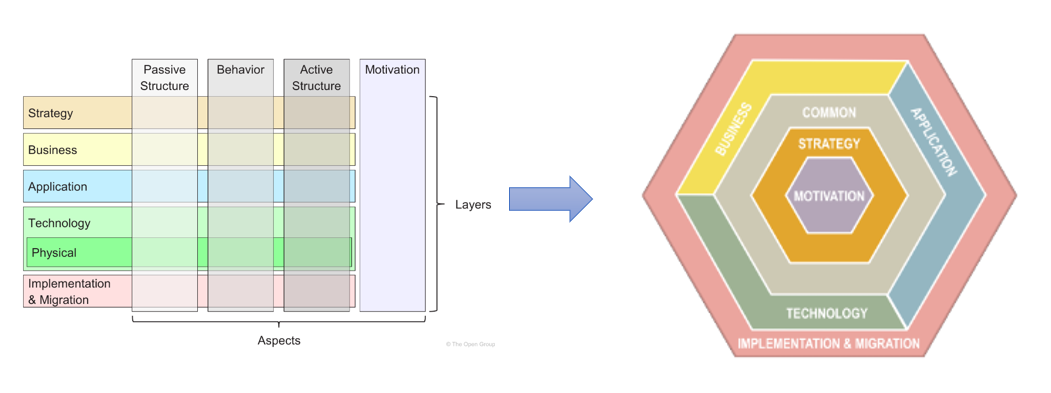
🧩 Structure of the Hexagonion Framework
| Section | Content | Strategic Purpose |
|---|---|---|
| Center Hub | Core building blocks:
– Active Structure |
Shows that stakeholder goals drive all architectural decisions. Motivation is the origin point of all modeling. |
| Top (Central Hexagon) | Business, Application, and Technology domains (now viewed as a single integrated operational domain) | Represents the enterprise’s operational core—where value is created and delivered. |
| Top Left & Right | Strategy & Motivation domains
(e.g., goals, capabilities, requirements) |
Enables modeling of enterprise vision, objectives, and long-term aspirations. |
| Bottom Left & Right | Implementation & Migration domains
(e.g., projects, transitions, change management) |
Supports modeling of change processes, roadmaps, and project lifecycles. |
🎯 Key Insight: The Hexagonion moves away from “top-down” thinking and embraces a centered, goal-driven, process-oriented model where motivation flows outward through all domains.
🔷 2. Unification: Breaking Down Layer Silos
ArchiMate 4 replaces rigid layer boundaries with flexible Domains, eliminating redundancy and enabling cross-domain modeling. Several key elements have been unified into a domain-agnostic Common Domain.
| Unified Element | Old Model | New Model |
|---|---|---|
| Behavior | Separate elements: Service, Process, Function, Event | Unified Behavior element (a generic “Process” can represent human actions, system workflows, or AI logic) |
| Collaboration | Layer-specific: Business, Application, Technology | Single Collaboration element in the Common Domain |
| Role | Business Role (only for humans), Application Role | Generic Role (assignable to any active structure – human, software, hardware) |
| Path | Path as a technology-specific construct | Now part of the Common Domain; represents a sequence of events, processes, or actions |
✅ Benefit: A single “Process” can now model a workflow involving:
- A human agent
- A CRM system
- An AI validator—without needing to duplicate logic or create separate process types.
⚠️ Caution: In complex models, labels and descriptions become critical to distinguish between business and technical behaviors.
🔷 3. Streamlining the Metamodel: Key Removals
To reduce cognitive load and eliminate redundant elements, ArchiMate 4 removes or redefines several underutilized or overlapping concepts.
| Element Removed | Replacement Strategy |
|---|---|
| Composition Relationship | Replaced by Aggregation or Assignment |
| Interaction Elements | Replaced by Collaboration or Service |
| Constraint | Replaced by a specialization of Requirement |
| Contract | Replaced by a specialization of Business Object |
| Gap | Replaced by Assessment or Deliverable |
| Representation | Replaced by Data Object, Artifact, or Material |
🚀 Why? These elements were often used inconsistently or created unnecessary model bloat. Their removal ensures cleaner, more precise, and less ambiguous models.
🔷 4. Metamodel Enhancements for Precision
While simplification is a core theme, ArchiMate 4 also introduces powerful enhancements to improve model accuracy and expressiveness.
✅ 4.1 Cardinalities (Multiplicities)
- Relationships now support multiplicity constraints (e.g.,
1..*,0..1,0..*) - Example: A “Customer” may have one or more orders (
1..*), or an “Order” may have zero or one delivery (0..1)
💡 This allows architects to define instance-level rules directly in the model—no need for external documentation.
✅ 4.2 Realization from Path
- Replaces the old “aggregation from Path to technology”
- New: Realization relationship from an Active Structure to a Path
🔄 Example: A “Customer Service Agent” realizes a “Customer Support Path” during a support session.
✅ 4.3 Standardized Visuals
- Introduction of standardized color codes:
- Blue = Business (e.g., Process, Role)
- Green = Application (e.g., Service, Function)
- Red = Technology (e.g., Data, Hardware)
- Unified box notations for:
- Meaning (what it represents)
- Value (its business impact)
- Business Object (what it is)
🎨 These standardizations improve readability, especially in cross-functional presentations.
🔷 5. Guidance: Core vs. Full Framework
To support different use cases, ArchiMate 4 introduces two modeling levels:
| Framework | Scope | Use Case |
|---|---|---|
| Core Framework | Covers the Common, Business, Application, and Technology domains | Modeling steady-state operations, system “at rest”, or current enterprise state |
| Full Framework | Adds Motivation, Strategy, and Implementation & Migration domains | Modeling strategic change, roadmaps, goal alignment, and project transitions |
📌 Best Practice:
- Use Core Framework for operational modeling
- Use Full Framework when modeling change, strategy, or future-state roadmaps
🔷 6. Migration and Backward Compatibility
The Open Group has prioritized smooth migration from ArchiMate 3.2 to NEXT.
✅ Migration Strategy
- No major language changes in semantics
- Most elements are replaced with generic equivalents:
Implementation Event→Event(generic)Business Role→Role(generic)Application Event→Eventwithin Behavior
- Existing models can be restructured with minimal effort
🔄 Migration Steps
- Identify all removed or renamed elements
- Replace them with their generic counterparts
- Update labels and descriptions to reflect domain context
- Verify cardinalities and relationships for precision
- Re-visualize using the Hexagonion Framework
🏁 Existing ArchiMate 3.2 models can be directly transitioned with little to no rework—making this update highly practical for enterprise-wide adoption.
🔷 7. Practitioner Perspective & Critique
✅ Strengths
- Simplified communication between business, IT, and stakeholders
- Improved clarity in hybrid environments (human + digital workflows)
- Reduced model bloat and cognitive load
- Better alignment with modern agile, DevOps, and digital transformation practices
⚠️ Criticisms & Considerations
| Concern | Explanation |
|---|---|
| Loss of Precision in Complex Models | Merging domains may obscure distinctions between business logic and technical implementation. Modelers must rely more on labels, descriptions, and context to maintain clarity. |
| Need for Improved Labeling | Without clear labeling, unified elements (e.g., Process, Role) may be misinterpreted. Best practice: annotate every element with domain context. |
| Serving Relationship Management | The service relationship between an interface and an internal active structure (e.g., a service provided by a software component) requires careful modeling to avoid ambiguity. Use clear labels and contextual descriptions. |
| Potential for Over-Abstraction | In highly technical environments, the removal of layer-specific elements may result in models that lack the depth needed for detailed system design. |
🛠️ Recommendation for Practitioners:
- Use Core Framework for day-to-day operations
- Use Full Framework for strategic planning and change initiatives
- Always include descriptive labels and contextual notes in complex models
- Validate models with stakeholders to ensure clarity and alignment
📚 Summary Table: Key Changes in ArchiMate 4
| Feature | ArchiMate 3.2 | ArchiMate 4 |
|---|---|---|
| Visual Framework | Rectangular, layered matrix | Hexagonion (hexagonal, centered) |
| Core Concept | Layers (Business, Application, Technology) | Domains (Common, Business, Application, Technology) |
| Behavior | Separate elements (Process, Service, Function) | Unified Behavior |
| Collaboration | Layer-specific | Single Collaboration |
| Role | Business Role only | Generic Role |
| Path | Technology-specific | Part of Common Domain |
| Removed Elements | Composition, Constraint, Gap, Contract, Representation | Removed or replaced |
| Cardinalities | Not supported | Supported (e.g., 1..*) |
| Color Coding | None standard | Standardized (Blue, Green, Red) |
| Motivation | Implicit | Explicitly placed at center |
| Framework Levels | Single model | Core & Full Framework |
🚀 Final Thoughts: Why ArchiMate 4 Matters
ArchiMate 4 is not just a technical update—it’s a philosophical shift in how we think about enterprise architecture.
❌ Past models assumed a clear separation between business and IT.
✅ ArchiMate 4 embraces integration, collaboration, and shared value.
By simplifying the language, unifying domains, and centering motivation, it enables architects to:
- Build clearer, more communicable models
- Focus on value delivery and stakeholder goals
- Model real-world hybrid systems more effectively
- Support digital transformation with agility and precision
✅ Getting Started: A Practical Roadmap
| Step | Action |
|---|---|
| 1 | Review your current ArchiMate 3.2 models for layer-specific elements |
| 2 | Identify elements to replace (e.g., “Implementation Event”, “Business Role”) |
| 3 | Replace with generic equivalents (e.g., “Event”, “Role”) |
| 4 | Reconstruct models using the Hexagonion Framework |
| 5 | Add labels and descriptions to clarify domain context |
| 6 | Validate with stakeholders using the Core or Full Framework as appropriate |
| 7 | Document change in your modeling process and training materials |
📎 Resources
- Official Specification Snapshot 1 – ArchiMate.org
- Training Videos & Workshops – Available via ArchiMate Academy
- Community Forums & Feedback – ArchiMate Community
💬 Final Quote
“ArchiMate 4 does not replace architecture—it refines it. It brings the language of enterprise modeling into the 21st century: simpler, more human-centered, and deeply aligned with real-world operations.”
— ArchiMate Working Group, Open Group
Related posts:
 Comprehensive Tutorial on ArchiMate Viewpoints
 Comprehensive Guide: AI-Powered TOGAF ADM Guide-Through
 ArchiMate Unlocked: A Practitioner’s Guide to Visualizing Enterprise Architecture with AI-Powered Tools
 A Practical Case Study of TOGAF ADM Implementation with Visual Paradigm and ArchiMate at Tech-Innovate Solutions