


Introduction
In the evolving landscape of software architecture, the C4 model has emerged as the industry standard for visualizing complex systems. However, creating these diagrams requires maintaining strict consistency across multiple levels of abstraction. With the rise of Artificial Intelligence, many architects attempt to use general-purpose Large Language Models (LLMs) like ChatGPT, Claude, or Gemini to automate this documentation. While these tools are powerful for brainstorming, they frequently fail when tasked with maintaining the structural integrity required for a full C4 suite.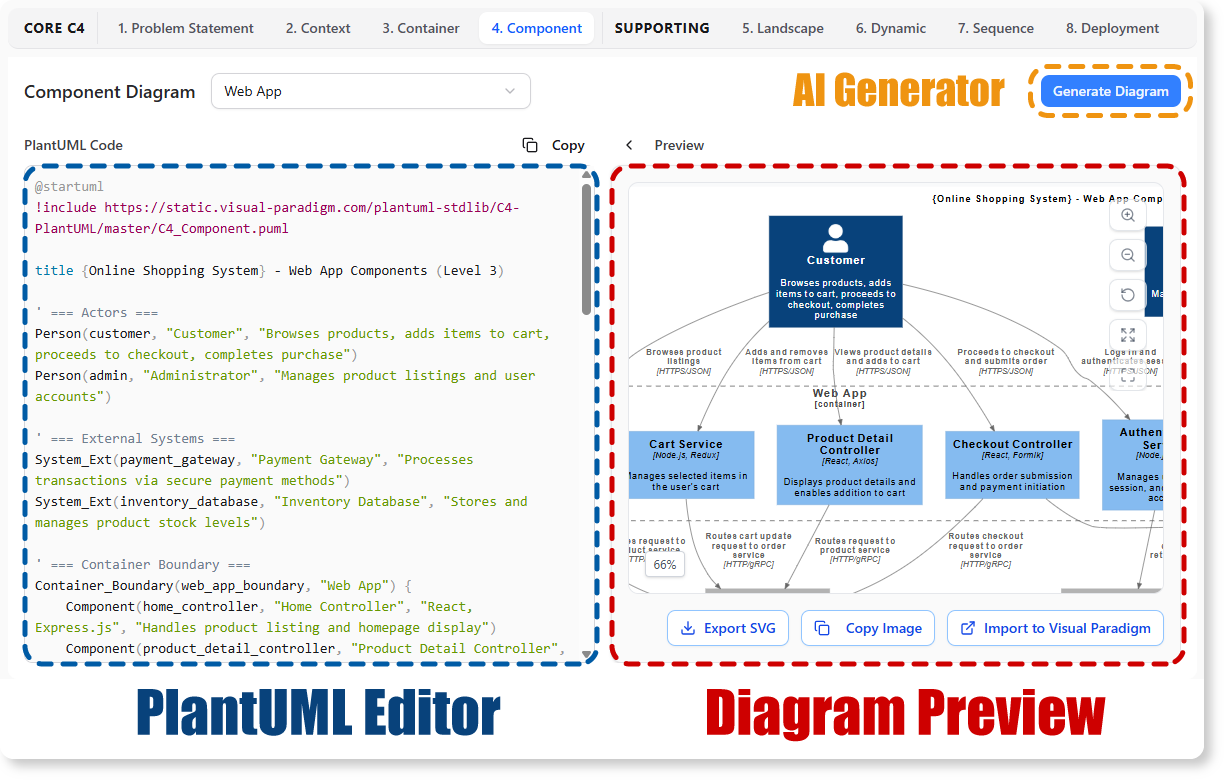
This guide explores the technical pitfalls of relying on generic AI for architectural modeling and demonstrates why specialized tools, specifically Visual Paradigm’s AI C4-PlantUML Studio, offer the consistency and dependency management necessary for professional software documentation.
Key Concepts: Understanding the C4 Model Architecture
Before analyzing the limitations of AI tools, it is crucial to understand the foundational definitions that make the C4 model unique. The C4 model relies on a strict “drill-down + evolution” structure, where every lower-level diagram depends entirely on the definitions established in the level above it.
- Level 1: System Context: This represents the big picture, showing the software system in the center and its relationships with users and external systems.
- Level 2: Containers: This zooms into the system boundary from Level 1 to show the high-level technical building blocks (e.g., web servers, databases, microservices).

- Level 3: Components: This further decomposes a specific container from Level 2 to show the internal structural elements.
- Hierarchical Interdependency: The core rule of C4. Lower-level diagrams cannot exist in isolation; they must respect the boundaries, naming conventions, and technology choices defined in higher levels without introducing contradictions.
The Inherent Struggle of General-Purpose LLMs
General-purpose LLMs are designed for creative flexibility and conversational flow, not for rigid structural consistency. When architects attempt to generate a full C4 suite using sequential prompting, they often encounter several critical failure points.
1. Lack of Canonical Memory
Generic LLMs lack a persistent, built-in memory of the “canonical model.” Each prompt is treated largely as a new task. Even with large context windows, subtle inconsistencies inevitably appear. For example, a container defined as “Order Service” in the Level 2 diagram might inexplicably change to “Orders Microservice” in Level 3, or a technology annotation might drift from “REST” to “gRPC” without user input.
2. Fragile Multi-Turn Prompting Chains
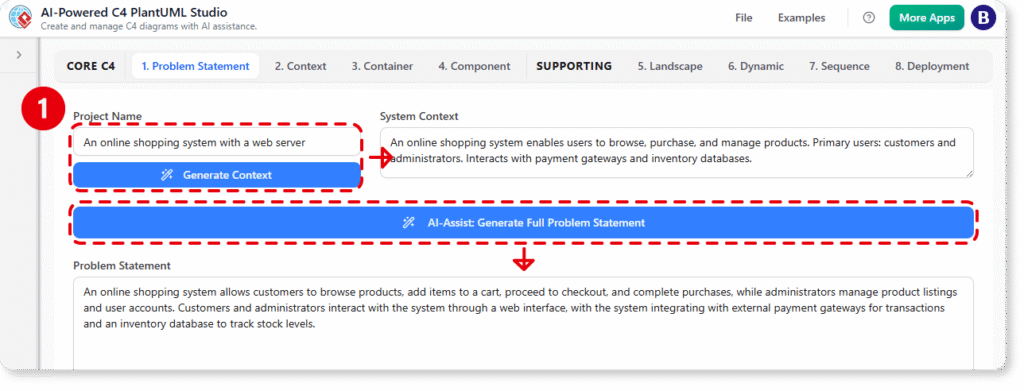
Generating a full suite requires a chain of prompts (e.g., Generate Context → Generate Containers → Decompose Container X). In a general LLM, a small hallucination or rephrasing in step two cascades down to step three, effectively breaking the logical link between diagrams. The model does not understand that it is building a single, cohesive system; it believes it is simply answering separate text generation requests.
3. Structural and Syntax Violations
General models are trained to be helpful, which sometimes means they “invent” details to fill gaps, violating golden C4 rules regarding abstraction levels. Furthermore, when generating PlantUML code, generic LLMs often produce syntax errors, use deprecated tags, or mishandle macro includes, rendering the code unusable without significant manual debugging.
Why Visual Paradigm’s AI C4 Studio Succeeds
Visual Paradigm has developed a specialized, C4-aware system that treats architecture not as a series of text chats, but as a unified data model. This shift in approach resolves the consistency issues plaguing general LLMs.
Unified Single-Source-of-Truth
Unlike a chat bot that forgets details between prompts, the AI C4 Studio generates the entire hierarchical suite (Context, Containers, Components, Deployment, etc.) from a single high-level description. It derives lower levels directly from higher ones internally, eliminating cascading errors. The tool maintains a central registry of actors, systems, and containers, ensuring that a change in one view propagates correctly to others.
Strict Structural Enforcement
The system is fine-tuned with official C4 rules. It understands that components belong inside containers and that containers belong inside systems. When a user requests a drill-down, the AI knows exactly which element to decompose, enforcing scope and boundary consistency that general LLMs simply cannot replicate.
PlantUML as the Core Language
Visual Paradigm uses PlantUML as a single source of truth. It produces clean, standards-compliant code first, then renders it. This allows architects to have an editable code base alongside a visual preview, facilitating version control and precise refinements.
Comparison: General LLMs vs. Specialized AI Studio
| Feature | General LLMs (ChatGPT, Claude, etc.) | Visual Paradigm AI C4 Studio |
|---|---|---|
| Context Awareness | Isolated prompts; prone to forgetting previous details. | Deep, built-in understanding of the full model hierarchy. |
| Consistency | High risk of naming drift and tech stack hallucinations. | Unified single-source-of-truth; strict dependency management. |
| Workflow | Requires fragile prompt chaining. | Generates full hierarchical suites in one workflow. |
| Syntax Reliability | Frequent PlantUML syntax errors or layout breaks. | Produces valid, compiled, and standard-compliant PlantUML. |
| Refinement | Changes often fail to propagate to other views. | Changes cascade correctly across all affected diagrams. |
Conclusion
While general-purpose AI tools are excellent for brainstorming and drafting initial ideas, they lack the structural discipline required for “living” software architecture. They treat C4 diagrams as independent creative writing tasks rather than a tightly coupled engineering model.
For architects seeking fast, beautiful, and—most importantly—consistent documentation, specialized tools like Visual Paradigm’s AI C4-PlantUML Studio are the practical solution. By treating the C4 model as a coherent, dependency-managed entity, it automates the tedious alignment work and ensures that your documentation evolves seamlessly alongside your project.
-
Ultimate Guide to C4 Model Visualization Using Visual Paradigm’s AI Tools: A comprehensive guide on leveraging Visual Paradigm’s AI-powered tools to automate and enhance C4 model visualization for faster, smarter software architecture design.
-
Leveraging Visual Paradigm’s AI C4 Studio for Streamlined Architecture Documentation: A detailed guide on using Visual Paradigm’s AI-enhanced C4 Studio to create clean, scalable, and maintainable software architecture documentation.
-
The Ultimate Guide to C4-PlantUML Studio: Revolutionizing Software Architecture Design – Visual Paradigm Blog: 2 weeks ago – Software architecture documentation is often a bottleneck—time-consuming, error-prone, and quickly outdated. The C4-PlantUML Studio, developed by Visual Paradigm, changes this by combining AI-driven automation, the C4 model’s clarity, and PlantUML’s flexibility into a single, powerful tool.
-
A Comprehensive Guide to Visual Paradigm’s AI-Powered C4 …: Dec 3, 2025 · Enter Visual Paradigm ’s AI-Powered C4 PlantUML Studio, released November 14, 2025 — a purpose-built tool that transforms natural language into correct, layered C4 diagrams. But how is it different from just asking ChatGPT or Claude to “draw a system diagram”? And can it really generate valid C4? Let’s unpack it all.
-
C4-PlantUML Studio | AI-Powered C4 Diagram Generator – Visual Paradigm: An AI-powered tool to automatically generate C4 software architecture diagrams from simple text descriptions.
-
Comprehensive Tutorial: Generating and Modifying C4 Component …: Dec 16, 2025 · This tutorial is based on the official Visual Paradigm product demo video, demonstrating how to use the AI-powered Chatbot to create and iteratively refine a C4 Component Diagram for a car park booking system. The C4 model (Context, Containers, Components, and Code) is a popular approach for visualizing software architecture, and the Component level focuses on the internal structure of a …
-
AI-Powered C4 Diagram Generator – Visual Paradigm AI: C4 & Supporting Diagrams The AI-Powered C4 Diagram Generator supports the four core levels of the C4 Model (Context, Container, Component, Deployment) plus essential supporting views to provide comprehensive architectural documentation. Core C4 Diagrams The Core C4 Diagrams are fundamental for documenting the static structure of your software system, detailing how it is broken down …
-
Visual Paradigm Full C4 Model Support Release: This release announcement details the integration of full C4 model support in Visual Paradigm, enabling users to create and manage architecture diagrams at multiple abstraction levels.
-
New: Full C4 Model Support Added to Visual Paradigm Desktop – ArchiMetric: 6 days ago · The C4 Model: A Comprehensive Guide to Visualizing Software Architecture with AI-Powered Tools …
-
Visual-paradigm: Our AI supports a wide range of diagrams across various domains, including UML, C4 models for software architecture, and strategic frameworks like SWOT and PESTLE analysis.
-
Visual Paradigm AI Suite: A Comprehensive Guide to Intelligent Modeling Tools – Cybermedian: 6 days ago – Strategic Frameworks: SWOT Analysis, PEST/PESTLE Analysis, Ansoff Matrix, and Blue Ocean Four Actions Framework. Systems Engineering: SysML Block Definition, Internal Block, and Requirement diagrams. Architecture: ArchiMate diagrams and C4 models. General Business: Organization Charts, Mind Maps, and PERT Charts. While the AI Chatbot is a cloud-based feature of VP Online, it is seamlessly integrated into the Visual Paradigm Desktop environment.
-
Visual-paradigm: Our AI supports a wide range of diagrams across various domains, including UML, C4 models for software architecture, and strategic frameworks like SWOT and PESTLE analysis.
-
PESTLE Analysis Explained: The Ultimate AI Guide: Sep 10, 2025 · Visual Paradigm ’s AI chatbot supports the generation of diagrams for several key business frameworks, including SWOT, PESTLE , Ansoff, BCG, and C4 models. These are not standalone tools but components of a holistic strategic analysis toolkit.
-
AI Diagram Generator: Complete C4 Model Support: This page details the release of an AI-powered diagram generation feature in Visual Paradigm that enables automated creation of C4 model diagrams.
-
C4 Model AI Generator: Automate Context … – Ez Knowledge –: Visual Paradigm’s new AI Chatbot is purpose-built to automate the full C4 modeling lifecycle using conversational prompts, guaranteeing consistency across all …
-
Comprehensive Review: Generic AI Chatbots vs. Visual Paradigm’s C4 Tools – ArchiMetric: 1 week ago – While generic AI chatbots (like … Generator, AI Diagramming Chatbot, and C4 PlantUML Studio
Related posts:
 Q&A: Real Questions Tech Startups Ask About the Business Model Canvas (And Answers)
 The “No-Code” Approach to Building a Robust Business Model Canvas for MVPs
 Beyond Revenue Streams: Using the Business Model Canvas to Secure Series A Funding
 The Silent Killer: Ignoring Key Partnerships on Your Business Model Canvas