
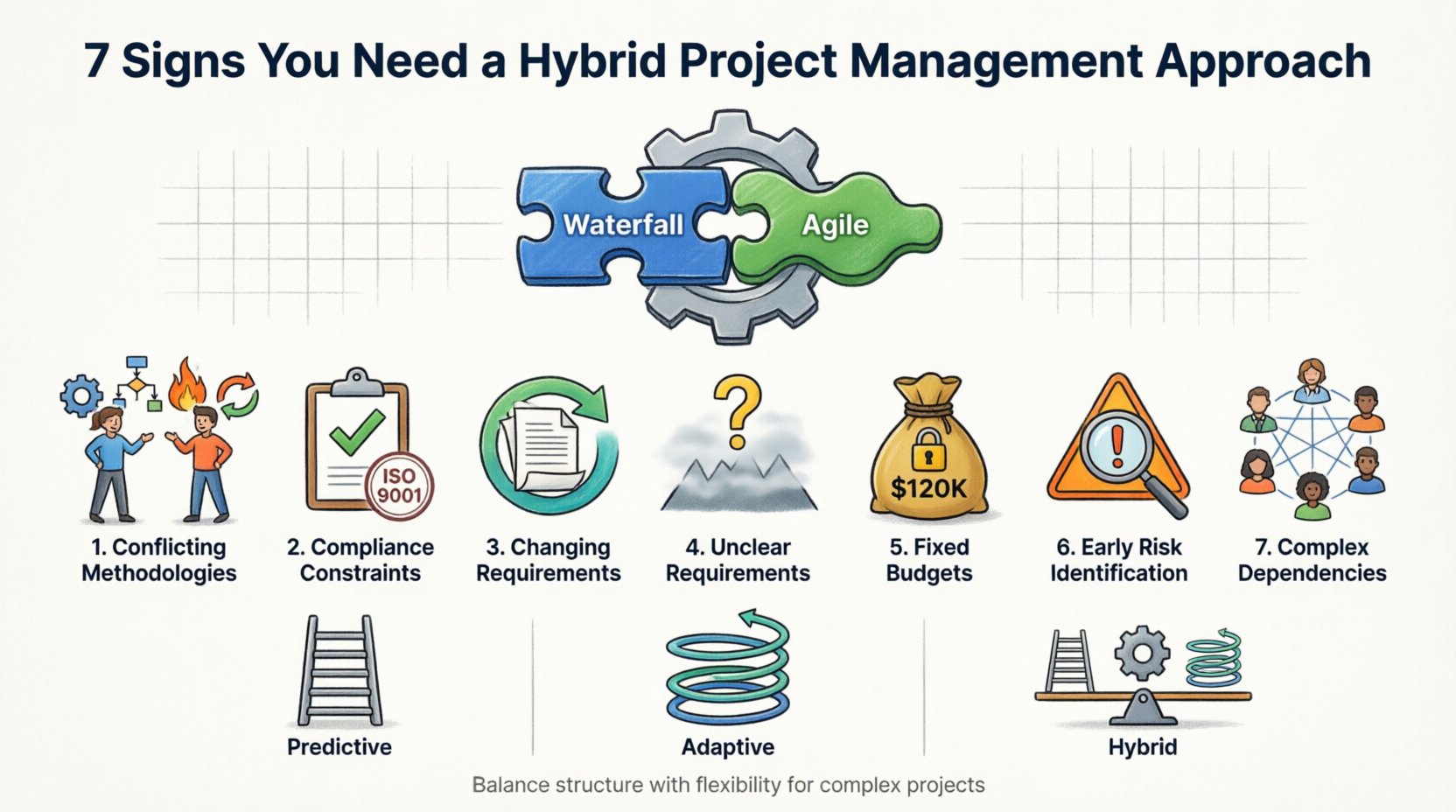
Project management is rarely a one-size-fits-all discipline. While some initiatives thrive under strict waterfall methodologies, others demand the flexibility of Agile. When neither pure approach delivers the desired results, organizations often find themselves in a precarious position. This is where the hybrid model steps in.
A hybrid project management approach combines elements of predictive (waterfall) and adaptive (Agile) methods. It allows teams to structure the high-level phases while maintaining agility within execution. However, adopting this strategy requires clear justification. You do not simply switch to hybrid because it sounds modern. You adopt it when specific conditions make standard methods inefficient.
Identifying the need for this balance is the first step toward operational stability. Below are seven distinct signs indicating that your current workflow is insufficient and a hybrid framework could restore alignment.
Understanding the Hybrid Model 🧩
Before examining the signs, it is essential to define what this approach entails without relying on specific tools. It is a methodology that acknowledges the complexity of modern work. Some parts of a project require rigid planning, such as budgeting, compliance, or hardware procurement. Other parts require iterative development, such as software features or user experience design.
The hybrid model does not mean doing half of one thing and half of another randomly. It means applying the right discipline to the right phase. Predictive methods handle the “what” and “when” of fixed constraints. Adaptive methods handle the “how” of evolving requirements.
7 Signs Your Current Approach is Failing ⚠️
Recognizing when your strategy is misaligned can be difficult. Teams often push through friction rather than adapting their process. Look for these indicators to determine if a shift is necessary.
1. Conflicting Methodologies Within the Same Team 🤔
One of the most common indicators is a team utilizing different frameworks for different tasks within a single project. For example, the engineering group may run daily stand-ups and sprints, while the marketing group adheres to a strict Gantt chart timeline.
- Communication breaks down between groups with different rhythms.
- Milestones are missed because one team moves faster than the other.
- Handoffs become chaotic due to differing definitions of “done”.
When a project is large enough to have multiple functional streams, forcing everyone into a single methodology creates friction. A hybrid approach allows you to standardize the handoff points while letting each stream operate in its most effective mode.
2. Regulatory or Compliance Constraints Exist 📋
Certain industries, such as healthcare, finance, or construction, require documented sign-offs at specific intervals. Pure Agile struggles here because it prioritizes working software over comprehensive documentation. Pure Waterfall struggles because it cannot accommodate the inevitable changes in user needs.
Consider these constraints:
- Audit Trails: You must prove who approved which decision.
- Legal Review: Contracts must be finalized before development begins.
- Safety Standards: Hardware must meet specific certifications.
If your project requires heavy documentation and approval gates alongside iterative delivery, a hybrid structure accommodates the compliance requirements while preserving speed in the development phases.
3. Stakeholder Requirements Change Frequently 🔄
Stakeholders often request changes mid-project. In a predictive model, this causes scope creep and budget overruns. In a rigid model, these changes are rejected, leading to a product that no longer solves the business problem.
Signs of this friction include:
- Constant revision of requirements documents.
- Stakeholders feeling unheard during planning phases.
- Delivered features being rejected because they do not match current market needs.
A hybrid approach allows for a fixed scope in the high-level phases (budget, timeline) while allowing flexibility in the specific deliverables within those phases. This provides stability for finance while satisfying the business need for adaptation.
4. Unclear Initial Requirements 🌫️
Traditional planning relies on knowing the end goal before starting. If the problem is not fully understood, detailed upfront planning is guesswork. This leads to rework and wasted resources.
Indicators include:
- Planning sessions lasting weeks without a clear definition.
- High uncertainty regarding technical feasibility.
- Need for user feedback before finalizing the design.
In this scenario, you can use a hybrid model. Define the project boundaries and budget upfront (Waterfall), but use iterative sprints to explore the solution space (Agile). This limits risk while allowing discovery.
5. Resource Constraints and Fixed Budgets 💰
Agile projects often assume a fixed team and variable scope. However, many organizations operate with fixed budgets and fixed timelines. If you cannot extend the timeline or add more people, you must control the scope carefully.
Consider these financial realities:
- Quarterly budget cycles that cannot be adjusted mid-year.
- Contractual obligations with specific delivery dates.
- Limited availability of specialized staff.
A hybrid approach respects these constraints by treating the budget and timeline as the “hard” constraints. Within those boundaries, the team manages the scope and features using Agile techniques to maximize value.
6. Risk Management Requires Early Identification ⚠️
Some risks cannot be mitigated later in the project. If a project fails late, the cost is catastrophic. You need early visibility into technical feasibility and market fit.
Signs you need early risk mitigation:
- High cost of failure.
- Complex integration with legacy systems.
- Dependency on external vendors with long lead times.
By using a hybrid model, you can run high-risk discovery phases early. Once risks are mitigated, you switch to a more predictive plan for execution. This reduces the chance of late-stage surprises.
7. Cross-Functional Dependencies Are Complex 🕸️
Projects often involve multiple departments. When one team finishes their work, another must start. If these dependencies are not synchronized, bottlenecks occur.
Look for these dependency issues:
- Teams waiting on other teams for weeks.
- Bottlenecks at specific integration points.
- Conflicting release schedules.
A hybrid approach helps synchronize these flows. You can plan the critical path predictively to ensure dependencies are met, while allowing the dependent teams to work iteratively within their allocated windows.
Comparing Approaches: Predictive vs. Adaptive vs. Hybrid 📊
To visualize where hybrid fits, compare the three main strategies. This table outlines the strengths and weaknesses of each regarding flexibility, planning, and risk.
| Feature | Predictive (Waterfall) | Adaptive (Agile) | Hybrid |
|---|---|---|---|
| Planning Depth | High upfront | Emergent | High upfront + Iterative |
| Flexibility | Low | High | Moderate to High |
| Client Involvement | End of phase | Continuous | Defined touchpoints |
| Risk Management | Early identification | Continuous mitigation | Early + Continuous |
| Best For | Fixed scope, regulated | Unknown requirements | Complex, mixed needs |
Implementing the Shift Without Confusion 🛠️
Moving to a hybrid model is not about changing the software you use. It is about changing how you make decisions. Here is how to structure the transition.
- Define the Boundaries: Clearly state which parts of the project are fixed (budget, date) and which are flexible (features).
- Standardize Communication: Ensure all teams understand the hybrid rules. A team working in sprints must know when the predictive milestones are.
- Train the Leaders: Project managers must be fluent in both methodologies. They need to know when to enforce a deadline and when to allow a pivot.
- Track Progress Differently: Use burn-up charts for iterative work and Gantt charts for overall timeline tracking.
Common Pitfalls to Avoid 🚫
Adopting hybrid does not guarantee success. Many teams fall into traps that negate the benefits.
- Half-Hearted Adoption: Claiming to be hybrid but sticking to waterfall processes for everything. This creates confusion without flexibility.
- Lack of Governance: Without clear rules, teams may drift back to their preferred methods, causing fragmentation.
- Ignoring Culture: Agile requires a mindset shift. If the culture is command-and-control, iterative work will fail even if the process is labeled “hybrid”.
Team Dynamics and Communication 🗣️
The success of a hybrid approach relies heavily on human interaction. When processes are complex, communication must be simpler.
- Transparency: Everyone needs to see the big picture (predictive) and the small picture (iterative).
- Feedback Loops: Establish regular intervals where stakeholders review progress against the fixed milestones.
- Role Clarity: Ensure roles like Product Owner and Project Manager are distinct. One manages value, the other manages constraints.
Evaluating Success Metrics 📈
How do you know if the hybrid model is working? Do not rely on velocity alone. Look at these metrics:
- On-Time Delivery: Are fixed milestones being met?
- Change Request Rate: Is the team absorbing changes without derailing the project?
- Stakeholder Satisfaction: Are clients happy with the final product?
- Team Morale: Is the team feeling overwhelmed by process or empowered by flexibility?
Monitoring these areas ensures the methodology serves the work, rather than the work serving the methodology.