
Most founders begin their journey with enthusiasm but end with exhaustion. The primary reason for this attrition is rarely a lack of effort. It is often a structural flaw embedded in the strategic planning phase. The Business Model Canvas (BMC) is a standard tool for visualizing strategy, yet many entrepreneurs treat it as a checklist rather than a diagnostic instrument. Filling out the nine building blocks does not guarantee viability. In fact, specific misalignments within these blocks can silently drain capital and momentum.
This guide examines the seven hidden levers within the Business Model Canvas that frequently lead to early startup failure. Understanding these mechanical weaknesses allows you to build a resilient foundation. We will analyze each lever, identifying the specific risks and providing actionable insights to mitigate them before they become fatal.
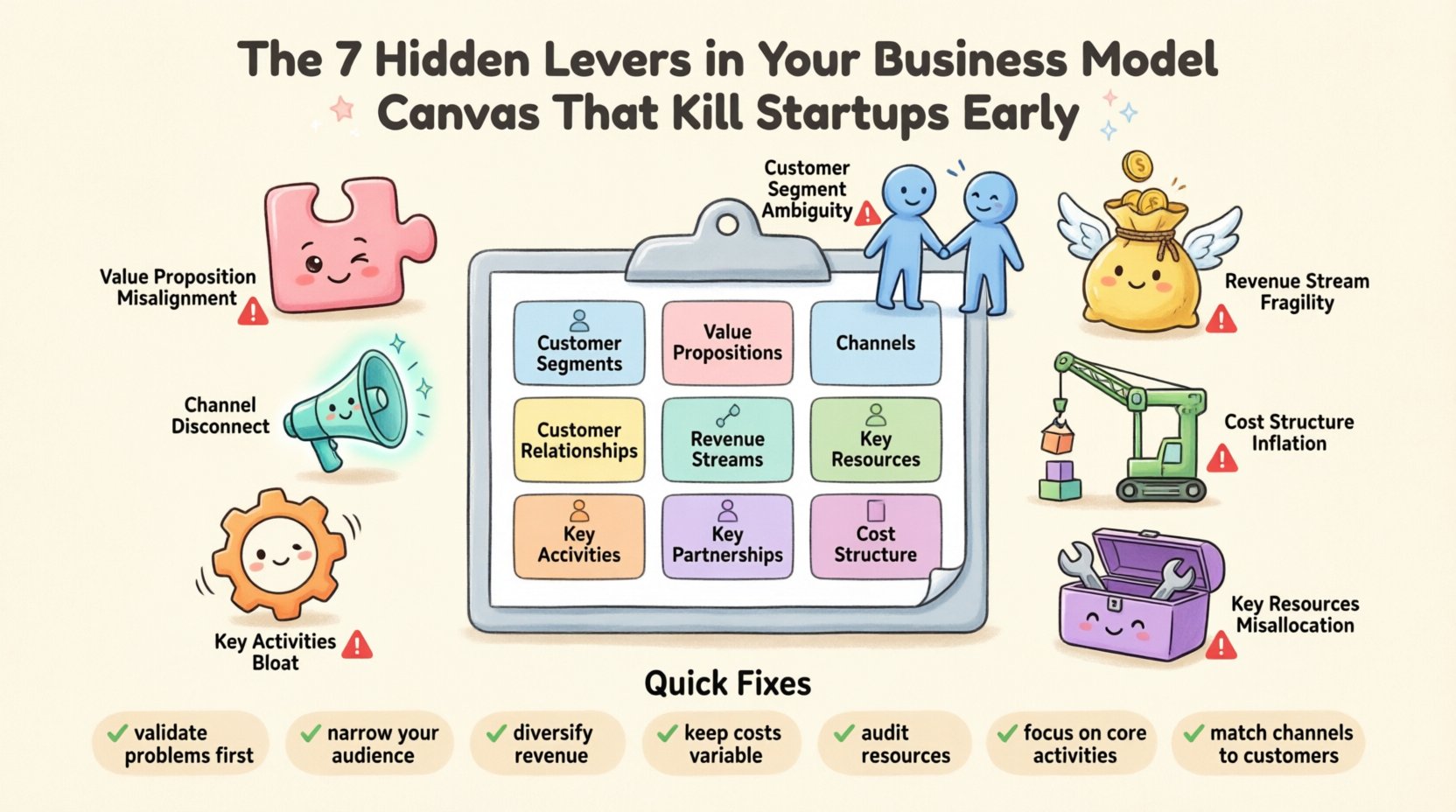
1. 🧩 Value Proposition Misalignment
The core of any business is the value it delivers. However, many teams fall in love with their solution rather than the problem they solve. This lever involves the connection between your problem-solving capabilities and the actual needs of the market.
- The Trap: Assuming that a technical innovation equates to market demand. You might build a feature-rich product that solves a problem no one is willing to pay to fix.
- The Sign: High engagement with your prototype but zero conversion to paying customers. Customer interviews reveal that the “pain” you are addressing is mild.
- The Impact: You burn cash developing features that do not increase the perceived value for the customer.
To correct this, you must validate the problem before scaling the solution. The value proposition should clearly articulate the unique benefit that distinguishes you from existing alternatives. If a competitor can offer the same result for less money or time, your value proposition is insufficient.
2. 👥 Customer Segment Ambiguity
A common mistake is defining your target audience too broadly. “Everyone” is not a customer segment. When you try to serve everyone, you often end up serving no one effectively.
- The Trap: Casting a wide net without defining specific personas. This leads to diluted messaging and inefficient customer acquisition costs.
- The Sign: Marketing campaigns yield inconsistent results. You cannot identify a clear pattern in your early adopters.
- The Impact: Product development becomes bloated as you attempt to accommodate diverse, conflicting needs.
Effective segmentation requires depth. Identify the specific demographic, psychographic, and behavioral traits of your ideal customer. Focus your resources on a niche where you can dominate before expanding. This lever dictates where your sales efforts are directed. If the channel does not match the segment, the model collapses.
3. 💸 Revenue Stream Fragility
Revenue models are often oversimplified. Many startups rely on a single source of income, such as one-time sales or a single subscription tier. This creates a vulnerability to market shifts.
- The Trap: Assuming current pricing power will remain constant. You may not have accounted for price sensitivity or competitive undercutting.
- The Sign: Churn rates increase when you attempt to raise prices. Revenue growth stalls despite increased user acquisition.
- The Impact: Cash flow becomes unpredictable. A single client loss or market downturn can jeopardize operations.
A robust revenue structure includes multiple streams. Consider subscriptions, licensing, transaction fees, or freemium models. Diversifying income reduces risk. Furthermore, you must ensure the revenue model aligns with the value proposition. If you promise premium quality, charging commodity prices will undermine your brand positioning.
4. 🏗️ Cost Structure Inflation
Startups often underestimate the operational costs required to deliver their value proposition. This lever involves the relationship between fixed costs, variable costs, and the revenue generated.
- The Trap: High fixed costs early in the lifecycle. Hiring too many staff or leasing expensive office space before validating demand.
- The Sign: Burn rate exceeds revenue consistently. You are forced to raise capital frequently just to maintain operations.
- The Impact: Runway shortens significantly. You may be forced to pivot or shut down before achieving product-market fit.
Lean operations are essential for early-stage growth. Align costs with revenue. If you adopt a variable cost structure, your expenses should scale with your sales. Avoid heavy asset ownership unless it is a core competitive advantage. Scrutinize every expense to ensure it directly contributes to value delivery.
5. 🛠️ Key Resources Misallocation
Resources include physical, intellectual, human, and financial assets. The error here lies in acquiring resources that do not drive the core business model.
- The Trap: Hoarding assets that are not currently necessary. Purchasing equipment or hiring specialized staff before the process is defined.
- The Sign: Low utilization rates of expensive assets. Teams are idle or waiting for resources to become available.
- The Impact: Capital is tied up in non-performing assets. Opportunity cost prevents investment in critical areas.
Identify the key resources that are truly indispensable. For a software company, this might be code and talent, not office furniture. For a logistics firm, it might be the fleet and the network. Focus your budget on these critical nodes. If a resource does not directly enable the delivery of your value proposition, question its necessity.
6. ⚙️ Key Activities Bloat
Key activities are the most important things a company must do to make its business model work. The danger lies in doing too much.
- The Trap: Spreading effort across multiple fronts. Attempting to handle marketing, sales, and product development simultaneously without a clear priority.
- The Sign: Projects are perpetually unfinished. The team feels overwhelmed by administrative overhead.
- The Impact: Lack of focus dilutes execution quality. You fail to excel in any single area.
Streamline your activities. Determine which processes are core and which are support. Core activities should receive the majority of your attention and funding. Outsourcing or automating non-core activities can preserve energy for what matters. Focus on the activities that directly influence customer retention and acquisition.
7. 📢 Channel Disconnect
Channels are how you communicate with and reach customer segments. A disconnect occurs when the channel does not match where the customer actually operates.
- The Trap: Choosing channels based on personal preference rather than customer behavior. Using social media when your B2B clients prefer direct email or industry events.
- The Sign: High traffic but low conversion. You are visible but not reaching the right decision-makers.
- The Impact: Customer acquisition costs skyrocket. The sales cycle becomes unnecessarily long.
Map the customer journey. Where do they seek information? How do they make purchasing decisions? Align your channels with these touchpoints. A multi-channel approach is effective only if the channels are integrated. Ensure consistency in messaging across all points of contact.
📊 Risk Assessment Matrix
The following table summarizes the critical risks associated with each lever. Use this to audit your current model.
| Business Model Lever | Primary Risk Indicator | Recommended Mitigation |
|---|---|---|
| Value Proposition | Low conversion rates | Conduct deep customer interviews |
| Customer Segments | Diluted messaging | Narrow target audience definition |
| Revenue Streams | Unpredictable cash flow | Diversify income sources |
| Cost Structure | High burn rate | Adopt variable cost models |
| Key Resources | Low asset utilization | Audit asset necessity |
| Key Activities | Execution fatigue | Focus on core competencies |
| Channels | High acquisition cost | Align with customer behavior |
🔄 Interconnectivity of Levers
It is crucial to understand that these levers do not operate in isolation. They function as an interconnected system. A change in one area inevitably affects others.
- Cost vs. Resources: If you reduce key resources, you may need to increase key activities to maintain quality.
- Channels vs. Segments: Changing your channel requires re-evaluating which segments you can reach.
- Revenue vs. Value: If you alter your revenue model, you must adjust your value proposition to justify the new pricing.
Ignoring these relationships creates friction. For example, lowering costs by reducing key resources might degrade the value proposition, leading to higher churn. You must analyze the system holistically. Small adjustments in one block can ripple through the entire model. Regular reviews are necessary to ensure alignment.
🛠️ Actionable Steps for Validation
To prevent these levers from causing failure, implement a rigorous validation process. Do not rely on assumptions.
- Document Hypotheses: Write down what you believe about each lever. Be specific.
- Test Assumptions: Run experiments to prove or disprove each hypothesis. Use minimum viable products.
- Measure Metrics: Define key performance indicators for each block. Track them religiously.
- Pivot Early: If a lever shows signs of failure, adjust immediately. Do not wait for total collapse.
Patience is not a strategy. Speed is. But speed without direction leads to disaster. Ensure your direction is based on data. Use the Business Model Canvas not as a static document, but as a living map that evolves with your findings.
📉 The Cost of Ignorance
Founders often ignore these hidden levers until it is too late. The capital spent on fixing structural issues is often higher than the capital needed to build them correctly from the start. By understanding the mechanics of failure, you can build a model that withstands market volatility.
Every business is unique, but the fundamental principles of viability remain constant. If your value proposition does not resonate, revenue will not follow. If your costs outpace your efficiency, growth will stall. If your channels do not reach your customers, sales will not occur.
Review your Business Model Canvas with a critical eye. Look for the gaps. Ask hard questions about each block. Be willing to discard ideas that do not hold up to scrutiny. This discipline is what separates successful ventures from the statistics of failure.
🔍 Final Thoughts on Strategy
Building a sustainable business requires more than just a good idea. It requires a robust framework that supports execution. The seven levers discussed here represent the structural integrity of that framework. When they are aligned, the business has a clear path forward. When they are misaligned, the business faces unnecessary friction.
Use this analysis as a diagnostic tool. Conduct a health check on your current operations. Identify which levers are under stress. Address them systematically. The goal is not perfection, but resilience. A model that can adapt to change is a model that survives.
Remember that the market is the ultimate judge. Your canvas is a tool to navigate it, not a shield against it. Keep the focus on value delivery and operational efficiency. These are the foundations of longevity.
By paying attention to these hidden mechanics, you increase your odds of success. You move from guessing to knowing. You move from hoping to planning. This shift in mindset is the first step toward building a company that lasts.